 Add to Chrome
 Add to Firefox
 Add to Edge
ReflectVLN: Training Vision-Language Navigation Agents with Reflective Reasoning
Jul 14, 2026
Existing vision-language navigation methods often couple a VLM with waypoint decoders to produce multi-step action plans, but they typically lack an explicit closed-loop mechanism for tracking semantic progress, diagnosing execution failures, and recovering from error accumulation in long-horizon navigation. To address this gap, we propose ReflectVLN, an agentic VLN framework that organizes decision-making through bidirectionally interactive intention and execution agents. The intention agent performs subtask decomposition and reflection, generating executable subtask descriptions as corrective plans. Conditioned on these descriptions, the execution agent grounds them into short-horizon actions under current observations while monitoring sub-goal progress and detecting off-track behavior. Crucially, ReflectVLN enables closed-loop bidirectional communication: the execution agent emits progress and deviation signals to trigger reflection and subtask updates on demand, and the intention agent returns structured guidance that reconditions subsequent actions for recovery. To encourage temporally coherent decisions with interpretable intermediate rationales, we introduce Action Chain-of-Thought (Action-CoT), a path-conditioned dual-query training scheme for action generation. Experiments on standard VLN benchmarks show that ReflectVLN improves success rates and path efficiency under a constrained data budget, with favorable training cost and fewer high-level intention calls at inference time, while providing interpretable intermediate decisions for analysis and collaboration. Code is available at: https://github.com/AIprogrammer/ReflectVLN

SurveilNav: Collaborative Object Goal Navigation with Robot and Surveillance System
Jun 23, 2026With the growing deployment of surveillance systems in factories, offices, and homes, integrating them with robots offers a promising direction for collaborative and efficient task execution. However, existing approaches largely focus on single-robot scenarios and struggle with multi-view collaboration in large-scale environments. In this paper, we present a novel indoor collaborative object navigation dataset built on Habitat-Sim, featuring 206 cameras across 74 floors. The dataset enables systematic evaluation of an agent's ability to exploit multi-view surveillance information. To address the limitations of single-robot perception, we propose SurveilNav, a collaborative navigation framework that integrates active camera scheduling, joint 2D/3D mapping, VLM-based value estimation, and collaborative target verification. By synergizing the robot's dynamic local perception with the static global view of surveillance, this architecture effectively overcomes both the limited perception range of single agents and the inherent blind spots of fixed cameras, resolving inefficient exploration. Experimental results on the HM3D dataset demonstrate that SurveilNav substantially outperforms existing methods, achieving state-of-the-art performance in both exploration efficiency and navigation success rate. Moreover, the system shows strong potential for applications in large-scale search, home environments, and rescue missions.
End-to-End Differentiable Photon Counting CT
Feb 12, 2026Quantitative imaging is an important feature of spectral X-ray and CT systems, especially photon-counting CT (PCCT) imaging systems, which is achieved through material decomposition (MD) using spectral measurements. In this work, we present a novel framework that makes the PCCT imaging chain end-to-end differentiable (differentiable PCCT), with which we can leverage quantitative information in the image domain to enable cross-domain learning and optimization for upstream models. Specifically, the material decomposition from maximum-likelihood estimation (MLE) was made differentiable based on the Implicit Function Theorem and inserted as a layer into the imaging chain for end-to-end optimization. This framework allows for an automatic and adaptive solution of a wide range of imaging tasks, ultimately achieving quantitative imaging through computation rather than manual intervention. The end-to-end training mechanism effectively avoids the need for direct-domain training or supervision from intermediate references as models are trained using quantitative images. We demonstrate its applicability in two representative tasks: correcting detector energy bin drift and training an object scatter correction network using cross-domain reference from quantitative material images.
ABot-N0: Technical Report on the VLA Foundation Model for Versatile Embodied Navigation
Feb 12, 2026Embodied navigation has long been fragmented by task-specific architectures. We introduce ABot-N0, a unified Vision-Language-Action (VLA) foundation model that achieves a ``Grand Unification'' across 5 core tasks: Point-Goal, Object-Goal, Instruction-Following, POI-Goal, and Person-Following. ABot-N0 utilizes a hierarchical ``Brain-Action'' architecture, pairing an LLM-based Cognitive Brain for semantic reasoning with a Flow Matching-based Action Expert for precise, continuous trajectory generation. To support large-scale learning, we developed the ABot-N0 Data Engine, curating 16.9M expert trajectories and 5.0M reasoning samples across 7,802 high-fidelity 3D scenes (10.7 $\text{km}^2$). ABot-N0 achieves new SOTA performance across 7 benchmarks, significantly outperforming specialized models. Furthermore, our Agentic Navigation System integrates a planner with hierarchical topological memory, enabling robust, long-horizon missions in dynamic real-world environments.
Bridging the Indoor-Outdoor Gap: Vision-Centric Instruction-Guided Embodied Navigation for the Last Meters
Feb 06, 2026Embodied navigation holds significant promise for real-world applications such as last-mile delivery. However, most existing approaches are confined to either indoor or outdoor environments and rely heavily on strong assumptions, such as access to precise coordinate systems. While current outdoor methods can guide agents to the vicinity of a target using coarse-grained localization, they fail to enable fine-grained entry through specific building entrances, critically limiting their utility in practical deployment scenarios that require seamless outdoor-to-indoor transitions. To bridge this gap, we introduce a novel task: out-to-in prior-free instruction-driven embodied navigation. This formulation explicitly eliminates reliance on accurate external priors, requiring agents to navigate solely based on egocentric visual observations guided by instructions. To tackle this task, we propose a vision-centric embodied navigation framework that leverages image-based prompts to drive decision-making. Additionally, we present the first open-source dataset for this task, featuring a pipeline that integrates trajectory-conditioned video synthesis into the data generation process. Through extensive experiments, we demonstrate that our proposed method consistently outperforms state-of-the-art baselines across key metrics including success rate and path efficiency.
UrbanNav: Learning Language-Guided Urban Navigation from Web-Scale Human Trajectories
Dec 10, 2025
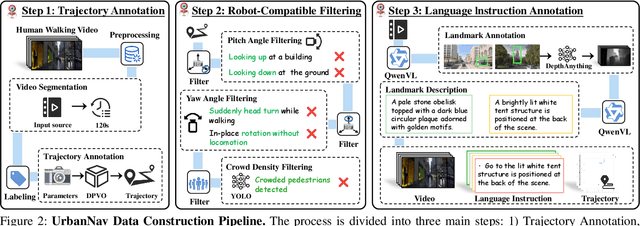
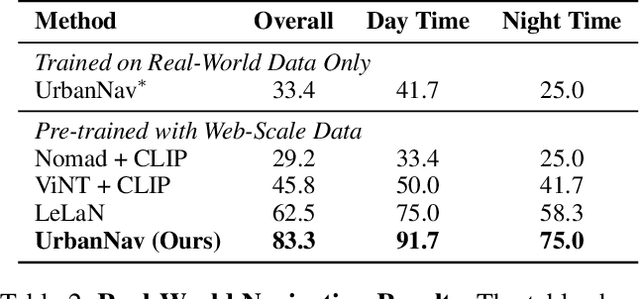
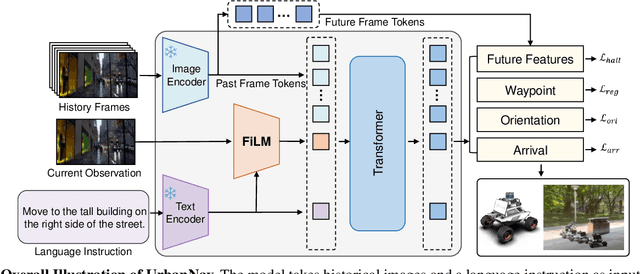
Navigating complex urban environments using natural language instructions poses significant challenges for embodied agents, including noisy language instructions, ambiguous spatial references, diverse landmarks, and dynamic street scenes. Current visual navigation methods are typically limited to simulated or off-street environments, and often rely on precise goal formats, such as specific coordinates or images. This limits their effectiveness for autonomous agents like last-mile delivery robots navigating unfamiliar cities. To address these limitations, we introduce UrbanNav, a scalable framework that trains embodied agents to follow free-form language instructions in diverse urban settings. Leveraging web-scale city walking videos, we develop an scalable annotation pipeline that aligns human navigation trajectories with language instructions grounded in real-world landmarks. UrbanNav encompasses over 1,500 hours of navigation data and 3 million instruction-trajectory-landmark triplets, capturing a wide range of urban scenarios. Our model learns robust navigation policies to tackle complex urban scenarios, demonstrating superior spatial reasoning, robustness to noisy instructions, and generalization to unseen urban settings. Experimental results show that UrbanNav significantly outperforms existing methods, highlighting the potential of large-scale web video data to enable language-guided, real-world urban navigation for embodied agents.
ProAV-DiT: A Projected Latent Diffusion Transformer for Efficient Synchronized Audio-Video Generation
Nov 15, 2025Sounding Video Generation (SVG) remains a challenging task due to the inherent structural misalignment between audio and video, as well as the high computational cost of multimodal data processing. In this paper, we introduce ProAV-DiT, a Projected Latent Diffusion Transformer designed for efficient and synchronized audio-video generation. To address structural inconsistencies, we preprocess raw audio into video-like representations, aligning both the temporal and spatial dimensions between audio and video. At its core, ProAV-DiT adopts a Multi-scale Dual-stream Spatio-Temporal Autoencoder (MDSA), which projects both modalities into a unified latent space using orthogonal decomposition, enabling fine-grained spatiotemporal modeling and semantic alignment. To further enhance temporal coherence and modality-specific fusion, we introduce a multi-scale attention mechanism, which consists of multi-scale temporal self-attention and group cross-modal attention. Furthermore, we stack the 2D latents from MDSA into a unified 3D latent space, which is processed by a spatio-temporal diffusion Transformer. This design efficiently models spatiotemporal dependencies, enabling the generation of high-fidelity synchronized audio-video content while reducing computational overhead. Extensive experiments conducted on standard benchmarks demonstrate that ProAV-DiT outperforms existing methods in both generation quality and computational efficiency.
C-NAV: Towards Self-Evolving Continual Object Navigation in Open World
Oct 23, 2025Embodied agents are expected to perform object navigation in dynamic, open-world environments. However, existing approaches typically rely on static trajectories and a fixed set of object categories during training, overlooking the real-world requirement for continual adaptation to evolving scenarios. To facilitate related studies, we introduce the continual object navigation benchmark, which requires agents to acquire navigation skills for new object categories while avoiding catastrophic forgetting of previously learned knowledge. To tackle this challenge, we propose C-Nav, a continual visual navigation framework that integrates two key innovations: (1) A dual-path anti-forgetting mechanism, which comprises feature distillation that aligns multi-modal inputs into a consistent representation space to ensure representation consistency, and feature replay that retains temporal features within the action decoder to ensure policy consistency. (2) An adaptive sampling strategy that selects diverse and informative experiences, thereby reducing redundancy and minimizing memory overhead. Extensive experiments across multiple model architectures demonstrate that C-Nav consistently outperforms existing approaches, achieving superior performance even compared to baselines with full trajectory retention, while significantly lowering memory requirements. The code will be publicly available at https://bigtree765.github.io/C-Nav-project.