 Add to Chrome
 Add to Firefox
 Add to Edge
NavWM: A Unified Navigation World Model for Foresight-Driven Planning
Jun 23, 2026
Conventional visual navigation policies often struggle with myopic decision-making and mode collapse in complex environments. While world models offer a promising alternative, existing paradigms typically isolate perception, generation, and control, failing to capture their shared spatio-temporal dynamics. In this paper, we propose NavWM, a unified navigation world model that seamlessly integrates latent world reasoning, multimodal action prediction, and controllable visual generation. At its core, NavWM leverages latent world tokens to distill geometric and semantic priors, endowing the agent with robust structural understanding. To overcome the limitations of deterministic policies, we introduce an anchor-based multimodal trajectory forecasting framework that generates a diverse action space. This inherent diversity explicitly empowers the generative world model to act as a robust closed-loop planner, utilizing visual foresight to evaluate and select the optimal path. Extensive experiments across diverse robotics datasets demonstrate that NavWM significantly advances the state-of-the-art, delivering remarkable improvements in both high-fidelity future state generation and zero-shot navigation success.

SurveilNav: Collaborative Object Goal Navigation with Robot and Surveillance System
Jun 23, 2026With the growing deployment of surveillance systems in factories, offices, and homes, integrating them with robots offers a promising direction for collaborative and efficient task execution. However, existing approaches largely focus on single-robot scenarios and struggle with multi-view collaboration in large-scale environments. In this paper, we present a novel indoor collaborative object navigation dataset built on Habitat-Sim, featuring 206 cameras across 74 floors. The dataset enables systematic evaluation of an agent's ability to exploit multi-view surveillance information. To address the limitations of single-robot perception, we propose SurveilNav, a collaborative navigation framework that integrates active camera scheduling, joint 2D/3D mapping, VLM-based value estimation, and collaborative target verification. By synergizing the robot's dynamic local perception with the static global view of surveillance, this architecture effectively overcomes both the limited perception range of single agents and the inherent blind spots of fixed cameras, resolving inefficient exploration. Experimental results on the HM3D dataset demonstrate that SurveilNav substantially outperforms existing methods, achieving state-of-the-art performance in both exploration efficiency and navigation success rate. Moreover, the system shows strong potential for applications in large-scale search, home environments, and rescue missions.
RANGER: A Monocular Zero-Shot Semantic Navigation Framework through Contextual Adaptation
Dec 30, 2025Efficiently finding targets in complex environments is fundamental to real-world embodied applications. While recent advances in multimodal foundation models have enabled zero-shot object goal navigation, allowing robots to search for arbitrary objects without fine-tuning, existing methods face two key limitations: (1) heavy reliance on precise depth and pose information provided by simulators, which restricts applicability in real-world scenarios; and (2) lack of in-context learning (ICL) capability, making it difficult to quickly adapt to new environments, as in leveraging short videos. To address these challenges, we propose RANGER, a novel zero-shot, open-vocabulary semantic navigation framework that operates using only a monocular camera. Leveraging powerful 3D foundation models, RANGER eliminates the dependency on depth and pose while exhibiting strong ICL capability. By simply observing a short video of a new environment, the system can also significantly improve task efficiency without requiring architectural modifications or fine-tuning. The framework integrates several key components: keyframe-based 3D reconstruction, semantic point cloud generation, vision-language model (VLM)-driven exploration value estimation, high-level adaptive waypoint selection, and low-level action execution. Experiments on the HM3D benchmark and real-world environments demonstrate that RANGER achieves competitive performance in terms of navigation success rate and exploration efficiency, while showing superior ICL adaptability, with no previous 3D mapping of the environment required.
UrbanNav: Learning Language-Guided Urban Navigation from Web-Scale Human Trajectories
Dec 10, 2025
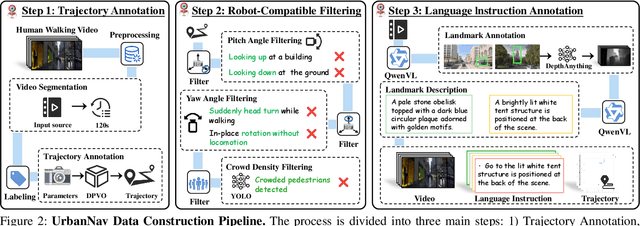
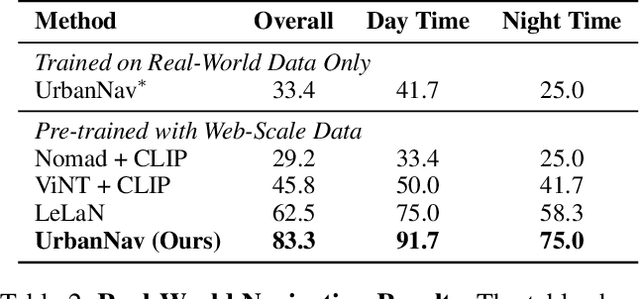
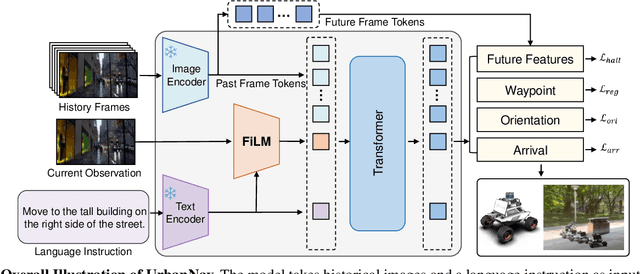
Navigating complex urban environments using natural language instructions poses significant challenges for embodied agents, including noisy language instructions, ambiguous spatial references, diverse landmarks, and dynamic street scenes. Current visual navigation methods are typically limited to simulated or off-street environments, and often rely on precise goal formats, such as specific coordinates or images. This limits their effectiveness for autonomous agents like last-mile delivery robots navigating unfamiliar cities. To address these limitations, we introduce UrbanNav, a scalable framework that trains embodied agents to follow free-form language instructions in diverse urban settings. Leveraging web-scale city walking videos, we develop an scalable annotation pipeline that aligns human navigation trajectories with language instructions grounded in real-world landmarks. UrbanNav encompasses over 1,500 hours of navigation data and 3 million instruction-trajectory-landmark triplets, capturing a wide range of urban scenarios. Our model learns robust navigation policies to tackle complex urban scenarios, demonstrating superior spatial reasoning, robustness to noisy instructions, and generalization to unseen urban settings. Experimental results show that UrbanNav significantly outperforms existing methods, highlighting the potential of large-scale web video data to enable language-guided, real-world urban navigation for embodied agents.
C-NAV: Towards Self-Evolving Continual Object Navigation in Open World
Oct 23, 2025Embodied agents are expected to perform object navigation in dynamic, open-world environments. However, existing approaches typically rely on static trajectories and a fixed set of object categories during training, overlooking the real-world requirement for continual adaptation to evolving scenarios. To facilitate related studies, we introduce the continual object navigation benchmark, which requires agents to acquire navigation skills for new object categories while avoiding catastrophic forgetting of previously learned knowledge. To tackle this challenge, we propose C-Nav, a continual visual navigation framework that integrates two key innovations: (1) A dual-path anti-forgetting mechanism, which comprises feature distillation that aligns multi-modal inputs into a consistent representation space to ensure representation consistency, and feature replay that retains temporal features within the action decoder to ensure policy consistency. (2) An adaptive sampling strategy that selects diverse and informative experiences, thereby reducing redundancy and minimizing memory overhead. Extensive experiments across multiple model architectures demonstrate that C-Nav consistently outperforms existing approaches, achieving superior performance even compared to baselines with full trajectory retention, while significantly lowering memory requirements. The code will be publicly available at https://bigtree765.github.io/C-Nav-project.