 Add to Chrome
 Add to Firefox
 Add to Edge
AtlasVLA: Persistent World-Ego State Modeling for Vision-Language-Action Models
Aug 07, 2026
While Vision-Language-Action (VLA) models have advanced embodied AI, their fundamentally reactive paradigm severely limits performance in partially observable and long-horizon tasks. When restricted to a single wrist-mounted camera, they inevitably suffer from perception forgetting as objects exit the field of view, and temporal task-progress forgetting} during multi-step execution. To overcome these bottlenecks, we propose AtlasVLA, a novel framework that transitions from direct reactive manipulation to proactive reasoning through a persistent world-ego state. AtlasVLA features a dual-memory architecture: a 4D Persistent World State Memory that lifts transient 2D observations into a globally updated, voxel-hashed spatial state to resolve visual blind spots, and an Ego-Working State Memory that tracks historical ego state and task progress. By conditioning a diffusion transformer (DiT) on this joint World-Ego state, AtlasVLA enables robust spatial reasoning. Extensive evaluations across LIBERO, RLBench, and real-world benchmarks demonstrate that AtlasVLA achieves state-of-the-art performance using solely a wrist camera. Remarkably, it decisively outperforms multi-view baselines, yielding absolute success rate improvements of 9.4% on LIBERO-Long and 17.5% in real-world long-horizon tasks.

NavWM: A Unified Navigation World Model for Foresight-Driven Planning
Jun 23, 2026Conventional visual navigation policies often struggle with myopic decision-making and mode collapse in complex environments. While world models offer a promising alternative, existing paradigms typically isolate perception, generation, and control, failing to capture their shared spatio-temporal dynamics. In this paper, we propose NavWM, a unified navigation world model that seamlessly integrates latent world reasoning, multimodal action prediction, and controllable visual generation. At its core, NavWM leverages latent world tokens to distill geometric and semantic priors, endowing the agent with robust structural understanding. To overcome the limitations of deterministic policies, we introduce an anchor-based multimodal trajectory forecasting framework that generates a diverse action space. This inherent diversity explicitly empowers the generative world model to act as a robust closed-loop planner, utilizing visual foresight to evaluate and select the optimal path. Extensive experiments across diverse robotics datasets demonstrate that NavWM significantly advances the state-of-the-art, delivering remarkable improvements in both high-fidelity future state generation and zero-shot navigation success.
SurveilNav: Collaborative Object Goal Navigation with Robot and Surveillance System
Jun 23, 2026With the growing deployment of surveillance systems in factories, offices, and homes, integrating them with robots offers a promising direction for collaborative and efficient task execution. However, existing approaches largely focus on single-robot scenarios and struggle with multi-view collaboration in large-scale environments. In this paper, we present a novel indoor collaborative object navigation dataset built on Habitat-Sim, featuring 206 cameras across 74 floors. The dataset enables systematic evaluation of an agent's ability to exploit multi-view surveillance information. To address the limitations of single-robot perception, we propose SurveilNav, a collaborative navigation framework that integrates active camera scheduling, joint 2D/3D mapping, VLM-based value estimation, and collaborative target verification. By synergizing the robot's dynamic local perception with the static global view of surveillance, this architecture effectively overcomes both the limited perception range of single agents and the inherent blind spots of fixed cameras, resolving inefficient exploration. Experimental results on the HM3D dataset demonstrate that SurveilNav substantially outperforms existing methods, achieving state-of-the-art performance in both exploration efficiency and navigation success rate. Moreover, the system shows strong potential for applications in large-scale search, home environments, and rescue missions.
VeriSpace: Spatially Grounded Action Verification for Vision-Language-Action Models
Jun 09, 2026Vision-language-action (VLA) models have shown strong promise for robotic manipulation, but their reliability at test time remains limited by one-shot action prediction, where even small action errors can cause grasp failure, collision, or incorrect task progression. A natural alternative is to equip VLA systems with test-time verification, allowing multiple candidate actions to be proposed and evaluated before execution. However, reliable action verification is challenging because it requires not only distinguishing subtle geometric differences between candidate actions, but also assessing whether an action makes meaningful progress toward the task goal. We present VeriSpace, a 3D-aware action verifier for test-time action selection in VLA systems. VeriSpace evaluates candidate actions through two key components: Dual-Path 3D-Injected Scene Encoding, which constructs a scene representation that jointly preserves visual semantics and explicit 3D geometry, and Spatially-Grounded Action Reasoning, which evaluates each action by reasoning over task-relevant spatial relations, geometric validity, and expected goal progress. Together, these components enable more reliable discrimination between subtle yet outcome-critical action candidates while remaining fully compatible with existing VLA policies. Experiments on public benchmarks and real-world robotic manipulation tasks show that VeriSpace consistently improves decision reliability over both underlying VLA policies and prior verification-based methods, yielding substantial gains in both in-distribution and out-of-distribution settings.
When Robots Do the Chores: A Benchmark and Agent for Long-Horizon Household Task Execution
May 14, 2026Long-horizon household tasks demand robust high-level planning and sustained reasoning capabilities, which are largely overlooked by existing embodied AI benchmarks that emphasize short-horizon navigation or manipulation and rely on fixed task categories. We introduce LongAct, a benchmark designed to evaluate planning-level autonomy in long-horizon household tasks specified through free-form instructions. By abstracting away embodiment-specific low-level control, LongAct isolates high-level cognitive capabilities such as instruction understanding, dependency management, memory maintenance, and adaptive planning. We further propose HoloMind, a VLM-driven agent with a DAG-based long-horizon hierarchical planner, a Multimodal Spatial Memory for persistent world modeling, an Episodic Memory for experience reuse, and a global Critic for reflective supervision. Experiments with GPT-5 and Qwen3-VL models show that HoloMind substantially improves long-horizon performance while reducing reliance on model scale. Even top models achieve only 59% goal completion and 16% full-task success, underscoring the difficulty of LongAct and the need for stronger long-horizon planning in embodied agents.
UrbanNav: Learning Language-Guided Urban Navigation from Web-Scale Human Trajectories
Dec 10, 2025
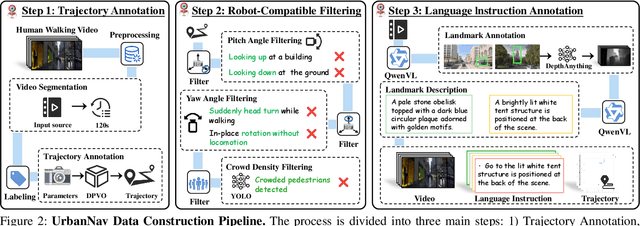
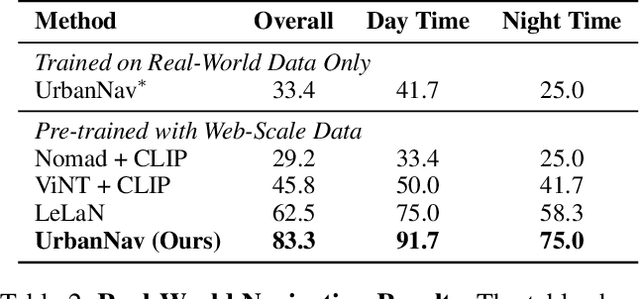
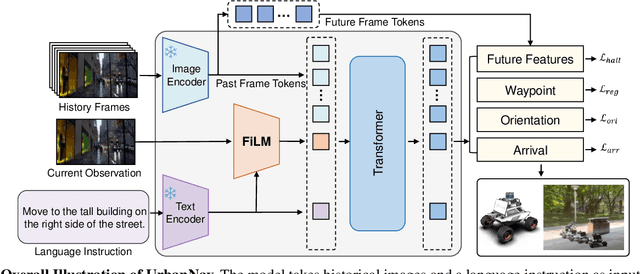
Navigating complex urban environments using natural language instructions poses significant challenges for embodied agents, including noisy language instructions, ambiguous spatial references, diverse landmarks, and dynamic street scenes. Current visual navigation methods are typically limited to simulated or off-street environments, and often rely on precise goal formats, such as specific coordinates or images. This limits their effectiveness for autonomous agents like last-mile delivery robots navigating unfamiliar cities. To address these limitations, we introduce UrbanNav, a scalable framework that trains embodied agents to follow free-form language instructions in diverse urban settings. Leveraging web-scale city walking videos, we develop an scalable annotation pipeline that aligns human navigation trajectories with language instructions grounded in real-world landmarks. UrbanNav encompasses over 1,500 hours of navigation data and 3 million instruction-trajectory-landmark triplets, capturing a wide range of urban scenarios. Our model learns robust navigation policies to tackle complex urban scenarios, demonstrating superior spatial reasoning, robustness to noisy instructions, and generalization to unseen urban settings. Experimental results show that UrbanNav significantly outperforms existing methods, highlighting the potential of large-scale web video data to enable language-guided, real-world urban navigation for embodied agents.