 Add to Chrome
 Add to Firefox
 Add to Edge
ASAP: Advancing Medical Volumetric Representation Learning with Anatomy-aware Semantically-adaptive Pre-training
May 30, 2026
Learning transferable and interpretable representations from medical volumetric scans remains challenging due to complex anatomical structures and weak, heterogeneous supervision provided by radiology reports. In this paper, we propose Anatomy-aware Semantically-Adaptive Pre-training (ASAP), a principled vision-language pre-training framework for fine-grained medical volumetric representation learning from large-scale chest CT scans and their corresponding radiology reports. ASAP integrates three key components: (1) an anatomy-aware knowledge injection module that incorporates organ-level structural priors via off-the-shelf segmentation tool to encourage anatomically coherent representations; (2) a semantically-adaptive selective alignment mechanism that dynamically associates sentence-level findings with localized volumetric regions; and (3) a semantically-adaptive fusion module for effective interaction between anatomically informed visual features and grounded textual cues under dual-modal masked modeling paradigm. Beyond methodological contributions, we establish a comprehensive benchmark for medical volumetric vision-language pre-training on chest CT, covering 15 datasets and 22 downstream tasks spanning abnormality classification, segmentation, disease prognosis prediction, report generation, vocabulary classification, cross-modal retrieval and visual question answering. This benchmark provides standardized evaluation protocols to systematically assess representation quality under diverse clinical settings and data regimes. Extensive experiments demonstrate that ASAP consistently achieves state-of-the-art performance across tasks and datasets, with particularly pronounced gains under limited supervision and distribution shift, validating its effectiveness in learning transferable and clinically meaningful volumetric representations.

Max-Window Scale Estimation for Near-Lossless HiF8 W8A8 Quantization-Aware Training
May 27, 2026Quantization-aware training (QAT) with low-bit floating-point formats enables efficient LLM deployment, yet introduces subtle failure modes invisible to standard training metrics. We present a systematic study of HiF8 W8A8 QAT for OpenPangu-Embedded-1B through the lens of Delayed Tensor Scaling (DTS). Across eight controlled experiments, we identify and disentangle two orthogonal failure modes: (i)amax saturation, where delayed scale estimates silently corrupt knowledge-sensitive representations via forward-pass clipping, and (ii)catastrophic forgetting, where an aggressive learning rate overwrites pretrained commonsense knowledge independently of quantization. Neither is detectable from training loss alone. We address amax saturation with a conservative max-algorithm DTS strategy over a 64-step history window, and mitigate forgetting via a 500-step BF16 warmup followed by QAT at lr=10^{-5}. Both fixes are necessary and sufficient: our final configuration achieves 0.43% MMLU drop, 0.58% HellaSwag drop, and 0.22% ARC-Challenge drop versus a matched BF16 baseline, with a training loss APE of only 0.11% over 10,000 steps.
ProMedical: Hierarchical Fine-Grained Criteria Modeling for Medical LLM Alignment via Explicit Injection
Apr 09, 2026Aligning Large Language Models (LLMs) with high-stakes medical standards remains a significant challenge, primarily due to the dissonance between coarse-grained preference signals and the complex, multi-dimensional nature of clinical protocols. To bridge this gap, we introduce ProMedical, a unified alignment framework grounded in fine-grained clinical criteria. We first construct ProMedical-Preference-50k, a dataset generated via a human-in-the-loop pipeline that augments medical instructions with rigorous, physician-derived rubrics. Leveraging this corpus, we propose the Explicit Criteria Injection paradigm to train a multi-dimensional reward model. Unlike traditional scalar reward models, our approach explicitly disentangles safety constraints from general proficiency, enabling precise guidance during reinforcement learning. To rigorously validate this framework, we establish ProMedical-Bench, a held-out evaluation suite anchored by double-blind expert adjudication. Empirical evaluations demonstrate that optimizing the Qwen3-8B base model via ProMedical-RM-guided GRPO yields substantial gains, improving overall accuracy by 22.3% and safety compliance by 21.7%, effectively rivaling proprietary frontier models. Furthermore, the aligned policy generalizes robustly to external benchmarks, demonstrating performance comparable to state-of-the-art models on UltraMedical. We publicly release our datasets, reward models, and benchmarks to facilitate reproducible research in safety-aware medical alignment.
Med3D-R1: Incentivizing Clinical Reasoning in 3D Medical Vision-Language Models for Abnormality Diagnosis
Feb 01, 2026Developing 3D vision-language models with robust clinical reasoning remains a challenge due to the inherent complexity of volumetric medical imaging, the tendency of models to overfit superficial report patterns, and the lack of interpretability-aware reward designs. In this paper, we propose Med3D-R1, a reinforcement learning framework with a two-stage training process: Supervised Fine-Tuning (SFT) and Reinforcement Learning (RL). During SFT stage, we introduce a residual alignment mechanism to bridge the gap between high-dimensional 3D features and textual embeddings, and an abnormality re-weighting strategy to emphasize clinically informative tokens and reduce structural bias in reports. In RL stage, we redesign the consistency reward to explicitly promote coherent, step-by-step diagnostic reasoning. We evaluate our method on medical multiple-choice visual question answering using two 3D diagnostic benchmarks, CT-RATE and RAD-ChestCT, where our model attains state-of-the-art accuracies of 41.92\% on CT-RATE and 44.99\% on RAD-ChestCT. These results indicate improved abnormality diagnosis and clinical reasoning and outperform prior methods on both benchmarks. Overall, our approach holds promise for enhancing real-world diagnostic workflows by enabling more reliable and transparent 3D medical vision-language systems.
MedFact: Benchmarking the Fact-Checking Capabilities of Large Language Models on Chinese Medical Texts
Sep 15, 2025The increasing deployment of Large Language Models (LLMs) in healthcare necessitates a rigorous evaluation of their factual reliability. However, existing benchmarks are often limited by narrow domains of data, failing to capture the complexity of real-world medical information. To address this critical gap, we introduce MedFact, a new and challenging benchmark for Chinese medical fact-checking. MedFact comprises 2,116 expert-annotated instances curated from diverse real-world texts, spanning 13 medical specialties, 8 fine-grained error types, 4 writing styles, and multiple difficulty levels. Its construction employs a hybrid AI-human framework where iterative expert feedback refines an AI-driven, multi-criteria filtering process, ensuring both high data quality and difficulty. We conduct a comprehensive evaluation of 20 leading LLMs, benchmarking their performance on veracity classification and error localization against a human expert baseline. Our results reveal that while models can often determine if a text contains an error, precisely localizing it remains a substantial challenge, with even top-performing models falling short of human performance. Furthermore, our analysis uncovers a frequent ``over-criticism'' phenomenon, a tendency for models to misidentify correct information as erroneous, which is exacerbated by advanced reasoning techniques such as multi-agent collaboration and inference-time scaling. By highlighting these critical challenges for deploying LLMs in medical applications, MedFact provides a robust resource to drive the development of more factually reliable and medically aware models.
SimCroP: Radiograph Representation Learning with Similarity-driven Cross-granularity Pre-training
Sep 10, 2025Medical vision-language pre-training shows great potential in learning representative features from massive paired radiographs and reports. However, in computed tomography (CT) scans, the distribution of lesions which contain intricate structures is characterized by spatial sparsity. Besides, the complex and implicit relationships between different pathological descriptions in each sentence of the report and their corresponding sub-regions in radiographs pose additional challenges. In this paper, we propose a Similarity-Driven Cross-Granularity Pre-training (SimCroP) framework on chest CTs, which combines similarity-driven alignment and cross-granularity fusion to improve radiograph interpretation. We first leverage multi-modal masked modeling to optimize the encoder for understanding precise low-level semantics from radiographs. Then, similarity-driven alignment is designed to pre-train the encoder to adaptively select and align the correct patches corresponding to each sentence in reports. The cross-granularity fusion module integrates multimodal information across instance level and word-patch level, which helps the model better capture key pathology structures in sparse radiographs, resulting in improved performance for multi-scale downstream tasks. SimCroP is pre-trained on a large-scale paired CT-reports dataset and validated on image classification and segmentation tasks across five public datasets. Experimental results demonstrate that SimCroP outperforms both cutting-edge medical self-supervised learning methods and medical vision-language pre-training methods. Codes and models are available at https://github.com/ToniChopp/SimCroP.
MVP-CBM:Multi-layer Visual Preference-enhanced Concept Bottleneck Model for Explainable Medical Image Classification
Jun 14, 2025The concept bottleneck model (CBM), as a technique improving interpretability via linking predictions to human-understandable concepts, makes high-risk and life-critical medical image classification credible. Typically, existing CBM methods associate the final layer of visual encoders with concepts to explain the model's predictions. However, we empirically discover the phenomenon of concept preference variation, that is, the concepts are preferably associated with the features at different layers than those only at the final layer; yet a blind last-layer-based association neglects such a preference variation and thus weakens the accurate correspondences between features and concepts, impairing model interpretability. To address this issue, we propose a novel Multi-layer Visual Preference-enhanced Concept Bottleneck Model (MVP-CBM), which comprises two key novel modules: (1) intra-layer concept preference modeling, which captures the preferred association of different concepts with features at various visual layers, and (2) multi-layer concept sparse activation fusion, which sparsely aggregates concept activations from multiple layers to enhance performance. Thus, by explicitly modeling concept preferences, MVP-CBM can comprehensively leverage multi-layer visual information to provide a more nuanced and accurate explanation of model decisions. Extensive experiments on several public medical classification benchmarks demonstrate that MVP-CBM achieves state-of-the-art accuracy and interoperability, verifying its superiority. Code is available at https://github.com/wcj6/MVP-CBM.
* 7 pages, 6 figures,
EMRModel: A Large Language Model for Extracting Medical Consultation Dialogues into Structured Medical Records
Apr 23, 2025Medical consultation dialogues contain critical clinical information, yet their unstructured nature hinders effective utilization in diagnosis and treatment. Traditional methods, relying on rule-based or shallow machine learning techniques, struggle to capture deep and implicit semantics. Recently, large pre-trained language models and Low-Rank Adaptation (LoRA), a lightweight fine-tuning method, have shown promise for structured information extraction. We propose EMRModel, a novel approach that integrates LoRA-based fine-tuning with code-style prompt design, aiming to efficiently convert medical consultation dialogues into structured electronic medical records (EMRs). Additionally, we construct a high-quality, realistically grounded dataset of medical consultation dialogues with detailed annotations. Furthermore, we introduce a fine-grained evaluation benchmark for medical consultation information extraction and provide a systematic evaluation methodology, advancing the optimization of medical natural language processing (NLP) models. Experimental results show EMRModel achieves an F1 score of 88.1%, improving by49.5% over standard pre-trained models. Compared to traditional LoRA fine-tuning methods, our model shows superior performance, highlighting its effectiveness in structured medical record extraction tasks.
Bridged Semantic Alignment for Zero-shot 3D Medical Image Diagnosis
Jan 07, 20253D medical images such as Computed tomography (CT) are widely used in clinical practice, offering a great potential for automatic diagnosis. Supervised learning-based approaches have achieved significant progress but rely heavily on extensive manual annotations, limited by the availability of training data and the diversity of abnormality types. Vision-language alignment (VLA) offers a promising alternative by enabling zero-shot learning without additional annotations. However, we empirically discover that the visual and textural embeddings after alignment endeavors from existing VLA methods form two well-separated clusters, presenting a wide gap to be bridged. To bridge this gap, we propose a Bridged Semantic Alignment (BrgSA) framework. First, we utilize a large language model to perform semantic summarization of reports, extracting high-level semantic information. Second, we design a Cross-Modal Knowledge Interaction (CMKI) module that leverages a cross-modal knowledge bank as a semantic bridge, facilitating interaction between the two modalities, narrowing the gap, and improving their alignment. To comprehensively evaluate our method, we construct a benchmark dataset that includes 15 underrepresented abnormalities as well as utilize two existing benchmark datasets. Experimental results demonstrate that BrgSA achieves state-of-the-art performances on both public benchmark datasets and our custom-labeled dataset, with significant improvements in zero-shot diagnosis of underrepresented abnormalities.
E3D-GPT: Enhanced 3D Visual Foundation for Medical Vision-Language Model
Oct 18, 2024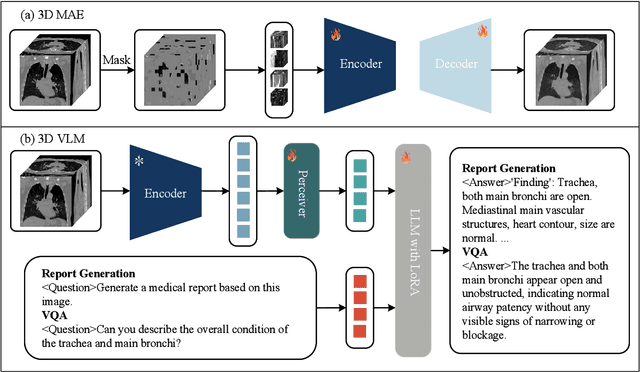


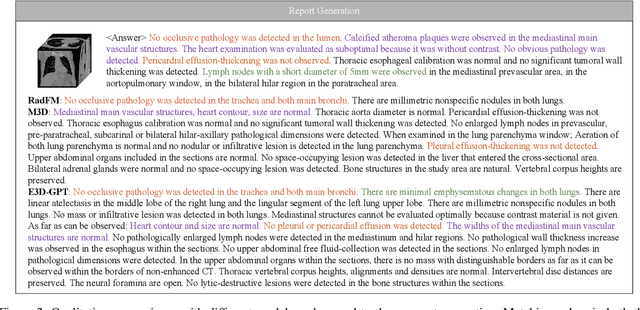
The development of 3D medical vision-language models holds significant potential for disease diagnosis and patient treatment. However, compared to 2D medical images, 3D medical images, such as CT scans, face challenges related to limited training data and high dimension, which severely restrict the progress of 3D medical vision-language models. To address these issues, we collect a large amount of unlabeled 3D CT data and utilize self-supervised learning to construct a 3D visual foundation model for extracting 3D visual features. Then, we apply 3D spatial convolutions to aggregate and project high-level image features, reducing computational complexity while preserving spatial information. We also construct two instruction-tuning datasets based on BIMCV-R and CT-RATE to fine-tune the 3D vision-language model. Our model demonstrates superior performance compared to existing methods in report generation, visual question answering, and disease diagnosis. Code and data will be made publicly available soon.