 Add to Chrome
 Add to Firefox
 Add to Edge
CaMo: Camera Motion Grounded Evaluation and Training for Vision-Language Models
May 19, 2026
Vision-Language Models (VLMs) achieve strong performance on spatial question answering benchmarks, yet it remains unclear whether such gains reflect genuine spatial intelligence. We show that existing spatial VLMs lack basic camera motion understanding, a key component of spatial cognition. We propose the Spatial Narrative Score (SNS), an evaluation framework that requires VLMs to generate explicit spatial narratives capturing both scene semantics and camera motion, followed by reasoning with a frozen proxy LLM. Under SNS, state-of-the-art spatial VLMs exhibit significant performance degradation despite high direct question answering accuracy. To address this gap, we introduce CaMo, a camera motion grounded VLM that achieves consistent performance across SNS evaluation and direct spatial question answering accuracy. Our results highlight the importance of explicit spatial narrative externalization for evaluating VLMs with transferable 3D spatial understanding. Our code, data, and model is available at https://github.com/hsiangwei0903/CaMo

Thinking in Dynamics: How Multimodal Large Language Models Perceive, Track, and Reason Dynamics in Physical 4D World
Mar 13, 2026Humans inhabit a physical 4D world where geometric structure and semantic content evolve over time, constituting a dynamic 4D reality (spatial with temporal dimension). While current Multimodal Large Language Models (MLLMs) excel in static visual understanding, can they also be adept at "thinking in dynamics", i.e., perceive, track and reason about spatio-temporal dynamics in evolving scenes? To systematically assess their spatio-temporal reasoning and localized dynamics perception capabilities, we introduce Dyn-Bench, a large-scale benchmark built from diverse real-world and synthetic video datasets, enabling robust and scalable evaluation of spatio-temporal understanding. Through multi-stage filtering from massive 2D and 4D data sources, Dyn-Bench provides a high-quality collection of dynamic scenes, comprising 1k videos, 7k visual question answering (VQA) pairs, and 3k dynamic object grounding pairs. We probe general, spatial and region-level MLLMs to express how they think in dynamics both linguistically and visually, and find that existing models cannot simultaneously maintain strong performance in both spatio-temporal reasoning and dynamic object grounding, often producing inconsistent interpretations of motion and interaction. Notably, conventional prompting strategies (e.g., chain-of-thought or caption-based hints) provide limited improvement, whereas structured integration approaches, including Mask-Guided Fusion and Spatio-Temporal Textual Cognitive Map (ST-TCM), significantly enhance MLLMs' dynamics perception and spatio-temporal reasoning in the physical 4D world. Code and benchmark are available at https://dyn-bench.github.io/.
Modeling LLM Agent Reviewer Dynamics in Elo-Ranked Review System
Jan 13, 2026In this work, we explore the Large Language Model (LLM) agent reviewer dynamics in an Elo-ranked review system using real-world conference paper submissions. Multiple LLM agent reviewers with different personas are engage in multi round review interactions moderated by an Area Chair. We compare a baseline setting with conditions that incorporate Elo ratings and reviewer memory. Our simulation results showcase several interesting findings, including how incorporating Elo improves Area Chair decision accuracy, as well as reviewers' adaptive review strategy that exploits our Elo system without improving review effort. Our code is available at https://github.com/hsiangwei0903/EloReview.
Pan-LUT: Efficient Pan-sharpening via Learnable Look-Up Tables
Mar 31, 2025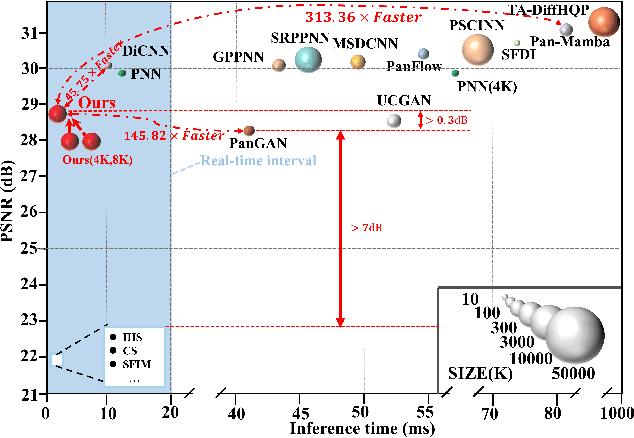
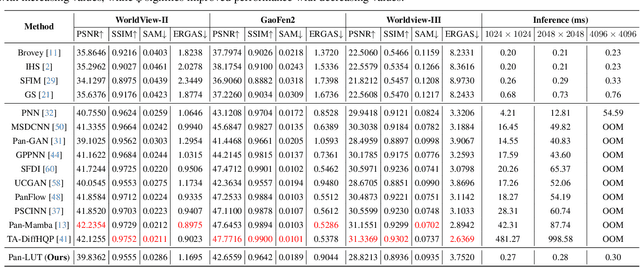
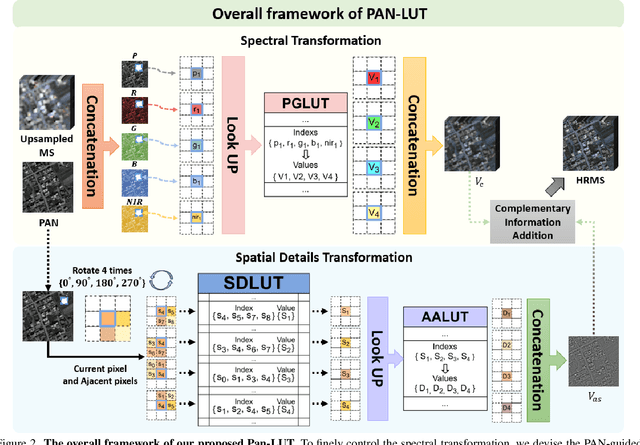
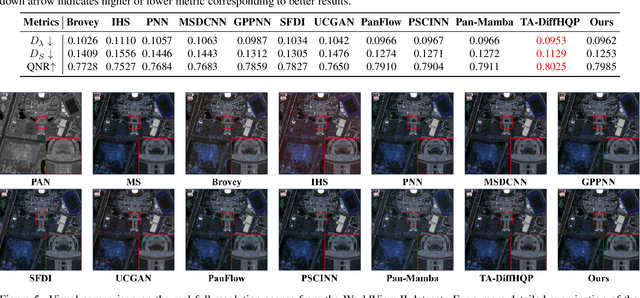
Recently, deep learning-based pan-sharpening algorithms have achieved notable advancements over traditional methods. However, many deep learning-based approaches incur substantial computational overhead during inference, especially with high-resolution images. This excessive computational demand limits the applicability of these methods in real-world scenarios, particularly in the absence of dedicated computing devices such as GPUs and TPUs. To address these challenges, we propose Pan-LUT, a novel learnable look-up table (LUT) framework for pan-sharpening that strikes a balance between performance and computational efficiency for high-resolution remote sensing images. To finely control the spectral transformation, we devise the PAN-guided look-up table (PGLUT) for channel-wise spectral mapping. To effectively capture fine-grained spatial details and adaptively learn local contexts, we introduce the spatial details look-up table (SDLUT) and adaptive aggregation look-up table (AALUT). Our proposed method contains fewer than 300K parameters and processes a 8K resolution image in under 1 ms using a single NVIDIA GeForce RTX 2080 Ti GPU, demonstrating significantly faster performance compared to other methods. Experiments reveal that Pan-LUT efficiently processes large remote sensing images in a lightweight manner, bridging the gap to real-world applications. Furthermore, our model surpasses SOTA methods in full-resolution scenes under real-world conditions, highlighting its effectiveness and efficiency.