 Add to Chrome
 Add to Firefox
 Add to Edge
AgriWorld:A World Tools Protocol Framework for Verifiable Agricultural Reasoning with Code-Executing LLM Agents
Feb 17, 2026
Foundation models for agriculture are increasingly trained on massive spatiotemporal data (e.g., multi-spectral remote sensing, soil grids, and field-level management logs) and achieve strong performance on forecasting and monitoring. However, these models lack language-based reasoning and interactive capabilities, limiting their usefulness in real-world agronomic workflows. Meanwhile, large language models (LLMs) excel at interpreting and generating text, but cannot directly reason over high-dimensional, heterogeneous agricultural datasets. We bridge this gap with an agentic framework for agricultural science. It provides a Python execution environment, AgriWorld, exposing unified tools for geospatial queries over field parcels, remote-sensing time-series analytics, crop growth simulation, and task-specific predictors (e.g., yield, stress, and disease risk). On top of this environment, we design a multi-turn LLM agent, Agro-Reflective, that iteratively writes code, observes execution results, and refines its analysis via an execute-observe-refine loop. We introduce AgroBench, with scalable data generation for diverse agricultural QA spanning lookups, forecasting, anomaly detection, and counterfactual "what-if" analysis. Experiments outperform text-only and direct tool-use baselines, validating execution-driven reflection for reliable agricultural reasoning.

Stable Language Guidance for Vision-Language-Action Models
Jan 07, 2026Vision-Language-Action (VLA) models have demonstrated impressive capabilities in generalized robotic control; however, they remain notoriously brittle to linguistic perturbations. We identify a critical ``modality collapse'' phenomenon where strong visual priors overwhelm sparse linguistic signals, causing agents to overfit to specific instruction phrasings while ignoring the underlying semantic intent. To address this, we propose \textbf{Residual Semantic Steering (RSS)}, a probabilistic framework that disentangles physical affordance from semantic execution. RSS introduces two theoretical innovations: (1) \textbf{Monte Carlo Syntactic Integration}, which approximates the true semantic posterior via dense, LLM-driven distributional expansion, and (2) \textbf{Residual Affordance Steering}, a dual-stream decoding mechanism that explicitly isolates the causal influence of language by subtracting the visual affordance prior. Theoretical analysis suggests that RSS effectively maximizes the mutual information between action and intent while suppressing visual distractors. Empirical results across diverse manipulation benchmarks demonstrate that RSS achieves state-of-the-art robustness, maintaining performance even under adversarial linguistic perturbations.
CoAgent: Collaborative Planning and Consistency Agent for Coherent Video Generation
Dec 27, 2025Maintaining narrative coherence and visual consistency remains a central challenge in open-domain video generation. Existing text-to-video models often treat each shot independently, resulting in identity drift, scene inconsistency, and unstable temporal structure. We propose CoAgent, a collaborative and closed-loop framework for coherent video generation that formulates the process as a plan-synthesize-verify pipeline. Given a user prompt, style reference, and pacing constraints, a Storyboard Planner decomposes the input into structured shot-level plans with explicit entities, spatial relations, and temporal cues. A Global Context Manager maintains entity-level memory to preserve appearance and identity consistency across shots. Each shot is then generated by a Synthesis Module under the guidance of a Visual Consistency Controller, while a Verifier Agent evaluates intermediate results using vision-language reasoning and triggers selective regeneration when inconsistencies are detected. Finally, a pacing-aware editor refines temporal rhythm and transitions to match the desired narrative flow. Extensive experiments demonstrate that CoAgent significantly improves coherence, visual consistency, and narrative quality in long-form video generation.
HybridToken-VLM: Hybrid Token Compression for Vision-Language Models
Dec 09, 2025Vision-language models (VLMs) have transformed multimodal reasoning, but feeding hundreds of visual patch tokens into LLMs incurs quadratic computational costs, straining memory and context windows. Traditional approaches face a trade-off: continuous compression dilutes high-level semantics such as object identities, while discrete quantization loses fine-grained details such as textures. We introduce HTC-VLM, a hybrid framework that disentangles semantics and appearance through dual channels, i.e., a continuous pathway for fine-grained details via ViT patches and a discrete pathway for symbolic anchors using MGVQ quantization projected to four tokens. These are fused into a 580-token hybrid sequence and compressed into a single voco token via a disentanglement attention mask and bottleneck, ensuring efficient and grounded representations. HTC-VLM achieves an average performance retention of 87.2 percent across seven benchmarks (GQA, VQAv2, MMBench, MME, POPE, SEED-Bench, ScienceQA-Image), outperforming the leading continuous baseline at 81.0 percent with a 580-to-1 compression ratio. Attention analyses show that the compressed token prioritizes the discrete anchor, validating its semantic guidance. Our work demonstrates that a minimalist hybrid design can resolve the efficiency-fidelity dilemma and advance scalable VLMs.
MM-CoT:A Benchmark for Probing Visual Chain-of-Thought Reasoning in Multimodal Models
Dec 09, 2025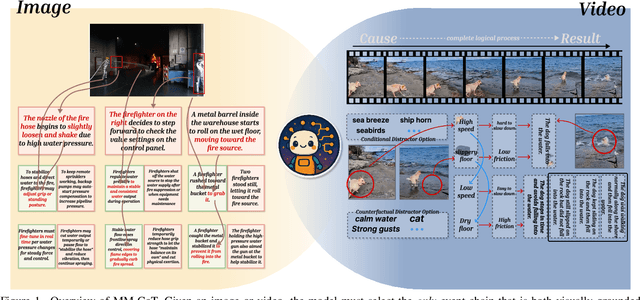
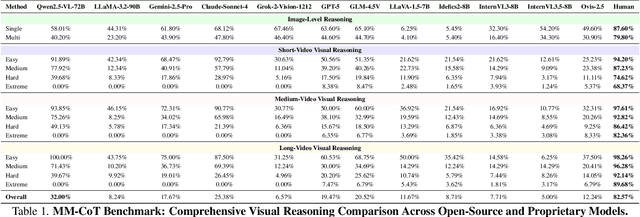
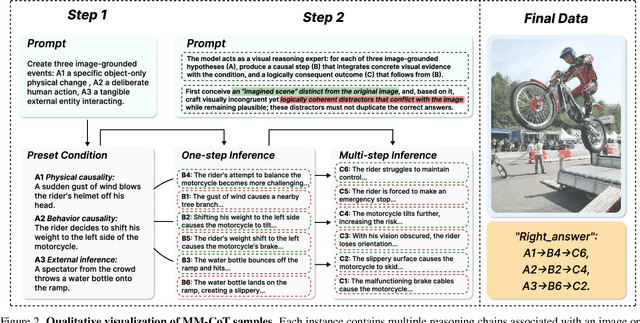
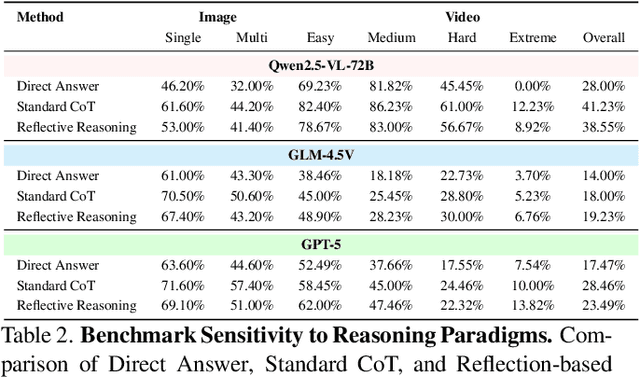
The ability to perform Chain-of-Thought (CoT) reasoning marks a major milestone for multimodal models (MMs), enabling them to solve complex visual reasoning problems. Yet a critical question remains: is such reasoning genuinely grounded in visual evidence and logically coherent? Existing benchmarks emphasize generation but neglect verification, i.e., the capacity to assess whether a reasoning chain is both visually consistent and logically valid. To fill this gap, we introduce MM-CoT, a diagnostic benchmark specifically designed to probe the visual grounding and logical coherence of CoT reasoning in MMs. Instead of generating free-form explanations, models must select the sole event chain that satisfies two orthogonal constraints: (i) visual consistency, ensuring all steps are anchored in observable evidence, and (ii) logical coherence, ensuring causal and commonsense validity. Adversarial distractors are engineered to violate one of these constraints, exposing distinct reasoning failures. We evaluate leading vision-language models on MM-CoT and find that even the most advanced systems struggle, revealing a sharp discrepancy between generative fluency and true reasoning fidelity. MM-CoT shows low correlation with existing benchmarks, confirming that it measures a unique combination of visual grounding and logical reasoning. This benchmark provides a foundation for developing future models that reason not just plausibly, but faithfully and coherently within the visual world.