 Add to Chrome
 Add to Firefox
 Add to Edge
CoAgent: Collaborative Planning and Consistency Agent for Coherent Video Generation
Dec 27, 2025
Maintaining narrative coherence and visual consistency remains a central challenge in open-domain video generation. Existing text-to-video models often treat each shot independently, resulting in identity drift, scene inconsistency, and unstable temporal structure. We propose CoAgent, a collaborative and closed-loop framework for coherent video generation that formulates the process as a plan-synthesize-verify pipeline. Given a user prompt, style reference, and pacing constraints, a Storyboard Planner decomposes the input into structured shot-level plans with explicit entities, spatial relations, and temporal cues. A Global Context Manager maintains entity-level memory to preserve appearance and identity consistency across shots. Each shot is then generated by a Synthesis Module under the guidance of a Visual Consistency Controller, while a Verifier Agent evaluates intermediate results using vision-language reasoning and triggers selective regeneration when inconsistencies are detected. Finally, a pacing-aware editor refines temporal rhythm and transitions to match the desired narrative flow. Extensive experiments demonstrate that CoAgent significantly improves coherence, visual consistency, and narrative quality in long-form video generation.

Reflective Confidence: Correcting Reasoning Flaws via Online Self-Correction
Dec 21, 2025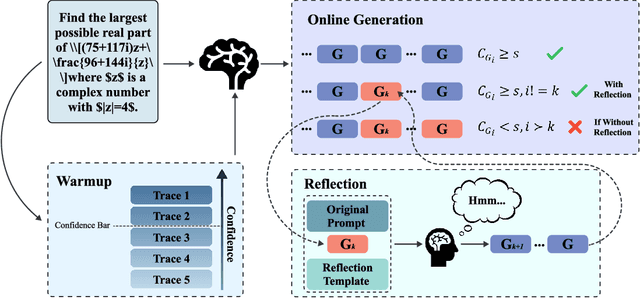
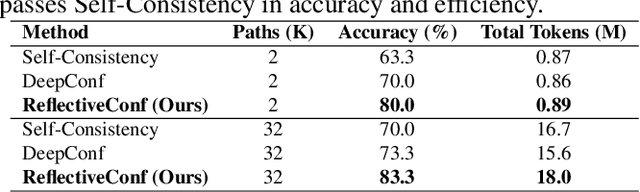
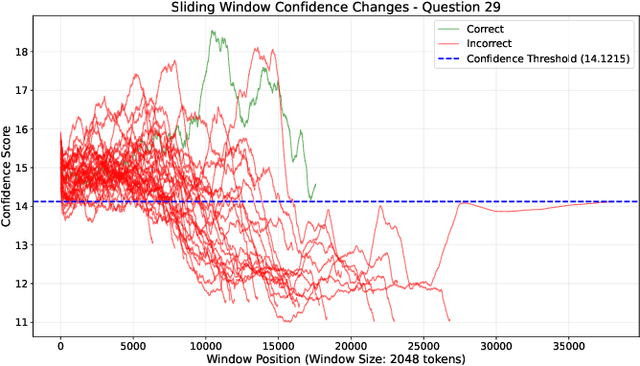
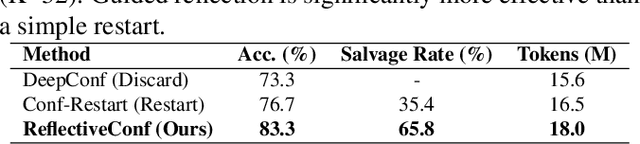
Large language models (LLMs) have achieved strong performance on complex reasoning tasks using techniques such as chain-of-thought and self-consistency. However, ensemble-based approaches, especially self-consistency which relies on multiple reasoning trajectories, often incur substantial computational overhead. To improve efficiency, prior work has leveraged internal confidence signals, where early stopping strategies such as DeepConf reduce cost by terminating low-confidence trajectories. However, this strategy discards incomplete reasoning paths and wastes partial computation. We propose reflective confidence, a novel reasoning framework that transforms low-confidence signals from termination indicators into reflection triggers. When confidence falls below a threshold, instead of stopping generation, the model produces a reflection prompt to analyze the current reasoning state, identify potential errors, and continue generation along a corrected trajectory. Experiments on mathematical reasoning benchmarks, including AIME 2025, demonstrate significant accuracy improvements over advanced early-stopping baselines at comparable computational cost, validating the effectiveness of proactive self-correction over passive discarding.
LLM-CAS: Dynamic Neuron Perturbation for Real-Time Hallucination Correction
Dec 21, 2025Large language models (LLMs) often generate hallucinated content that lacks factual or contextual grounding, limiting their reliability in critical applications. Existing approaches such as supervised fine-tuning and reinforcement learning from human feedback are data intensive and computationally expensive, while static parameter editing methods struggle with context dependent errors and catastrophic forgetting. We propose LLM-CAS, a framework that formulates real-time hallucination correction as a hierarchical reinforcement learning problem. LLM-CAS trains an agent to learn a policy that dynamically selects temporary neuron perturbations during inference based on the current context. Unlike prior dynamic approaches that rely on heuristic or predefined adjustments, this policy driven mechanism enables adaptive and fine grained correction without permanent parameter modification. Experiments across multiple language models demonstrate that LLM-CAS consistently improves factual accuracy, achieving gains of 10.98 percentage points on StoryCloze, 2.71 points on TriviaQA, and 2.06 points on the MC1 score of TruthfulQA. These results outperform both static editing methods such as ITI and CAA and the dynamic SADI framework. Overall, LLM-CAS provides an efficient and context aware solution for improving the reliability of LLMs, with promising potential for future multimodal extensions.