 Add to Chrome
 Add to Firefox
 Add to Edge
Self-Rewarded Multimodal Coherent Reasoning Across Diverse Visual Domains
Dec 27, 2025
Multimodal LLMs often produce fluent yet unreliable reasoning, exhibiting weak step-to-step coherence and insufficient visual grounding, largely because existing alignment approaches supervise only the final answer while ignoring the reliability of the intermediate reasoning process. We introduce SR-MCR, a lightweight and label-free framework that aligns reasoning by exploiting intrinsic process signals derived directly from model outputs. Five self-referential cues -- semantic alignment, lexical fidelity, non-redundancy, visual grounding, and step consistency -- are integrated into a normalized, reliability-weighted reward that provides fine-grained process-level guidance. A critic-free GRPO objective, enhanced with a confidence-aware cooling mechanism, further stabilizes training and suppresses trivial or overly confident generations. Built on Qwen2.5-VL, SR-MCR improves both answer accuracy and reasoning coherence across a broad set of visual benchmarks; among open-source models of comparable size, SR-MCR-7B achieves state-of-the-art performance with an average accuracy of 81.4%. Ablation studies confirm the independent contributions of each reward term and the cooling module.

MM-CoT:A Benchmark for Probing Visual Chain-of-Thought Reasoning in Multimodal Models
Dec 09, 2025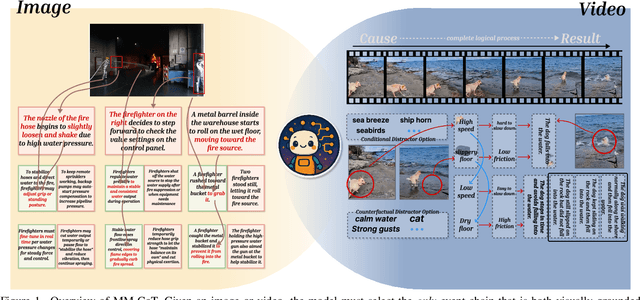
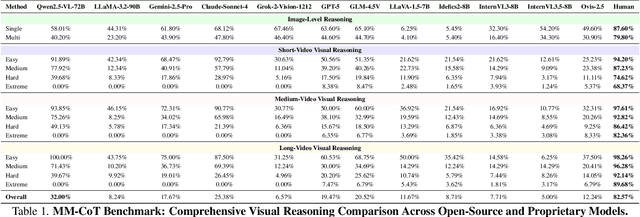
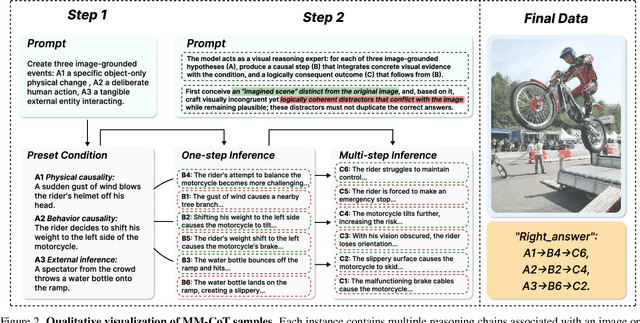
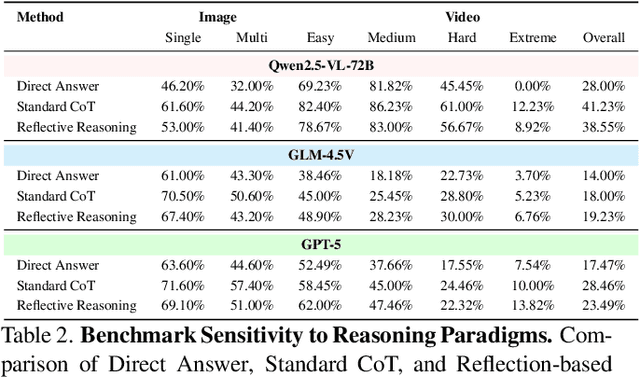
The ability to perform Chain-of-Thought (CoT) reasoning marks a major milestone for multimodal models (MMs), enabling them to solve complex visual reasoning problems. Yet a critical question remains: is such reasoning genuinely grounded in visual evidence and logically coherent? Existing benchmarks emphasize generation but neglect verification, i.e., the capacity to assess whether a reasoning chain is both visually consistent and logically valid. To fill this gap, we introduce MM-CoT, a diagnostic benchmark specifically designed to probe the visual grounding and logical coherence of CoT reasoning in MMs. Instead of generating free-form explanations, models must select the sole event chain that satisfies two orthogonal constraints: (i) visual consistency, ensuring all steps are anchored in observable evidence, and (ii) logical coherence, ensuring causal and commonsense validity. Adversarial distractors are engineered to violate one of these constraints, exposing distinct reasoning failures. We evaluate leading vision-language models on MM-CoT and find that even the most advanced systems struggle, revealing a sharp discrepancy between generative fluency and true reasoning fidelity. MM-CoT shows low correlation with existing benchmarks, confirming that it measures a unique combination of visual grounding and logical reasoning. This benchmark provides a foundation for developing future models that reason not just plausibly, but faithfully and coherently within the visual world.