 Add to Chrome
 Add to Firefox
 Add to Edge
Rational ANOVA Networks
Feb 03, 2026
Deep neural networks typically treat nonlinearities as fixed primitives (e.g., ReLU), limiting both interpretability and the granularity of control over the induced function class. While recent additive models (like KANs) attempt to address this using splines, they often suffer from computational inefficiency and boundary instability. We propose the Rational-ANOVA Network (RAN), a foundational architecture grounded in functional ANOVA decomposition and Padé-style rational approximation. RAN models f(x) as a composition of main effects and sparse pairwise interactions, where each component is parameterized by a stable, learnable rational unit. Crucially, we enforce a strictly positive denominator, which avoids poles and numerical instability while capturing sharp transitions and near-singular behaviors more efficiently than polynomial bases. This ANOVA structure provides an explicit low-order interaction bias for data efficiency and interpretability, while the rational parameterization significantly improves extrapolation. Across controlled function benchmarks and vision classification tasks (e.g., CIFAR-10) under matched parameter and compute budgets, RAN matches or surpasses parameter-matched MLPs and learnable-activation baselines, with better stability and throughput. Code is available at https://github.com/jushengzhang/Rational-ANOVA-Networks.git.

Self-Rewarded Multimodal Coherent Reasoning Across Diverse Visual Domains
Dec 27, 2025Multimodal LLMs often produce fluent yet unreliable reasoning, exhibiting weak step-to-step coherence and insufficient visual grounding, largely because existing alignment approaches supervise only the final answer while ignoring the reliability of the intermediate reasoning process. We introduce SR-MCR, a lightweight and label-free framework that aligns reasoning by exploiting intrinsic process signals derived directly from model outputs. Five self-referential cues -- semantic alignment, lexical fidelity, non-redundancy, visual grounding, and step consistency -- are integrated into a normalized, reliability-weighted reward that provides fine-grained process-level guidance. A critic-free GRPO objective, enhanced with a confidence-aware cooling mechanism, further stabilizes training and suppresses trivial or overly confident generations. Built on Qwen2.5-VL, SR-MCR improves both answer accuracy and reasoning coherence across a broad set of visual benchmarks; among open-source models of comparable size, SR-MCR-7B achieves state-of-the-art performance with an average accuracy of 81.4%. Ablation studies confirm the independent contributions of each reward term and the cooling module.
RevFFN: Memory-Efficient Full-Parameter Fine-Tuning of Mixture-of-Experts LLMs with Reversible Blocks
Dec 24, 2025Full parameter fine tuning is a key technique for adapting large language models (LLMs) to downstream tasks, but it incurs substantial memory overhead due to the need to cache extensive intermediate activations for backpropagation. This bottleneck makes full fine tuning of contemporary large scale LLMs challenging in practice. Existing distributed training frameworks such as DeepSpeed alleviate this issue using techniques like ZeRO and FSDP, which rely on multi GPU memory or CPU offloading, but often require additional hardware resources and reduce training speed. We introduce RevFFN, a memory efficient fine tuning paradigm for mixture of experts (MoE) LLMs. RevFFN employs carefully designed reversible Transformer blocks that allow reconstruction of layer input activations from outputs during backpropagation, eliminating the need to store most intermediate activations in memory. While preserving the expressive capacity of MoE architectures, this approach significantly reduces peak memory consumption for full parameter fine tuning. As a result, RevFFN enables efficient full fine tuning on a single consumer grade or server grade GPU.
LLM-CAS: Dynamic Neuron Perturbation for Real-Time Hallucination Correction
Dec 21, 2025Large language models (LLMs) often generate hallucinated content that lacks factual or contextual grounding, limiting their reliability in critical applications. Existing approaches such as supervised fine-tuning and reinforcement learning from human feedback are data intensive and computationally expensive, while static parameter editing methods struggle with context dependent errors and catastrophic forgetting. We propose LLM-CAS, a framework that formulates real-time hallucination correction as a hierarchical reinforcement learning problem. LLM-CAS trains an agent to learn a policy that dynamically selects temporary neuron perturbations during inference based on the current context. Unlike prior dynamic approaches that rely on heuristic or predefined adjustments, this policy driven mechanism enables adaptive and fine grained correction without permanent parameter modification. Experiments across multiple language models demonstrate that LLM-CAS consistently improves factual accuracy, achieving gains of 10.98 percentage points on StoryCloze, 2.71 points on TriviaQA, and 2.06 points on the MC1 score of TruthfulQA. These results outperform both static editing methods such as ITI and CAA and the dynamic SADI framework. Overall, LLM-CAS provides an efficient and context aware solution for improving the reliability of LLMs, with promising potential for future multimodal extensions.
GTMA: Dynamic Representation Optimization for OOD Vision-Language Models
Dec 20, 2025Vision-language models (VLMs) struggle in open-world applications, where out-of-distribution (OOD) concepts often trigger cross-modal alignment collapse and severely degrade zero-shot performance. We identify the root cause as modal asymmetry: while the visual encoder can extract discriminative features from unseen images, the text encoder is constrained by a fixed discrete vocabulary and cannot synthesize new semantic anchors. Existing approaches such as CoOp or LoRA provide only partial remedies, as they remain confined to the pre-trained semantic space. To overcome this bottleneck, we propose dynamic representation optimization, realized through the Guided Target-Matching Adaptation (GTMA) framework. At inference time, GTMA constructs a continuous pseudo-word embedding that best aligns with an OOD image's visual anchor, effectively bypassing vocabulary limitations. The optimization is driven by an adaptive gradient-based representation policy optimization algorithm, which incorporates semantic regularization to preserve plausibility and compatibility with the model's prior knowledge. Experiments on ImageNet-R and the VISTA-Beyond benchmark demonstrate that GTMA improves zero-shot and few-shot OOD accuracy by up to 15-20 percent over the base VLM while maintaining performance on in-distribution concepts. Ablation studies further confirm the necessity of pseudo-word optimization.
KABB: Knowledge-Aware Bayesian Bandits for Dynamic Expert Coordination in Multi-Agent Systems
Feb 11, 2025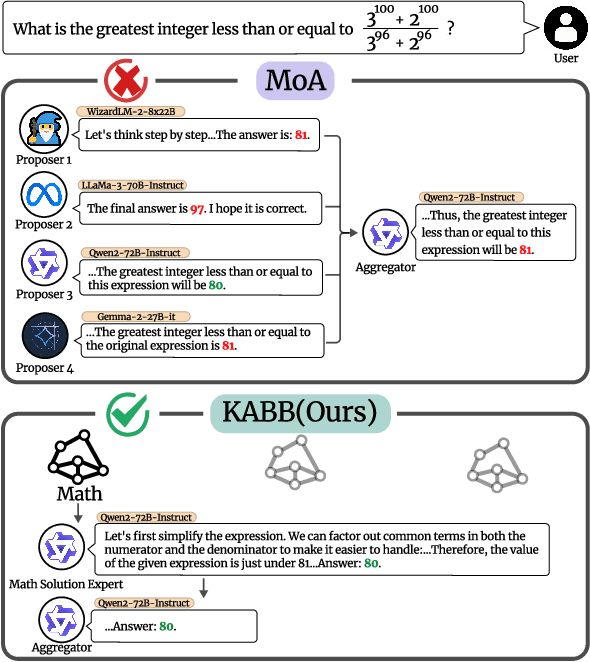
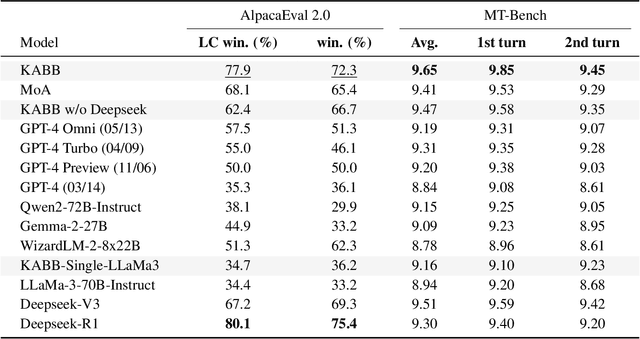
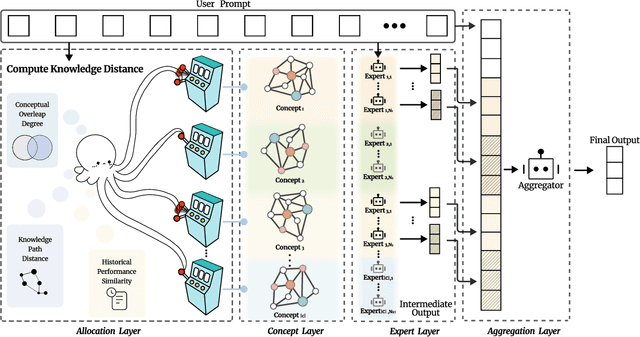
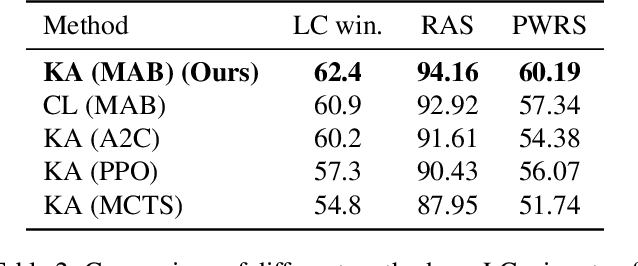
As scaling large language models faces prohibitive costs, multi-agent systems emerge as a promising alternative, though challenged by static knowledge assumptions and coordination inefficiencies. We introduces Knowledge-Aware Bayesian Bandits (KABB), a novel framework that enhances multi-agent system coordination through semantic understanding and dynamic adaptation. The framework features three key innovations: a three-dimensional knowledge distance model for deep semantic understanding, a dual-adaptation mechanism for continuous expert optimization, and a knowledge-aware Thompson Sampling strategy for efficient expert selection. Extensive evaluation demonstrates KABB achieves an optimal cost-performance balance, maintaining high performance while keeping computational demands relatively low in multi-agent coordination.