 Add to Chrome
 Add to Firefox
 Add to Edge
Towards Better Agents for Multi-Turn User Interaction: The Next User Turn Is More Than Context
Aug 18, 2026
User-facing tool agents must coordinate dialogue and tool use as user goals unfold over multiple turns. Yet interactive reinforcement learning typically reduces each rollout to a terminal reward, assigning the same credit to effective elicitation, errors, and later repair. The next user turn is more than context: it also provides noisy, temporally local evidence about the preceding user-to-user segment. We introduce \textbf{F}eedback-\textbf{A}ware \textbf{C}redit \textbf{A}ssignment (\textsc{FACA}), which aligns each reaction with that segment, derives a locally normalized reaction advantage, and adds it to verified terminal outcome advantage without an extra critic or rollout. Against an outcome-only Interactive GRPO control matched in simulator, visible dialogue, initialization, rollout, and optimization, \textsc{FACA} improves the nine-domain $τ$-family average across three independently trained runs by 5.91 and 10.22 percentage points at 8B and 14B, respectively. Gains concentrate in Telecom; at 8B, randomizing reaction polarity removes the Telecom gain. The same ordering holds zero-shot on Pare-Bench and Co-Gym. These results demonstrate that next-turn user reactions provide actionable local credit for improving multi-turn user-interacting agents.

Diagnosis Before Recovery: Turning Agent Failures into Selective Self-Correction
Aug 12, 2026Self-correction is particularly useful when a failure constrains the next repair. Coding agents benefit from this property because compilers, tests, and execution traces turn many failures into typed recovery signals, but broad language-agent tasks often expose only a coarse task failure. This creates a tension for generic recovery playbooks: they broaden the agent's context precisely when the system needs a narrower repair interface, mixing incompatible signals for invalid actions, missing procedures, and strict-format errors. Our insight is that development-set failures can recover part of the missing diagnostic substrate by deciding which recovery interventions are admissible before test-time correction. We propose DARC, a diagnosis-guided recovery harness that profiles task-family failure modes, prunes mismatched interventions from a shared recovery library, and freezes a verifier-selected success-cost policy for deployment. This causal order makes correction selective: the harness first determines what kind of failure can be repaired, then decides how much recovery evidence to spend. In ALFWorld, AppWorld, and XBRL Finance, the same protocol yields an action-validity harness, a procedural-recovery fallback, and a format-precision retrieval policy; in each evaluated setting it improves average task performance over base agents and broad playbooks while reducing environment steps or retrieval budget. Our experiments show that failures need not trigger uniformly more context: DARC turns self-correction from prompt expansion into recovery-interface design. DARC provides a practical route toward more reliable agents in domains where compiler-like feedback is absent: making failures actionable before making contexts larger.
CogSENet: Blind Image Deblurring with Blur-Conditioned Semantic Routing and Explicit Frequency Fusion
Jun 29, 2026Blind image deblurring demands the recovery of high-fidelity details and coherent structures from complex, unknown degradations. Current blind image deblurring methods struggle with real-world, spatially varying degradations, and lack the semantic awareness necessary to reliably differentiate valid textures from artifacts. To bridge this gap, we propose CogSENet, a dynamic, semantic-aligned reconstruction framework inspired by the eagle's visual system. By mimicking the eagle's active saccadic scanning, we devise a Semantic-Driven State Space Module (SDSSM) with semantic-aware token regrouping via differentiable routing, enabling prompt-conditioned long-range dependency modeling. To ensure physically interpretable recovery of textures and structures, a BiFreqFusionBlock (BFFB) mirrors functional differentiation of the eagle's retina by decomposing features into high and low frequencies using wavelet transforms. Finally, we estimate a continuous Blur Field (CBF) from blur image and fuse it with CLIP semantic priors to modulate the deepest latent features, emulating focal adaptation and enabling adaptive restoration under spatially non-uniform blur. Extensive experiments demonstrate that CogSENetoutperforms state-of-the-art deblurring methods in both visual quality and structural fidelity with fewer parameters, while also performing favorably on dehazing, deraining, and denoising tasks.
SEAL: Synergistic Co-Evolution of Agents and Learning Environments
May 23, 2026Large Language Model (LLM) agents are increasingly improved through interaction, yet most self-evolution methods adapt either the policy or the learning environment in isolation. We identify this structural gap as \emph{Agent-Environment Misalignment}: the agent's capability frontier changes during training, while the environment that provides supervision remains static or only weakly coupled to the agent's revealed failures. We propose SEAL, a closed-loop co-evolution framework for interactive tool-use agents. SEAL collects on-policy trajectories under executable verification, diagnoses failed rollouts into turn-level failure labels, and uses these diagnoses as a shared signal for both environment-side adaptation and model-side policy optimization. The environment evolves its training-time learning interface by exposing clearer tool affordance cues, constraint information, and recovery-oriented feedback, while the policy is updated with diagnosis-guided advantage reweighting. Extensive experiments across in-distribution and out-of-distribution multi-turn tool-use evaluations show that SEAL improves low-resource agent learning: with only 400 training samples, it yields +8.25 to +26.25 average-point gains across three backbones and exhibits positive out-of-distribution transfer. These results demonstrate the value of jointly adapting the learner and its training-time learning substrate for robust self-improving LLM agents.
CFSR: Geometry-Conditioned Shadow Removal via Physical Disentanglement
Apr 20, 2026Traditional shadow removal networks often treat image restoration as an unconstrained mapping, lacking the physical interpretability required to balance localized texture recovery with global illumination consistency. To address this, we propose CFSR, a multi-modal prior-driven framework that reframes shadow removal as a physics-constrained restoration process. By seamlessly integrating 3D geometric cues with large-scale foundation model semantics, CFSR effectively bridges the 2D-3D domain gap. Specifically, we first map observations into a custom HVI color space to suppress shadow-induced noise and robustly fuse RGB data with estimated depth priors. At its core, our Geometric & Semantic Dual Explicit Guided Attention mechanism utilizes DINO features and 3D surface normals to directly modulate the attention affinity matrix, structurally enforcing physical lighting constraints. To recover severely degraded regions, we inject holistic priors via a frozen CLIP encoder. Finally, our Frequency Collaborative Reconstruction Module (FCRM) achieves an optimal synthesis by decoupling the decoding process. Conditioned on geometric priors, FCRM seamlessly harmonizes the reconstruction of sharp high-frequency occlusion boundaries with the restoration of low-frequency global illumination. Extensive experiments demonstrate that CFSR achieves state-of-the-art performance across multiple challenging benchmarks.
OmniVideo-R1: Reinforcing Audio-visual Reasoning with Query Intention and Modality Attention
Feb 05, 2026While humans perceive the world through diverse modalities that operate synergistically to support a holistic understanding of their surroundings, existing omnivideo models still face substantial challenges on audio-visual understanding tasks. In this paper, we propose OmniVideo-R1, a novel reinforced framework that improves mixed-modality reasoning. OmniVideo-R1 empowers models to "think with omnimodal cues" by two key strategies: (1) query-intensive grounding based on self-supervised learning paradigms; and (2) modality-attentive fusion built upon contrastive learning paradigms. Extensive experiments on multiple benchmarks demonstrate that OmniVideo-R1 consistently outperforms strong baselines, highlighting its effectiveness and robust generalization capabilities.
Dual Latent Memory for Visual Multi-agent System
Jan 31, 2026While Visual Multi-Agent Systems (VMAS) promise to enhance comprehensive abilities through inter-agent collaboration, empirical evidence reveals a counter-intuitive "scaling wall": increasing agent turns often degrades performance while exponentially inflating token costs. We attribute this failure to the information bottleneck inherent in text-centric communication, where converting perceptual and thinking trajectories into discrete natural language inevitably induces semantic loss. To this end, we propose L$^{2}$-VMAS, a novel model-agnostic framework that enables inter-agent collaboration with dual latent memories. Furthermore, we decouple the perception and thinking while dynamically synthesizing dual latent memories. Additionally, we introduce an entropy-driven proactive triggering that replaces passive information transmission with efficient, on-demand memory access. Extensive experiments among backbones, sizes, and multi-agent structures demonstrate that our method effectively breaks the "scaling wall" with superb scalability, improving average accuracy by 2.7-5.4% while reducing token usage by 21.3-44.8%. Codes: https://github.com/YU-deep/L2-VMAS.
Reduction-based Pseudo-label Generation for Instance-dependent Partial Label Learning
Oct 28, 2024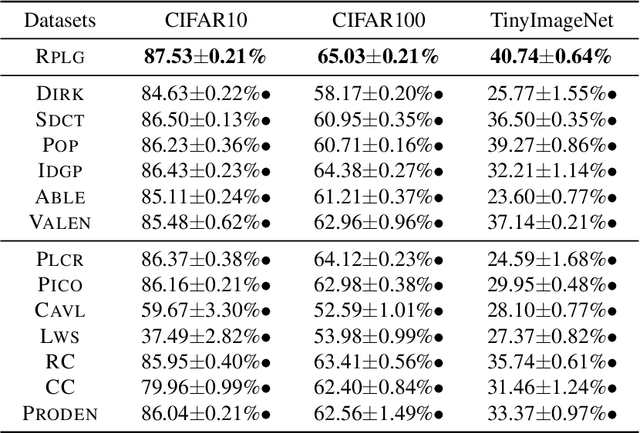
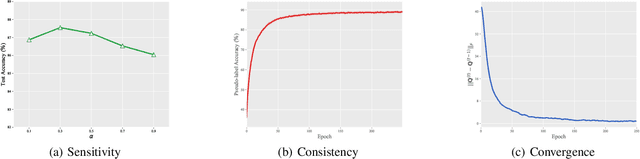
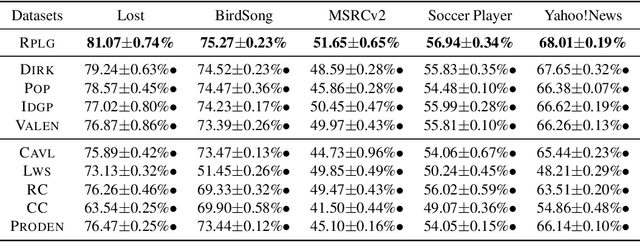
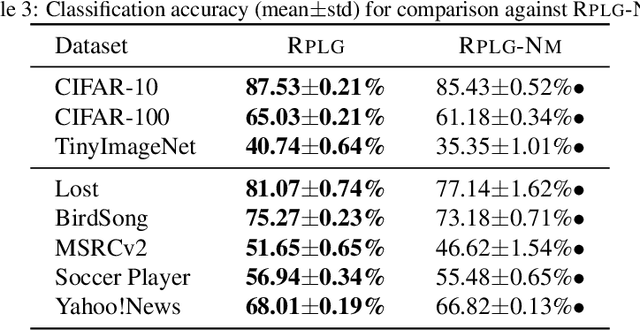
Instance-dependent Partial Label Learning (ID-PLL) aims to learn a multi-class predictive model given training instances annotated with candidate labels related to features, among which correct labels are hidden fixed but unknown. The previous works involve leveraging the identification capability of the training model itself to iteratively refine supervision information. However, these methods overlook a critical aspect of ID-PLL: the training model is prone to overfitting on incorrect candidate labels, thereby providing poor supervision information and creating a bottleneck in training. In this paper, we propose to leverage reduction-based pseudo-labels to alleviate the influence of incorrect candidate labels and train our predictive model to overcome this bottleneck. Specifically, reduction-based pseudo-labels are generated by performing weighted aggregation on the outputs of a multi-branch auxiliary model, with each branch trained in a label subspace that excludes certain labels. This approach ensures that each branch explicitly avoids the disturbance of the excluded labels, allowing the pseudo-labels provided for instances troubled by these excluded labels to benefit from the unaffected branches. Theoretically, we demonstrate that reduction-based pseudo-labels exhibit greater consistency with the Bayes optimal classifier compared to pseudo-labels directly generated from the predictive model.
A spatio-temporal LSTM model to forecast across multiple temporal and spatial scales
Aug 26, 2021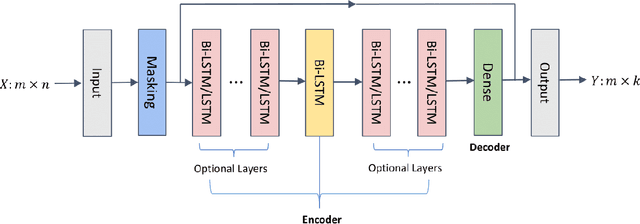
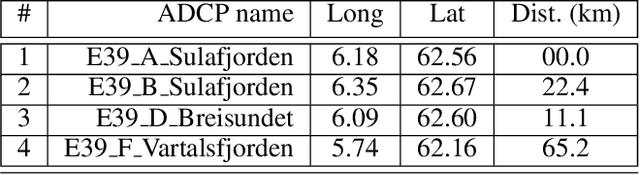
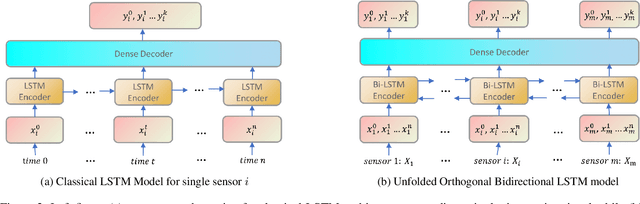
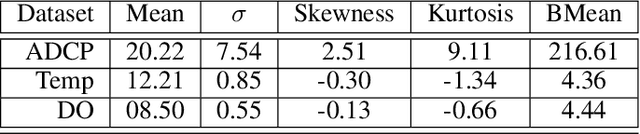
This paper presents a novel spatio-temporal LSTM (SPATIAL) architecture for time series forecasting applied to environmental datasets. The framework was evaluated across multiple sensors and for three different oceanic variables: current speed, temperature, and dissolved oxygen. Network implementation proceeded in two directions that are nominally separated but connected as part of a natural environmental system -- across the spatial (between individual sensors) and temporal components of the sensor data. Data from four sensors sampling current speed, and eight measuring both temperature and dissolved oxygen evaluated the framework. Results were compared against RF and XGB baseline models that learned on the temporal signal of each sensor independently by extracting the date-time features together with the past history of data using sliding window matrix. Results demonstrated ability to accurately replicate complex signals and provide comparable performance to state-of-the-art benchmarks. Notably, the novel framework provided a simpler pre-processing and training pipeline that handles missing values via a simple masking layer. Enabling learning across the spatial and temporal directions, this paper addresses two fundamental challenges of ML applications to environmental science: 1) data sparsity and the challenges and costs of collecting measurements of environmental conditions such as ocean dynamics, and 2) environmental datasets are inherently connected in the spatial and temporal directions while classical ML approaches only consider one of these directions. Furthermore, sharing of parameters across all input steps makes SPATIAL a fast, scalable, and easily-parameterized forecasting framework.
Neural Time-Dependent Partial Differential Equation
Sep 08, 2020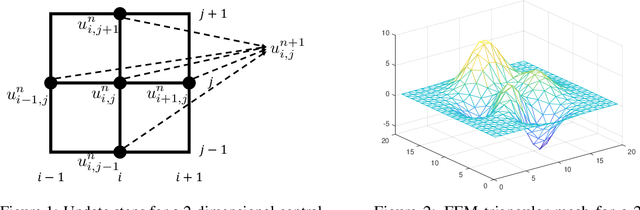
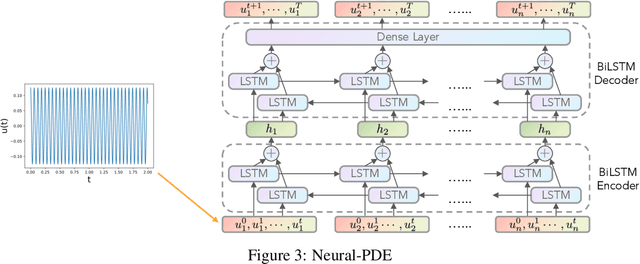
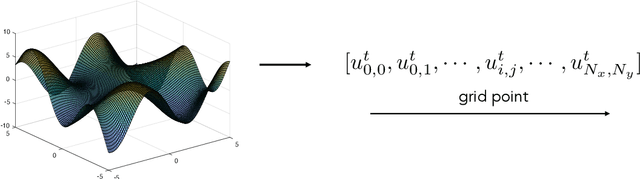
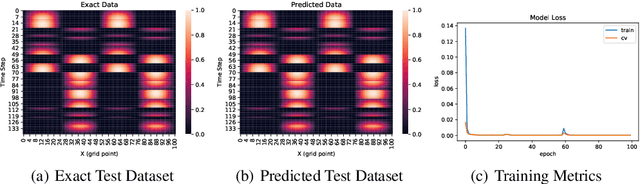
Partial differential equations (PDEs) play a crucial role in studying a vast number of problems in science and engineering. Numerically solving nonlinear and/or high-dimensional PDEs is often a challenging task. Inspired by the traditional finite difference and finite elements methods and emerging advancements in machine learning, we propose a sequence deep learning framework called Neural-PDE, which allows to automatically learn governing rules of any time-dependent PDE system from existing data by using a bidirectional LSTM encoder, and predict the next n time steps data. One critical feature of our proposed framework is that the Neural-PDE is able to simultaneously learn and simulate the multiscale variables.We test the Neural-PDE by a range of examples from one-dimensional PDEs to a high-dimensional and nonlinear complex fluids model. The results show that the Neural-PDE is capable of learning the initial conditions, boundary conditions and differential operators without the knowledge of the specific form of a PDE system.In our experiments the Neural-PDE can efficiently extract the dynamics within 20 epochs training, and produces accurate predictions. Furthermore, unlike the traditional machine learning approaches in learning PDE such as CNN and MLP which require vast parameters for model precision, Neural-PDE shares parameters across all time steps, thus considerably reduces the computational complexity and leads to a fast learning algorithm.