 Add to Chrome
 Add to Firefox
 Add to Edge
Schreier-Coset Graph Rewiring
Jul 29, 2026
The information flow in the graph neural networks (GNNs) is fundamentally constrained by over-squashing, where structural bottlenecks impede long range information propagation. Graph-rewiring methods, which modify graph topology, have been extensively used to alleviate this. However, existing approaches often introduce prohibitive structural and computational bottlenecks, fail to preserve the critical properties of original graphs, and increase the edge counts massively. We introduce a novel method Schreier-Coset Graph Rewiring , a group-theoretic rewiring method that augments the input graph with a Schreier-Coset graph derived from a special linear group. Our method provides theoretical guarantees, a graph that exhibits spectral gap and a bounded effective resistance, creating a low-resistance bypass for long-range communication. Empirical evaluations demonstrate that SCGR reduces effective resistance by 5-40% across various learning tasks, effectively mitigating connectivity bottlenecks while maintaining competitive accuracy.

Posterior Contraction Rates for Sparse Kolmogorov-Arnold Networks in Anisotropic Besov Spaces
May 12, 2026We study posterior contraction rates for sparse Bayesian Kolmogorov-Arnold networks (KANs) over anisotropic Besov spaces, providing a statistical foundation of KANs from a Bayesian point of view. We show that sparse Bayesian KANs equipped with spike-and-slab-type sparsity priors attain the near-minimax posterior contraction. In particular, the contraction rate depends on the intrinsic anisotropic smoothness of the underlying function. Moreover, by placing a hyperprior on a single model-size parameter, the resulting posterior adapts to unknown anisotropic smoothness and still achieves the corresponding near-minimax rate. A distinctive feature of our results, compared with those for standard sparse MLP-based models, is that the KAN depth can be kept fixed: owing to the flexibility of learnable spline edge functions, the required approximation complexity is controlled through the network width, spline-grid range and size, and parameter sparsity. Our analysis develops theoretical tools tailored to sparse spline-edge architectures, including approximation and complexity bounds for Bayesian KANs. We then extend to compositional Besov spaces and show that the contraction rates depend on layerwise smoothness and effective dimension of the underlying compositional structure, thereby effectively avoiding the curse of dimensionality. Together, the developed tools and findings advance the theoretical understanding of Bayesian neural networks and provide rigorous statistical foundations for KANs.
Early-stopped aggregation: Adaptive inference with computational efficiency
Apr 15, 2026When considering a model selection or, more generally, an aggregation approach for adaptive statistical inference, it is often necessary to compute estimators over a wide range of model complexities including unnecessarily large models even when the true data-generating process is relatively simple, due to the lack of prior knowledge. This requirement can lead to substantial computational inefficiency. In this work, we propose a novel framework for efficient model aggregation called the early-stopped aggregation (ESA): instead of computing and aggregating estimators for all candidate models, we compute only a small number of simpler ones using an early-stopping criterion and aggregate only these for final inference. Our framework is versatile and applies to both Bayesian model selection, in particular, within the variational Bayes framework, and frequentist estimation, including a general penalized estimation setting. We investigate adaptive optimal property of the ESA approach across three learning paradigms. We first show that ESA achieves optimal adaptive contraction rates in the variational Bayes setting under mild conditions. We extend this result to variational empirical Bayes, where prior hyperparameters are chosen in a data-dependent manner. In addition, we apply the ESA approach to frequentist aggregation including both penalization-based and sample-splitting implementations, and establish corresponding theory. As we demonstrate, there is a clear unification between early-stopped Bayes and frequentist penalized aggregation, with a common "energy" functional comprising a data-fitting term and a complexity-control term that drives both procedures. We further present several applications and numerical studies that highlight the efficiency and strong performance of the proposed approach.
A Deep Generative Approach to Stratified Learning
Apr 12, 2026While the manifold hypothesis is widely adopted in modern machine learning, complex data is often better modeled as stratified spaces -- unions of manifolds (strata) of varying dimensions. Stratified learning is challenging due to varying dimensionality, intersection singularities, and lack of efficient models in learning the underlying distributions. We provide a deep generative approach to stratified learning by developing two generative frameworks for learning distributions on stratified spaces. The first is a sieve maximum likelihood approach realized via a dimension-aware mixture of variational autoencoders. The second is a diffusion-based framework that explores the score field structure of a mixture. We establish the convergence rates for learning both the ambient and intrinsic distributions, which are shown to be dependent on the intrinsic dimensions and smoothness of the underlying strata. Utilizing the geometry of the score field, we also establish consistency for estimating the intrinsic dimension of each stratum and propose an algorithm that consistently estimates both the number of strata and their dimensions. Theoretical results for both frameworks provide fundamental insights into the interplay of the underlying geometry, the ambient noise level, and deep generative models. Extensive simulations and real dataset applications, such as molecular dynamics, demonstrate the effectiveness of our methods.
Flow Matching is Adaptive to Manifold Structures
Feb 25, 2026Flow matching has emerged as a simulation-free alternative to diffusion-based generative modeling, producing samples by solving an ODE whose time-dependent velocity field is learned along an interpolation between a simple source distribution (e.g., a standard normal) and a target data distribution. Flow-based methods often exhibit greater training stability and have achieved strong empirical performance in high-dimensional settings where data concentrate near a low-dimensional manifold, such as text-to-image synthesis, video generation, and molecular structure generation. Despite this success, existing theoretical analyses of flow matching assume target distributions with smooth, full-dimensional densities, leaving its effectiveness in manifold-supported settings largely unexplained. To this end, we theoretically analyze flow matching with linear interpolation when the target distribution is supported on a smooth manifold. We establish a non-asymptotic convergence guarantee for the learned velocity field, and then propagate this estimation error through the ODE to obtain statistical consistency of the implicit density estimator induced by the flow-matching objective. The resulting convergence rate is near minimax-optimal, depends only on the intrinsic dimension, and reflects the smoothness of both the manifold and the target distribution. Together, these results provide a principled explanation for how flow matching adapts to intrinsic data geometry and circumvents the curse of dimensionality.
Posterior Contraction for Sparse Neural Networks in Besov Spaces with Intrinsic Dimensionality
Jun 23, 2025This work establishes that sparse Bayesian neural networks achieve optimal posterior contraction rates over anisotropic Besov spaces and their hierarchical compositions. These structures reflect the intrinsic dimensionality of the underlying function, thereby mitigating the curse of dimensionality. Our analysis shows that Bayesian neural networks equipped with either sparse or continuous shrinkage priors attain the optimal rates which are dependent on the intrinsic dimension of the true structures. Moreover, we show that these priors enable rate adaptation, allowing the posterior to contract at the optimal rate even when the smoothness level of the true function is unknown. The proposed framework accommodates a broad class of functions, including additive and multiplicative Besov functions as special cases. These results advance the theoretical foundations of Bayesian neural networks and provide rigorous justification for their practical effectiveness in high-dimensional, structured estimation problems.
Schreier-Coset Graph Propagation
May 15, 2025Graph Neural Networks (GNNs) offer a principled framework for learning over graph-structured data, yet their expressive capacity is often hindered by over-squashing, wherein information from distant nodes is compressed into fixed-size vectors. Existing solutions, including graph rewiring and bottleneck-resistant architectures such as Cayley and expander graphs, avoid this problem but introduce scalability bottlenecks. In particular, the Cayley graphs constructed over $SL(2,\mathbb{Z}_n)$ exhibit strong theoretical properties, yet suffer from cubic node growth $O(n^3)$, leading to high memory usage. To address this, this work introduces Schrier-Coset Graph Propagation (SCGP), a group-theoretic augmentation method that enriches node features through Schreier-coset embeddings without altering the input graph topology. SCGP embeds bottleneck-free connectivity patterns into a compact feature space, improving long-range message passing while maintaining computational efficiency. Empirical evaluations across standard node and graph classification benchmarks demonstrate that SCGP achieves performance comparable to, or exceeding, expander graph and rewired GNN baselines. Furthermore, SCGP exhibits particular advantages in processing hierarchical and modular graph structures, offering reduced inference latency, improved scalability, and a low memory footprint, making it suitable for real-time and resource-constrained applications.
Robust and Scalable Variational Bayes
Apr 16, 2025We propose a robust and scalable framework for variational Bayes (VB) that effectively handles outliers and contamination of arbitrary nature in large datasets. Our approach divides the dataset into disjoint subsets, computes the posterior for each subset, and applies VB approximation independently to these posteriors. The resulting variational posteriors with respect to the subsets are then aggregated using the geometric median of probability measures, computed with respect to the Wasserstein distance. This novel aggregation method yields the Variational Median Posterior (VM-Posterior) distribution. We rigorously demonstrate that the VM-Posterior preserves contraction properties akin to those of the true posterior, while accounting for approximation errors or the variational gap inherent in VB methods. We also provide provable robustness guarantee of the VM-Posterior. Furthermore, we establish a variational Bernstein-von Mises theorem for both multivariate Gaussian distributions with general covariance structures and the mean-field variational family. To facilitate practical implementation, we adapt existing algorithms for computing the VM-Posterior and evaluate its performance through extensive numerical experiments. The results highlight its robustness and scalability, making it a reliable tool for Bayesian inference in the presence of complex, contaminated datasets.
A Likelihood Based Approach to Distribution Regression Using Conditional Deep Generative Models
Oct 02, 2024


In this work, we explore the theoretical properties of conditional deep generative models under the statistical framework of distribution regression where the response variable lies in a high-dimensional ambient space but concentrates around a potentially lower-dimensional manifold. More specifically, we study the large-sample properties of a likelihood-based approach for estimating these models. Our results lead to the convergence rate of a sieve maximum likelihood estimator (MLE) for estimating the conditional distribution (and its devolved counterpart) of the response given predictors in the Hellinger (Wasserstein) metric. Our rates depend solely on the intrinsic dimension and smoothness of the true conditional distribution. These findings provide an explanation of why conditional deep generative models can circumvent the curse of dimensionality from the perspective of statistical foundations and demonstrate that they can learn a broader class of nearly singular conditional distributions. Our analysis also emphasizes the importance of introducing a small noise perturbation to the data when they are supported sufficiently close to a manifold. Finally, in our numerical studies, we demonstrate the effective implementation of the proposed approach using both synthetic and real-world datasets, which also provide complementary validation to our theoretical findings.
Nested stochastic block model for simultaneously clustering networks and nodes
Jul 18, 2023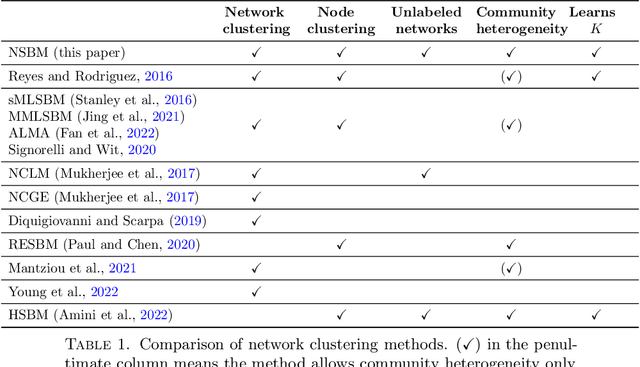
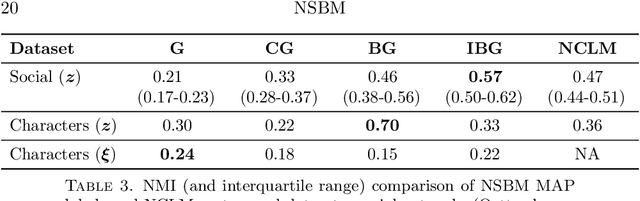
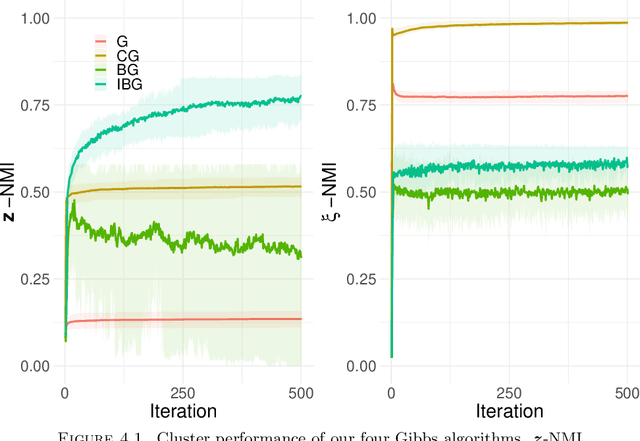
We introduce the nested stochastic block model (NSBM) to cluster a collection of networks while simultaneously detecting communities within each network. NSBM has several appealing features including the ability to work on unlabeled networks with potentially different node sets, the flexibility to model heterogeneous communities, and the means to automatically select the number of classes for the networks and the number of communities within each network. This is accomplished via a Bayesian model, with a novel application of the nested Dirichlet process (NDP) as a prior to jointly model the between-network and within-network clusters. The dependency introduced by the network data creates nontrivial challenges for the NDP, especially in the development of efficient samplers. For posterior inference, we propose several Markov chain Monte Carlo algorithms including a standard Gibbs sampler, a collapsed Gibbs sampler, and two blocked Gibbs samplers that ultimately return two levels of clustering labels from both within and across the networks. Extensive simulation studies are carried out which demonstrate that the model provides very accurate estimates of both levels of the clustering structure. We also apply our model to two social network datasets that cannot be analyzed using any previous method in the literature due to the anonymity of the nodes and the varying number of nodes in each network.