 Add to Chrome
 Add to Firefox
 Add to Edge
GRACE: Generative Recommender Acceleration Engine for Real-Time Ads Retrieval
Aug 02, 2026
Productionizing generative recommenders for high-volume, real-time ads retrieval creates two serving challenges: eligibility, ensuring that each generated ad is eligible for the request under the advertiser's audience targeting rules, and compute, which requires meeting strict latency and GPU cost requirements while remaining capable of generating thousands of ads per request with wide-beam decoding. This paper presents GRACE, a serving system for ads generative retrieval that addresses both challenges. For eligibility, GRACE introduces Generative Target Matching (GTM), which extends catalog-valid constrained decoding with personalized filtering over Semantic ID (SID) prefixes using bitmask and Bloom filter matchers derived from targeting rules. SID-level GTM improves final ad-level target matching pass rate from 23.55% to 40.42% over constrained decoding alone. For compute-cost and latency, GRACE targets encoder-decoder Transformers, which are more lightweight than LLMs. It redesigns the decoder around the wide-beam, short-sequence regime, covering attention kernels, KV cache, and beam search optimizations. On NVIDIA GH200, compared with the faster of FlashAttention-2 and FlashAttention-3 baselines, GRACE improves cross-attention latency by 68.0 times and self-attention latency by 23.4-25.8 times across decode steps. Together, these changes reduce decoder latency by 11.1 times, keeping ads generative retrieval within latency and compute requirements.

A Theory on Flow Matching with Neural Networks
Jun 08, 2026In this work, we develop theoretical foundation for flow matching with neural-network-parameterized conditional velocity fields. We establish convergence guarantees for gradient descent in the over-parameterized 2-layered ReLU neural network regime. We derive generalization bounds for the conditional velocity-field matching objective. Building on these results, we provide Wasserstein-distance guarantees for the samples generated by the induced flow. Our analysis is based on generalization bound for multi-task representation learning with unbounded losses, which may be of independent interest beyond flow-based generative modeling. These theoretical results are validated through extensive experiments on both synthetic and real-world image benchmarks.
KernelEvolve: Scaling Agentic Kernel Coding for Heterogeneous AI Accelerators at Meta
Dec 30, 2025Making deep learning recommendation model (DLRM) training and inference fast and efficient is important. However, this presents three key system challenges - model architecture diversity, kernel primitive diversity, and hardware generation and architecture heterogeneity. This paper presents KernelEvolve-an agentic kernel coding framework-to tackle heterogeneity at-scale for DLRM. KernelEvolve is designed to take kernel specifications as input and automate the process of kernel generation and optimization for recommendation model across heterogeneous hardware architectures. KernelEvolve does so by operating at multiple programming abstractions, from Triton and CuTe DSL to low-level hardware agnostic languages, spanning the full hardware-software optimization stack. The kernel optimization process is described as graph-based search with selection policy, universal operator, fitness function, and termination rule, dynamically adapts to runtime execution context through retrieval-augmented prompt synthesis. We designed, implemented, and deployed KernelEvolve to optimize a wide variety of production recommendation models across generations of NVIDIA and AMD GPUs, as well as Meta's AI accelerators. We validate KernelEvolve on the publicly-available KernelBench suite, achieving 100% pass rate on all 250 problems across three difficulty levels, and 160 PyTorch ATen operators across three heterogeneous hardware platforms, demonstrating 100% correctness. KernelEvolve reduces development time from weeks to hours and achieves substantial performance improvements over PyTorch baselines across diverse production use cases and for heterogeneous AI systems at-scale. Beyond performance efficiency improvements, KernelEvolve significantly mitigates the programmability barrier for new AI hardware by enabling automated kernel generation for in-house developed AI hardware.
A Novel P-bit-based Probabilistic Computing Approach for Solving the 3-D Protein Folding Problem
Feb 27, 2025In the post-Moore era, the need for efficient solutions to non-deterministic polynomial-time (NP) problems is becoming more pressing. In this context, the Ising model implemented by the probabilistic computing systems with probabilistic bits (p-bits) has attracted attention due to the widespread availability of p-bits and support for large-scale simulations. This study marks the first work to apply probabilistic computing to tackle protein folding, a significant NP-complete problem challenge in biology. We represent proteins as sequences of hydrophobic (H) and polar (P) beads within a three-dimensional (3-D) grid and introduce a novel many-body interaction-based encoding method to map the problem onto an Ising model. Our simulations show that this approach significantly simplifies the energy landscape for short peptide sequences of six amino acids, halving the number of energy levels. Furthermore, the proposed mapping method achieves approximately 100 times acceleration for sequences consisting of ten amino acids in identifying the correct folding configuration. We predicted the optimal folding configuration for a peptide sequence of 36 amino acids by identifying the ground state. These findings highlight the unique potential of the proposed encoding method for solving protein folding and, importantly, provide new tools for solving similar NP-complete problems in biology by probabilistic computing approach.
Transformers versus the EM Algorithm in Multi-class Clustering
Feb 09, 2025LLMs demonstrate significant inference capacities in complicated machine learning tasks, using the Transformer model as its backbone. Motivated by the limited understanding of such models on the unsupervised learning problems, we study the learning guarantees of Transformers in performing multi-class clustering of the Gaussian Mixture Models. We develop a theory drawing strong connections between the Softmax Attention layers and the workflow of the EM algorithm on clustering the mixture of Gaussians. Our theory provides approximation bounds for the Expectation and Maximization steps by proving the universal approximation abilities of multivariate mappings by Softmax functions. In addition to the approximation guarantees, we also show that with a sufficient number of pre-training samples and an initialization, Transformers can achieve the minimax optimal rate for the problem considered. Our extensive simulations empirically verified our theory by revealing the strong learning capacities of Transformers even beyond the assumptions in the theory, shedding light on the powerful inference capacities of LLMs.
Transformers and Their Roles as Time Series Foundation Models
Feb 05, 2025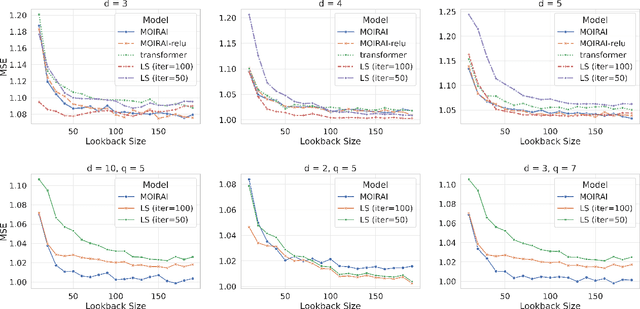
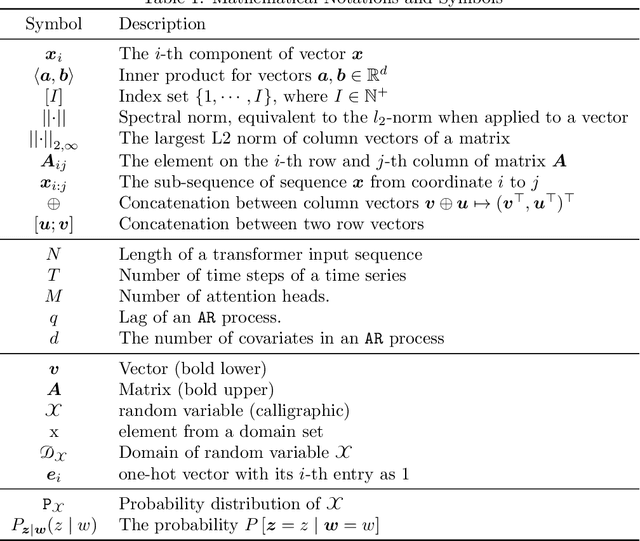

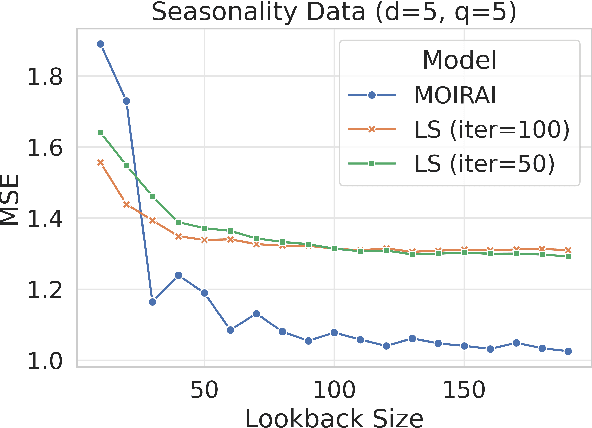
We give a comprehensive analysis of transformers as time series foundation models, focusing on their approximation and generalization capabilities. First, we demonstrate that there exist transformers that fit an autoregressive model on input univariate time series via gradient descent. We then analyze MOIRAI, a multivariate time series foundation model capable of handling an arbitrary number of covariates. We prove that it is capable of automatically fitting autoregressive models with an arbitrary number of covariates, offering insights into its design and empirical success. For generalization, we establish bounds for pretraining when the data satisfies Dobrushin's condition. Experiments support our theoretical findings, highlighting the efficacy of transformers as time series foundation models.
Transformers Simulate MLE for Sequence Generation in Bayesian Networks
Jan 05, 2025

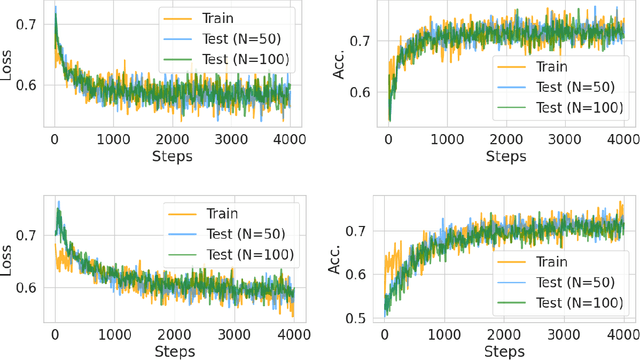
Transformers have achieved significant success in various fields, notably excelling in tasks involving sequential data like natural language processing. Despite these achievements, the theoretical understanding of transformers' capabilities remains limited. In this paper, we investigate the theoretical capabilities of transformers to autoregressively generate sequences in Bayesian networks based on in-context maximum likelihood estimation (MLE). Specifically, we consider a setting where a context is formed by a set of independent sequences generated according to a Bayesian network. We demonstrate that there exists a simple transformer model that can (i) estimate the conditional probabilities of the Bayesian network according to the context, and (ii) autoregressively generate a new sample according to the Bayesian network with estimated conditional probabilities. We further demonstrate in extensive experiments that such a transformer does not only exist in theory, but can also be effectively obtained through training. Our analysis highlights the potential of transformers to learn complex probabilistic models and contributes to a better understanding of large language models as a powerful class of sequence generators.
Learning Spectral Methods by Transformers
Jan 05, 2025


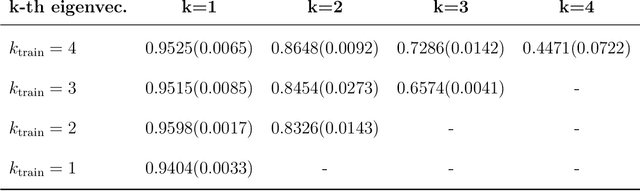
Transformers demonstrate significant advantages as the building block of modern LLMs. In this work, we study the capacities of Transformers in performing unsupervised learning. We show that multi-layered Transformers, given a sufficiently large set of pre-training instances, are able to learn the algorithms themselves and perform statistical estimation tasks given new instances. This learning paradigm is distinct from the in-context learning setup and is similar to the learning procedure of human brains where skills are learned through past experience. Theoretically, we prove that pre-trained Transformers can learn the spectral methods and use the classification of bi-class Gaussian mixture model as an example. Our proof is constructive using algorithmic design techniques. Our results are built upon the similarities of multi-layered Transformer architecture with the iterative recovery algorithms used in practice. Empirically, we verify the strong capacity of the multi-layered (pre-trained) Transformer on unsupervised learning through the lens of both the PCA and the Clustering tasks performed on the synthetic and real-world datasets.
One-Layer Transformer Provably Learns One-Nearest Neighbor In Context
Nov 16, 2024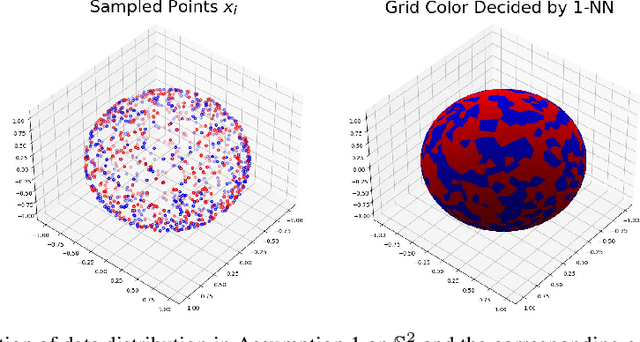
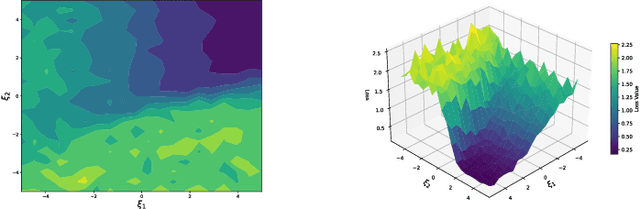
Transformers have achieved great success in recent years. Interestingly, transformers have shown particularly strong in-context learning capability -- even without fine-tuning, they are still able to solve unseen tasks well purely based on task-specific prompts. In this paper, we study the capability of one-layer transformers in learning one of the most classical nonparametric estimators, the one-nearest neighbor prediction rule. Under a theoretical framework where the prompt contains a sequence of labeled training data and unlabeled test data, we show that, although the loss function is nonconvex when trained with gradient descent, a single softmax attention layer can successfully learn to behave like a one-nearest neighbor classifier. Our result gives a concrete example of how transformers can be trained to implement nonparametric machine learning algorithms, and sheds light on the role of softmax attention in transformer models.
Global Convergence in Training Large-Scale Transformers
Oct 31, 2024

Despite the widespread success of Transformers across various domains, their optimization guarantees in large-scale model settings are not well-understood. This paper rigorously analyzes the convergence properties of gradient flow in training Transformers with weight decay regularization. First, we construct the mean-field limit of large-scale Transformers, showing that as the model width and depth go to infinity, gradient flow converges to the Wasserstein gradient flow, which is represented by a partial differential equation. Then, we demonstrate that the gradient flow reaches a global minimum consistent with the PDE solution when the weight decay regularization parameter is sufficiently small. Our analysis is based on a series of novel mean-field techniques that adapt to Transformers. Compared with existing tools for deep networks (Lu et al., 2020) that demand homogeneity and global Lipschitz smoothness, we utilize a refined analysis assuming only $\textit{partial homogeneity}$ and $\textit{local Lipschitz smoothness}$. These new techniques may be of independent interest.