 Add to Chrome
 Add to Firefox
 Add to Edge
nuTruck: Benchmarking Autonomous Driving Planning for Distributed Electric-drive Trucks
Jul 15, 2026
The dominance of traditional rule-based methods in autonomous driving has gradually been replaced by learning-based approaches. While learning-based planners have achieved considerable success in passenger vehicles, their performance on heavy-duty trucks, particularly modern distributed electric-drive trucks (DETs), remains largely unexplored. To facilitate research and application of learning-based planners in DETs, this letter presents the first high-fidelity benchmark, called nuTruck, designed to support large-scale neural network training and closed-loop evaluation. Given the complex dynamics and high rollover susceptibility of DETs, we first incorporate a highly accurate nonlinear truck dynamical model into the simulation, which enables independent driving and steering of all wheels and captures dynamic load transfer caused by acceleration, deceleration, and cornering, thereby allowing quantitative assessment of rollover risk in closed-loop simulation. Second, we adapt several rule-based and learning-based planners as baselines for DETs and evaluate their performance in closed-loop simulation. Finally, using real-world driving scenarios from the nuPlan dataset, we conduct extensive closed-loop evaluations, analyzing not only conventional collision-free planning performance, but also the dynamical safety of the planned trajectories. The proposed nuTruck benchmark is expected to serve as a new standard for fair and realistic evaluation of autonomous driving planners on DETs.

Dual-Flow Reinforcement Learning with State-Aware Exploration
Jun 29, 2026In complex continuous-control reinforcement learning tasks, multimodal optimal actions often coincide with uncertain, multimodal return distributions, making reliable value estimation and multimodal exploration challenging. Existing value estimation methods using unimodal Gaussians restrict expressiveness and yield biased estimates. Recent generative policies can represent multimodal actions but often collapse to a few modes and under-explore high-value areas of the action space. Motivated by these challenges, we propose Dual-Flow RL, a unified actor-critic framework that jointly models a continuous return distribution and a multimodal policy distribution using conditional flow matching (CFM). This design supports reliable value estimation and sustained multimodal exploration. To further enhance exploration, we introduce an Entropy-Covariance Exploration Regulator (ECER) that enables state-aware exploration regulation leveraging policy entropy and action-uncertainty covariance. Experiments on DeepMind Control Suite and Humanoid-Bench show that Dual-Flow RL achieves state-of-the-art performance on most tasks, significantly outperforming prior diffusion-based and flow-based methods.
Envision4D: Envisioning Visual Futures via Feed-forward 4D Gaussian Splatting for Autonomous Driving
Jun 09, 2026Forecasting the future evolution of dynamic scenes is crucial in autonomous driving. However, existing feed-forward paradigms are primarily designed for interpolation. When extended to future extrapolation, they suffer from ghosting artifacts under large displacements and are constrained by simplified motion assumptions or strict future priors. To overcome these challenges, we propose Envision4D, a fully self-supervised feed-forward framework for pose-free future extrapolation. Specifically, we introduce a Future Pose Prediction module that infers future camera parameters via an iterative denoising process. Furthermore, to capture non-linear dynamics, we propose In-layer Temporal Attention and employ Conditioned Motion Lifting, which transforms the highly uncertain extrapolation process into robust relational mappings. Finally, a Progressive Training Strategy is utilized to stabilize unsupervised motion learning against error accumulation. Extensive experiments demonstrate that Envision4D achieves state-of-the-art performance, significantly outperforming existing methods in future view synthesis.
PRO-CUA: Process-Reward Optimization for Computer Use Agents
May 27, 2026Computer use agents (CUAs) have shown strong potential for automating complex digital workflows, yet their training remains constrained by costly live environment interaction and limited high-quality supervision. Existing filtered behavior cloning pipelines suffer from imitation bottlenecks, including distribution shift from the expert demonstration and the absence of negative learning signals. Meanwhile, standard trajectory-level reinforcement learning struggles with sparse rewards, ambiguous credit assignment, and high infrastructure costs for long-horizon GUI interaction. In this work, we propose PRO-CUA, a process-reward optimization framework for training CUAs with iterative step-level reinforcement learning. PRO-CUA decouples on-policy environment interaction from policy optimization: the current policy collects states through live rollouts, generates diverse candidate actions for each state, receives step-level feedback from a process reward model (PRM), and is optimized with group-relative advantages. This design enables dense and flexible credit assignment without relying on golden answers or offline expert trajectories, while reducing distribution shift by training on the agent's own execution states. Experiments on live web benchmarks demonstrate the effectiveness of PRO-CUA and the reliability of PRM-guided step-level training.
Physics-informed Deep Mixture-of-Koopmans Vehicle Dynamics Model with Dual-branch Encoder for Distributed Electric-drive Trucks
Mar 18, 2026Advanced autonomous driving systems require accurate vehicle dynamics modeling. However, identifying a precise dynamics model remains challenging due to strong nonlinearities and the coupled longitudinal and lateral dynamic characteristics. Previous research has employed physics-based analytical models or neural networks to construct vehicle dynamics representations. Nevertheless, these approaches often struggle to simultaneously achieve satisfactory performance in terms of system identification efficiency, modeling accuracy, and compatibility with linear control strategies. In this paper, we propose a fully data-driven dynamics modeling method tailored for complex distributed electric-drive trucks (DETs), leveraging Koopman operator theory to represent highly nonlinear dynamics in a lifted linear embedding space. To achieve high-precision modeling, we first propose a novel dual-branch encoder which encodes dynamic states and provides a powerful basis for the proposed Koopman-based methods entitled KODE. A physics-informed supervision mechanism, grounded in the geometric consistency of temporal vehicle motion, is incorporated into the training process to facilitate effective learning of both the encoder and the Koopman operator. Furthermore, to accommodate the diverse driving patterns of DETs, we extend the vanilla Koopman operator to a mixture-of-Koopman operator framework, enhancing modeling capability. Simulations conducted in a high-fidelity TruckSim environment and real-world experiments demonstrate that the proposed approach achieves state-of-the-art performance in long-term dynamics state estimation.
MergeBench: A Benchmark for Merging Domain-Specialized LLMs
May 16, 2025Model merging provides a scalable alternative to multi-task training by combining specialized finetuned models through parameter arithmetic, enabling efficient deployment without the need for joint training or access to all task data. While recent methods have shown promise, existing evaluations are limited in both model scale and task diversity, leaving open questions about their applicability to large, domain-specialized LLMs. To tackle the challenges, we introduce MergeBench, a comprehensive evaluation suite designed to assess model merging at scale. MergeBench builds on state-of-the-art open-source language models, including Llama and Gemma families at 2B to 9B scales, and covers five key domains: instruction following, mathematics, multilingual understanding, coding and safety. We standardize finetuning and evaluation protocols, and assess eight representative merging methods across multi-task performance, forgetting and runtime efficiency. Based on extensive experiments, we provide practical guidelines for algorithm selection and share insights showing that model merging tends to perform better on stronger base models, with techniques such as merging coefficient tuning and sparsification improving knowledge retention. However, several challenges remain, including the computational cost on large models, the gap for in-domain performance compared to multi-task models, and the underexplored role of model merging in standard LLM training pipelines. We hope MergeBench provides a foundation for future research to advance the understanding and practical application of model merging. We open source our code at \href{https://github.com/uiuctml/MergeBench}{https://github.com/uiuctml/MergeBench}.
Optimizing FDTD Solvers for Electromagnetics: A Compiler-Guided Approach with High-Level Tensor Abstractions
Apr 12, 2025The Finite Difference Time Domain (FDTD) method is a widely used numerical technique for solving Maxwell's equations, particularly in computational electromagnetics and photonics. It enables accurate modeling of wave propagation in complex media and structures but comes with significant computational challenges. Traditional FDTD implementations rely on handwritten, platform-specific code that optimizes certain kernels while underperforming in others. The lack of portability increases development overhead and creates performance bottlenecks, limiting scalability across modern hardware architectures. To address these challenges, we introduce an end-to-end domain-specific compiler based on the MLIR/LLVM infrastructure for FDTD simulations. Our approach generates efficient and portable code optimized for diverse hardware platforms.We implement the three-dimensional FDTD kernel as operations on a 3D tensor abstraction with explicit computational semantics. High-level optimizations such as loop tiling, fusion, and vectorization are automatically applied by the compiler. We evaluate our customized code generation pipeline on Intel, AMD, and ARM platforms, achieving up to $10\times$ speedup over baseline Python implementation using NumPy.
Efficient Model Editing with Task Vector Bases: A Theoretical Framework and Scalable Approach
Feb 03, 2025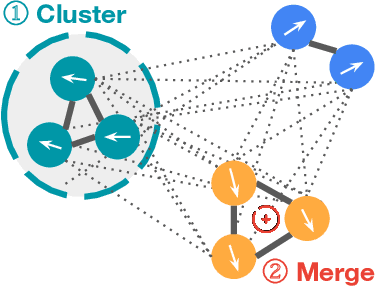
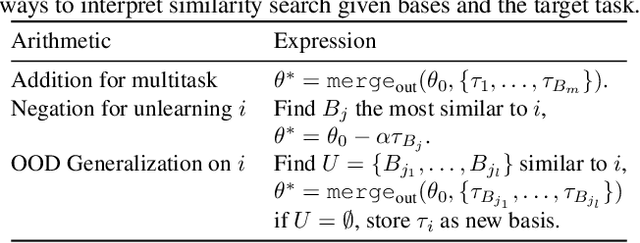
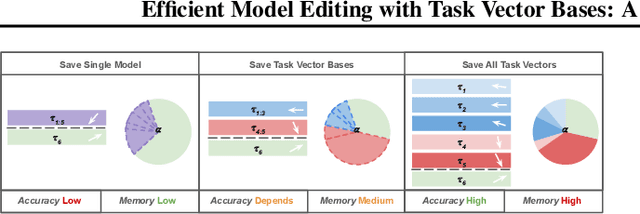
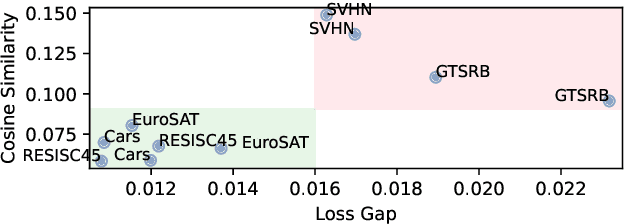
Task vectors, which are derived from the difference between pre-trained and fine-tuned model weights, enable flexible task adaptation and model merging through arithmetic operations such as addition and negation. However, existing approaches often rely on heuristics with limited theoretical support, often leading to performance gaps comparing to direct task fine tuning. Meanwhile, although it is easy to manipulate saved task vectors with arithmetic for different purposes, such compositional flexibility demands high memory usage, especially when dealing with a huge number of tasks, limiting scalability. This work addresses these issues with a theoretically grounded framework that explains task vector arithmetic and introduces the task vector bases framework. Building upon existing task arithmetic literature, our method significantly reduces the memory cost for downstream arithmetic with little effort, while achieving competitive performance and maintaining compositional advantage, providing a practical solution for large-scale task arithmetic.
MICCAI-CDMRI 2023 QuantConn Challenge Findings on Achieving Robust Quantitative Connectivity through Harmonized Preprocessing of Diffusion MRI
Nov 14, 2024
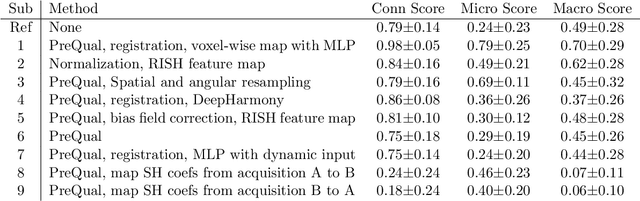
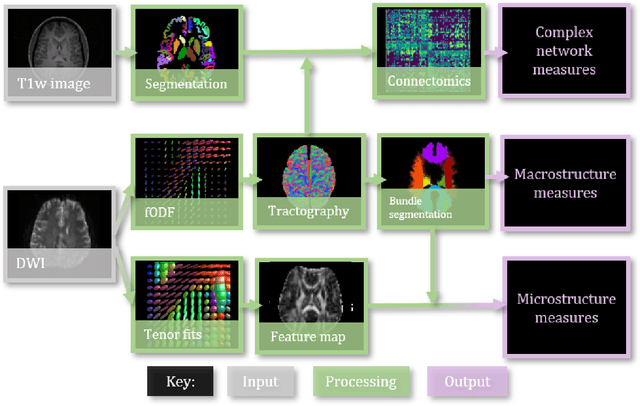

White matter alterations are increasingly implicated in neurological diseases and their progression. International-scale studies use diffusion-weighted magnetic resonance imaging (DW-MRI) to qualitatively identify changes in white matter microstructure and connectivity. Yet, quantitative analysis of DW-MRI data is hindered by inconsistencies stemming from varying acquisition protocols. There is a pressing need to harmonize the preprocessing of DW-MRI datasets to ensure the derivation of robust quantitative diffusion metrics across acquisitions. In the MICCAI-CDMRI 2023 QuantConn challenge, participants were provided raw data from the same individuals collected on the same scanner but with two different acquisitions and tasked with preprocessing the DW-MRI to minimize acquisition differences while retaining biological variation. Submissions are evaluated on the reproducibility and comparability of cross-acquisition bundle-wise microstructure measures, bundle shape features, and connectomics. The key innovations of the QuantConn challenge are that (1) we assess bundles and tractography in the context of harmonization for the first time, (2) we assess connectomics in the context of harmonization for the first time, and (3) we have 10x additional subjects over prior harmonization challenge, MUSHAC and 100x over SuperMUDI. We find that bundle surface area, fractional anisotropy, connectome assortativity, betweenness centrality, edge count, modularity, nodal strength, and participation coefficient measures are most biased by acquisition and that machine learning voxel-wise correction, RISH mapping, and NeSH methods effectively reduce these biases. In addition, microstructure measures AD, MD, RD, bundle length, connectome density, efficiency, and path length are least biased by these acquisition differences.
* Accepted for publication at the Journal of Machine Learning for Biomedical Imaging (MELBA) https://melba-journal.org/2024/019
Towards Understanding the Fragility of Multilingual LLMs against Fine-Tuning Attacks
Oct 23, 2024Recent advancements in Large Language Models (LLMs) have sparked widespread concerns about their safety. Recent work demonstrates that safety alignment of LLMs can be easily removed by fine-tuning with a few adversarially chosen instruction-following examples, i.e., fine-tuning attacks. We take a further step to understand fine-tuning attacks in multilingual LLMs. We first discover cross-lingual generalization of fine-tuning attacks: using a few adversarially chosen instruction-following examples in one language, multilingual LLMs can also be easily compromised (e.g., multilingual LLMs fail to refuse harmful prompts in other languages). Motivated by this finding, we hypothesize that safety-related information is language-agnostic and propose a new method termed Safety Information Localization (SIL) to identify the safety-related information in the model parameter space. Through SIL, we validate this hypothesis and find that only changing 20% of weight parameters in fine-tuning attacks can break safety alignment across all languages. Furthermore, we provide evidence to the alternative pathways hypothesis for why freezing safety-related parameters does not prevent fine-tuning attacks, and we demonstrate that our attack vector can still jailbreak LLMs adapted to new languages.