 Add to Chrome
 Add to Firefox
 Add to Edge
Harmonization mitigates diffusion MRI scanner effects in infancy: insights from the HEALthy Brain and Childhood Development (HBCD) study
Mar 31, 2026
The HEALthy Brain and Childhood Development (HBCD) Study is an ongoing longitudinal initiative to understand population-level brain maturation; however, large-scale studies must overcome site-related variance and preserve biologically relevant signal. In addition to diffusion-weighted magnetic resonance imaging images, the HBCD dataset offers analysis-ready derivatives for scientists to conduct their analysis, including scalar diffusion tensor (DTI) metrics in a predetermined set of bundles. The purpose of this study is to characterize HBCD-specific site effects in diffusion MRI data, which have not been systematically reported. In this work, we investigate the sensitivity of HBCD bundle metrics to scanner model-related variance and address these variations with ComBat-GAM harmonization within the current HBCD data release 1.1 across six scanner models. Following ComBat-GAM, we observe zero statistically significant differences between the distributions from any scanner model following FDR correction and reduce Cohen's f effect sizes across all metrics. Our work underscores the importance of rigorous harmonization efforts in large-scale studies, and we encourage future investigations of HBCD data to control for these effects.

Generalization and Memorization in Rectified Flow
Mar 12, 2026Generative models based on the Flow Matching objective, particularly Rectified Flow, have emerged as a dominant paradigm for efficient, high-fidelity image synthesis. However, while existing research heavily prioritizes generation quality and architectural scaling, the underlying dynamics of how RF models memorize training data remain largely underexplored. In this paper, we systematically investigate the memorization behaviors of RF through the test statistics of Membership Inference Attacks (MIA). We progressively formulate three test statistics, culminating in a complexity-calibrated metric ($T_\text{mc\_cal}$) that successfully decouples intrinsic image spatial complexity from genuine memorization signals. This calibration yields a significant performance surge -- boosting attack AUC by up to 15\% and the privacy-critical TPR@1\%FPR metric by up to 45\% -- establishing the first non-trivial MIA specifically tailored for RF. Leveraging these refined metrics, we uncover a distinct temporal pattern: under standard uniform temporal training, a model's susceptibility to MIA strictly peaks at the integration midpoint, a phenomenon we justify via the network's forced deviation from linear approximations. Finally, we demonstrate that substituting uniform timestep sampling with a Symmetric Exponential (U-shaped) distribution effectively minimizes exposure to vulnerable intermediate timesteps. Extensive evaluations across three datasets confirm that this temporal regularization suppresses memorization while preserving generative fidelity.
Personalized White Matter Bundle Segmentation for Early Childhood
Feb 04, 2026White matter segmentation methods from diffusion magnetic resonance imaging range from streamline clustering-based approaches to bundle mask delineation, but none have proposed a pediatric-specific approach. We hypothesize that a deep learning model with a similar approach to TractSeg will improve similarity between an algorithm-generated mask and an expert-labeled ground truth. Given a cohort of 56 manually labelled white matter bundles, we take inspiration from TractSeg's 2D UNet architecture, and we modify inputs to match bundle definitions as determined by pediatric experts, evaluation to use k fold cross validation, the loss function to masked Dice loss. We evaluate Dice score, volume overlap, and volume overreach of 16 major regions of interest compared to the expert labeled dataset. To test whether our approach offers statistically significant improvements over TractSeg, we compare Dice voxels, volume overlap, and adjacency voxels with a Wilcoxon signed rank test followed by false discovery rate correction. We find statistical significance across all bundles for all metrics with one exception in volume overlap. After we run TractSeg and our model, we combine their output masks into a 60 label atlas to evaluate if TractSeg and our model combined can generate a robust, individualized atlas, and observe smoothed, continuous masks in cases that TractSeg did not produce an anatomically plausible output. With the improvement of white matter pathway segmentation masks, we can further understand neurodevelopment on a population level scale, and we can produce reliable estimates of individualized anatomy in pediatric white matter diseases and disorders.
IntraStyler: Exemplar-based Style Synthesis for Cross-modality Domain Adaptation
Jan 01, 2026Image-level domain alignment is the de facto approach for unsupervised domain adaptation, where unpaired image translation is used to minimize the domain gap. Prior studies mainly focus on the domain shift between the source and target domains, whereas the intra-domain variability remains under-explored. To address the latter, an effective strategy is to diversify the styles of the synthetic target domain data during image translation. However, previous methods typically require intra-domain variations to be pre-specified for style synthesis, which may be impractical. In this paper, we propose an exemplar-based style synthesis method named IntraStyler, which can capture diverse intra-domain styles without any prior knowledge. Specifically, IntraStyler uses an exemplar image to guide the style synthesis such that the output style matches the exemplar style. To extract the style-only features, we introduce a style encoder to learn styles discriminatively based on contrastive learning. We evaluate the proposed method on the largest public dataset for cross-modality domain adaptation, CrossMoDA 2023. Our experiments show the efficacy of our method in controllable style synthesis and the benefits of diverse synthetic data for downstream segmentation. Code is available at https://github.com/han-liu/IntraStyler.
Fully Differentiable dMRI Streamline Propagation in PyTorch
Nov 17, 2025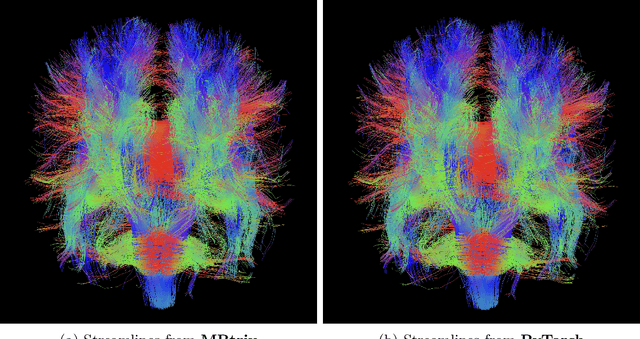

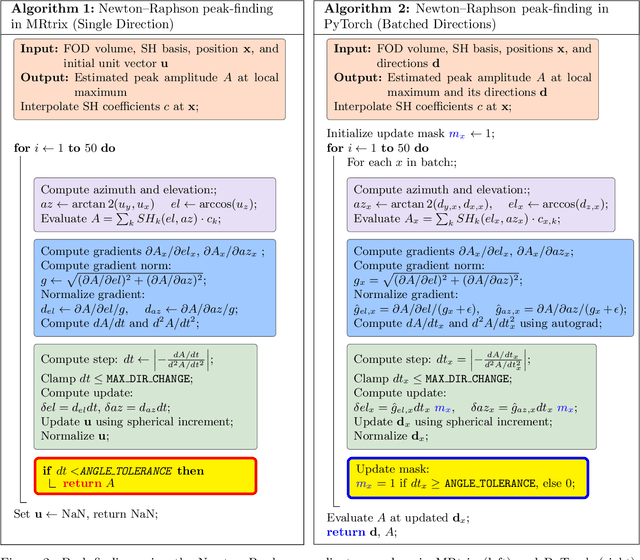
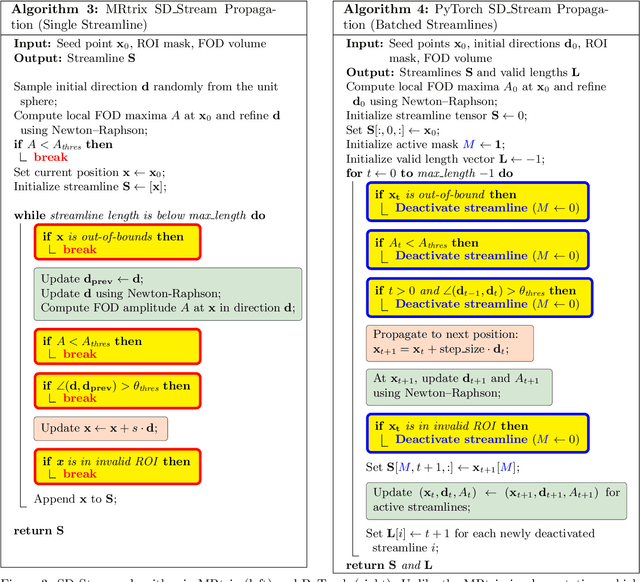
Diffusion MRI (dMRI) provides a distinctive means to probe the microstructural architecture of living tissue, facilitating applications such as brain connectivity analysis, modeling across multiple conditions, and the estimation of macrostructural features. Tractography, which emerged in the final years of the 20th century and accelerated in the early 21st century, is a technique for visualizing white matter pathways in the brain using dMRI. Most diffusion tractography methods rely on procedural streamline propagators or global energy minimization methods. Although recent advancements in deep learning have enabled tasks that were previously challenging, existing tractography approaches are often non-differentiable, limiting their integration in end-to-end learning frameworks. While progress has been made in representing streamlines in differentiable frameworks, no existing method offers fully differentiable propagation. In this work, we propose a fully differentiable solution that retains numerical fidelity with a leading streamline algorithm. The key is that our PyTorch-engineered streamline propagator has no components that block gradient flow, making it fully differentiable. We show that our method matches standard propagators while remaining differentiable. By translating streamline propagation into a differentiable PyTorch framework, we enable deeper integration of tractography into deep learning workflows, laying the foundation for a new category of macrostructural reasoning that is not only computationally robust but also scientifically rigorous.
Pedicle Screw Pairing and Registration for Screw Pose Estimation from Dual C-arm Images Using CAD Models
Nov 07, 2025Accurate matching of pedicle screws in both anteroposterior (AP) and lateral (LAT) images is critical for successful spinal decompression and stabilization during surgery. However, establishing screw correspondence, especially in LAT views, remains a significant clinical challenge. This paper introduces a method to address pedicle screw correspondence and pose estimation from dual C-arm images. By comparing screw combinations, the approach demonstrates consistent accuracy in both pairing and registration tasks. The method also employs 2D-3D alignment with screw CAD 3D models to accurately pair and estimate screw pose from dual views. Our results show that the correct screw combination consistently outperforms incorrect pairings across all test cases, even prior to registration. After registration, the correct combination further enhances alignment between projections and images, significantly reducing projection error. This approach shows promise for improving surgical outcomes in spinal procedures by providing reliable feedback on screw positioning.
Better Pose Initialization for Fast and Robust 2D/3D Pelvis Registration
Mar 10, 2025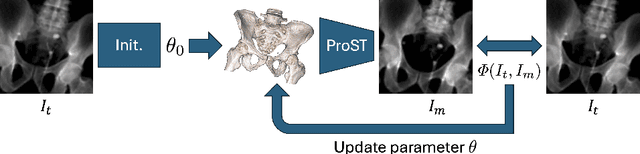
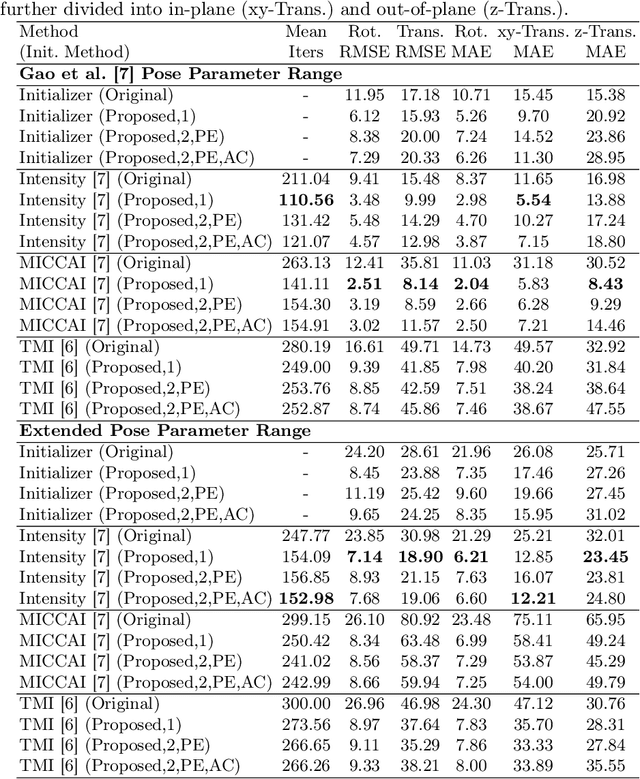
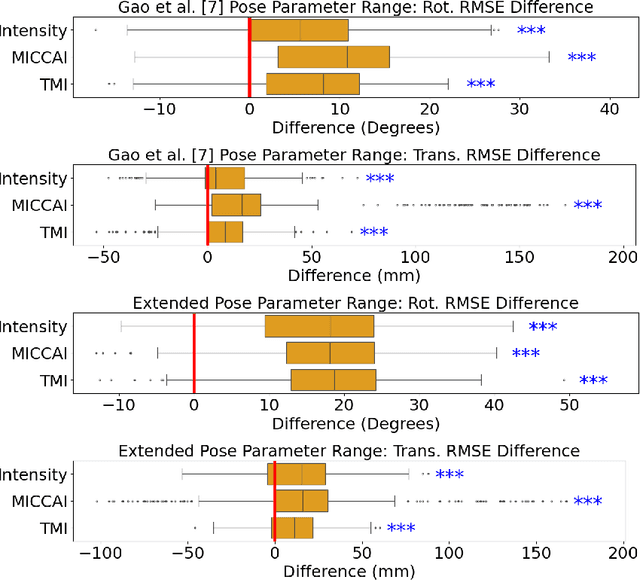
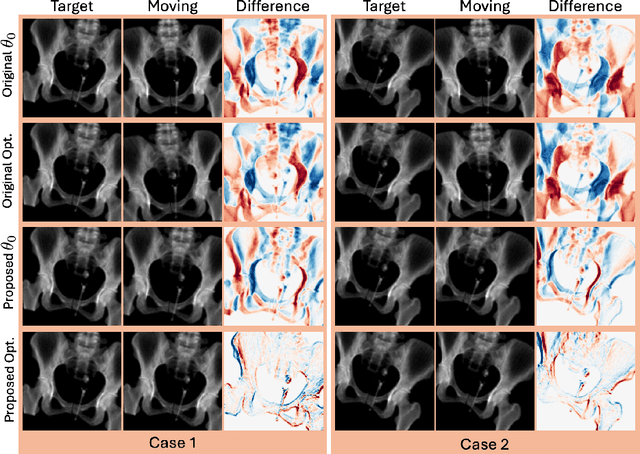
This paper presents an approach for improving 2D/3D pelvis registration in optimization-based pose estimators using a learned initialization function. Current methods often fail to converge to the optimal solution when initialized naively. We find that even a coarse initializer greatly improves pose estimator accuracy, and improves overall computational efficiency. This approach proves to be effective also in challenging cases under more extreme pose variation. Experimental validation demonstrates that our method consistently achieves robust and accurate registration, enhancing the reliability of 2D/3D registration for clinical applications.
2D/3D Registration of Acetabular Hip Implants Under Perspective Projection and Fully Differentiable Ellipse Fitting
Mar 10, 2025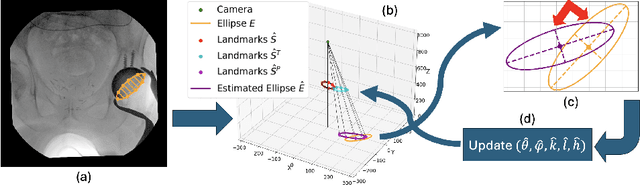
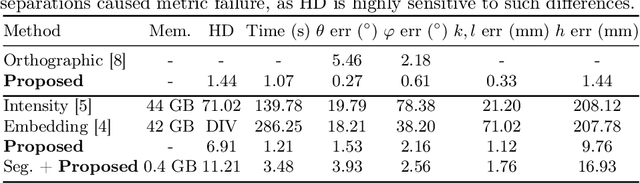
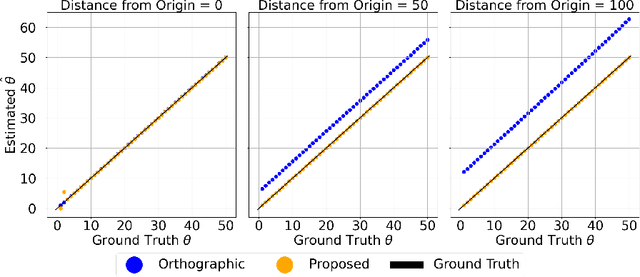
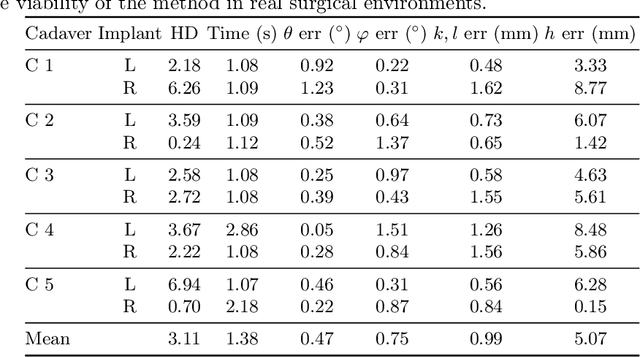
This paper presents a novel method for estimating the orientation and the position of acetabular hip implants in total hip arthroplasty using full anterior-posterior hip fluoroscopy images. Our method accounts for distortions induced in the fluoroscope geometry, estimating acetabular component pose by creating a forward model of the perspective projection and implementing differentiable ellipse fitting for the similarity of our estimation from the ground truth. This approach enables precise estimation of the implant's rotation (anteversion, inclination) and the translation under the fluoroscope induced deformation. Experimental results from both numerically simulated and digitally reconstructed radiograph environments demonstrate high accuracy with minimal computational demands, offering enhanced precision and applicability in clinical and surgical settings.
Scale-up Unlearnable Examples Learning with High-Performance Computing
Jan 10, 2025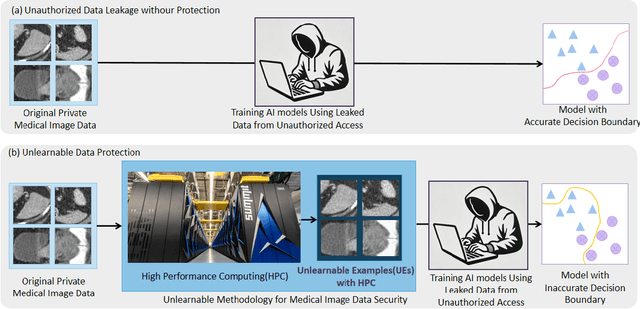
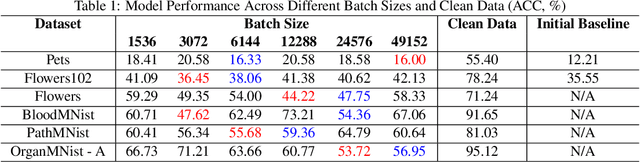

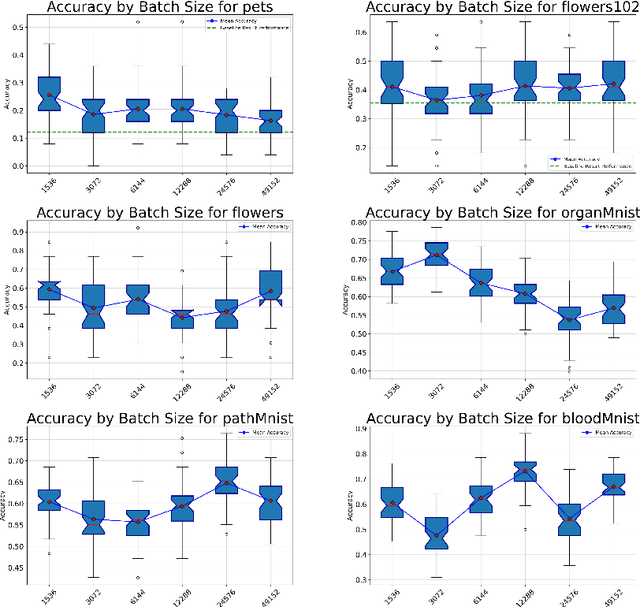
Recent advancements in AI models are structured to retain user interactions, which could inadvertently include sensitive healthcare data. In the healthcare field, particularly when radiologists use AI-driven diagnostic tools hosted on online platforms, there is a risk that medical imaging data may be repurposed for future AI training without explicit consent, spotlighting critical privacy and intellectual property concerns around healthcare data usage. Addressing these privacy challenges, a novel approach known as Unlearnable Examples (UEs) has been introduced, aiming to make data unlearnable to deep learning models. A prominent method within this area, called Unlearnable Clustering (UC), has shown improved UE performance with larger batch sizes but was previously limited by computational resources. To push the boundaries of UE performance with theoretically unlimited resources, we scaled up UC learning across various datasets using Distributed Data Parallel (DDP) training on the Summit supercomputer. Our goal was to examine UE efficacy at high-performance computing (HPC) levels to prevent unauthorized learning and enhance data security, particularly exploring the impact of batch size on UE's unlearnability. Utilizing the robust computational capabilities of the Summit, extensive experiments were conducted on diverse datasets such as Pets, MedMNist, Flowers, and Flowers102. Our findings reveal that both overly large and overly small batch sizes can lead to performance instability and affect accuracy. However, the relationship between batch size and unlearnability varied across datasets, highlighting the necessity for tailored batch size strategies to achieve optimal data protection. Our results underscore the critical role of selecting appropriate batch sizes based on the specific characteristics of each dataset to prevent learning and ensure data security in deep learning applications.
Training Noise Token Pruning
Nov 27, 2024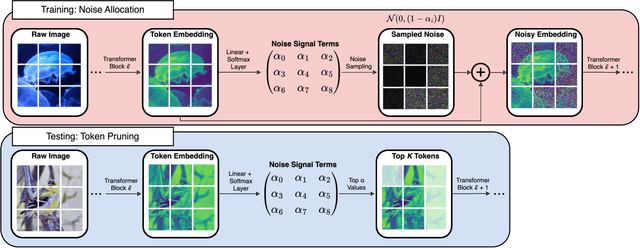

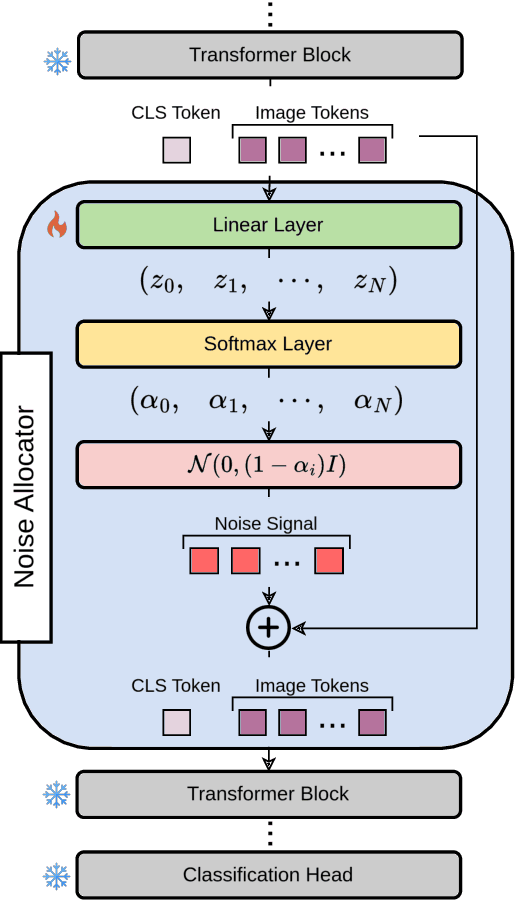
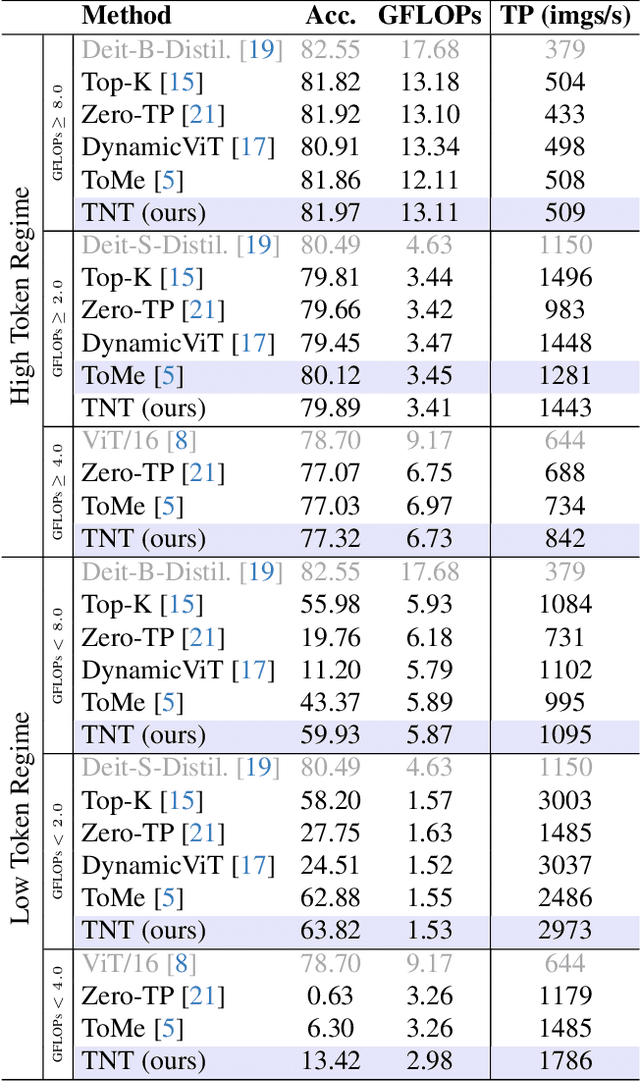
In the present work we present Training Noise Token (TNT) Pruning for vision transformers. Our method relaxes the discrete token dropping condition to continuous additive noise, providing smooth optimization in training, while retaining discrete dropping computational gains in deployment settings. We provide theoretical connections to Rate-Distortion literature, and empirical evaluations on the ImageNet dataset using ViT and DeiT architectures demonstrating TNT's advantages over previous pruning methods.