 Add to Chrome
 Add to Firefox
 Add to Edge
Energy-guided Recursive Model
Jul 11, 2026
Recursive reasoning models address structured problems by repeatedly updating latent states of small neural networks. However, their test-time scaling lacks a principled inference mechanism: increasing depth or stochastic breadth generates more trajectories without a clear criterion for selection, and existing methods predominantly rely on additional q-heads or heuristic voting. Here, we develop the Energy-guided Recursive Model (ERM), which introduces an intrinsic selection principle based on explicit Hopfield energies. ERM leverages Hopfield-type memories of valid local or global structures to define the selector over candidate trajectories. The resulting energy seamlessly integrates with energy-based techniques such as parallel tempering to enhance sampling efficiency and ranking. With $D=64$ recurrent steps and $K=128$ candidates, ERM reaches optimal solutions on Sudoku ($98.97\%$), Pencil Puzzle Bench (PPBench, $88.04\%$) and Maze ($99.30\%$), improving upon recent Probabilistic Tiny Recursive Model and Equilibrium Reasoners. These results suggest that incorporating explicit energy functions into recursive reasoning offers a principled path toward more effective inference.

Scalable Physics-Inspired Transformers for Spin Glasses
Jun 23, 2026Efficient sampling of the Boltzmann distribution in frustrated spin glasses is central to statistical mechanics and combinatorial optimization. Despite advances in machine-learning-based approaches, two issues persist: limited understanding of why variational models fail to benefit from increased scale, unlike the monotonic scaling law of large language models; and high computational cost on large systems that negates advantages over classical sampling methods. Here, we develop a physics-inspired transformer with interpretable sparse attention and spin-tailored positional embeddings to address these challenges. By further leveraging FlashAttention for parallel ancestral sampling, it achieves up to two orders of magnitude speedup over vanilla variational autoregressive networks, enabling neural-network simulations of spin-glass systems to unprecedented sizes on a single GPU. It can resolve full probability distributions, free energies, and overlap statistics across temperatures, for Sherrington-Kirkpatrick and 2D or 3D Edwards-Anderson models, where existing machine-learning methods encounter limitations at certain temperatures. This framework thus establishes a scalable paradigm for frustrated spin-glass systems.
Kolmogorov-Arnold Reservoir Computing
Jun 18, 2026Reservoir computing offers a lightweight framework for forecasting dynamical systems but may struggle to capture long-range dependencies due to limited representational capacity. Conventional reservoir computing recurrently uses trainable reservoirs with hyperparameter sensitivity, while the next-generation reservoir computing removes recurrence at the cost of rapidly growing feature dimensions. Here, we develop Kolmogorov-Arnold Reservoir Computing (KARC), which replaces reservoirs with explicit basis-function expansions inspired by the Kolmogorov-Arnold representation theorem. We rigorously show that KARC is a lightweight design of Kolmogorov-Arnold networks (KANs), preserving the potential expressive capacity of KANs while admitting efficient closed-form training of reservoir computing. At comparable cost, KARC outperforms existing reservoir computing methods on challenging benchmarks including partial differential equations. It can also be integrated with generative diffusion models for text-to-image generation. This work thus establishes a principled bridge between reservoir computing and KANs, enabling efficient and high-fidelity dynamical system forecasting.
PRISM: Synergizing Vision Foundation Models via Self-organized Expert Specialization
Jun 02, 2026Unifying the complementary strengths of diverse Vision Foundation Models (VFMs) into a single efficient model is highly desirable but challenged by the negative transfer inherent in monolithic distillation. To address these feature conflicts, we introduce \textbf{PRISM}, a novel dual-stream Mixture-of-Experts (MoE) framework that synergizes VFMs via modular specialization. We propose a two-stage paradigm: (1) expertise deconstruction, where a teacher-conditional router guides experts to specialize in distinct representational subspaces to mitigate interference, followed by (2) dynamic recomposition, where the router learns to assemble these experts into tailored computational pathways for downstream tasks. Experiments on PASCAL-Context and NYUD-v2 show that \textbf{PRISM} establishes a new state of the art, validating that sparse, emergent specialization is a scalable approach for integrating diverse visual knowledge.
Turbulence-Robust Dynamic Object Segmentation with Multi-Signal Priors and SAM2 Refinement
May 28, 2026This technical report presents our solution for the CVPR 2026 UG2+ Challenge Track 3: Dynamic Object Segmentation in Turbulence (DOST). We design a training-free multi-signal segmentation pipeline that combines pretrained motion estimation, self-supervised semantic priors, background anomaly modeling, manually calibrated proposal fusion, and SAM2-based mask refinement. The method uses RAFT for dense motion responses, DINOv2 for semantic objectness priors, ViBe for training-free background modeling, and pretrained SAM2 for box-prompt mask refinement. Instead of optimizing an end-to-end segmentation network, our system operates entirely in inference mode. This design is suitable for the DOST setting, where severe atmospheric turbulence produces pseudo-motion, blur, and intermittent target visibility, making a single motion cue unreliable. The final submitted masks are evaluated by the official leaderboard, which reports 0.425041 mIoU and 0.457206 mDice. Since no task-specific model training or fine-tuning is performed, stronger learned temporal association, adaptive proposal selection, or task-specific adaptation may further improve the system.
Steering Dynamical Regimes of Diffusion Models by Breaking Detailed Balance
Feb 17, 2026We show that deliberately breaking detailed balance in generative diffusion processes can accelerate the reverse process without changing the stationary distribution. Considering the Ornstein--Uhlenbeck process, we decompose the dynamics into a symmetric component and a non-reversible anti-symmetric component that generates rotational probability currents. We then construct an exponentially optimal non-reversible perturbation that improves the long-time relaxation rate while preserving the stationary target. We analyze how such non-reversible control reshapes the macroscopic dynamical regimes of the phase transitions recently identified in generative diffusion models. We derive a general criterion for the speciation time and show that suitable non-reversible perturbations can accelerate speciation. In contrast, the collapse transition is governed by a trace-controlled phase-space contraction mechanism that is fixed by the symmetric component, and the corresponding collapse time remains unchanged under anti-symmetric perturbations. Numerical experiments on Gaussian mixture models support these findings.
DB-MSMUNet:Dual Branch Multi-scale Mamba UNet for Pancreatic CT Scans Segmentation
Jan 08, 2026Accurate segmentation of the pancreas and its lesions in CT scans is crucial for the precise diagnosis and treatment of pancreatic cancer. However, it remains a highly challenging task due to several factors such as low tissue contrast with surrounding organs, blurry anatomical boundaries, irregular organ shapes, and the small size of lesions. To tackle these issues, we propose DB-MSMUNet (Dual-Branch Multi-scale Mamba UNet), a novel encoder-decoder architecture designed specifically for robust pancreatic segmentation. The encoder is constructed using a Multi-scale Mamba Module (MSMM), which combines deformable convolutions and multi-scale state space modeling to enhance both global context modeling and local deformation adaptation. The network employs a dual-decoder design: the edge decoder introduces an Edge Enhancement Path (EEP) to explicitly capture boundary cues and refine fuzzy contours, while the area decoder incorporates a Multi-layer Decoder (MLD) to preserve fine-grained details and accurately reconstruct small lesions by leveraging multi-scale deep semantic features. Furthermore, Auxiliary Deep Supervision (ADS) heads are added at multiple scales to both decoders, providing more accurate gradient feedback and further enhancing the discriminative capability of multi-scale features. We conduct extensive experiments on three datasets: the NIH Pancreas dataset, the MSD dataset, and a clinical pancreatic tumor dataset provided by collaborating hospitals. DB-MSMUNet achieves Dice Similarity Coefficients of 89.47%, 87.59%, and 89.02%, respectively, outperforming most existing state-of-the-art methods in terms of segmentation accuracy, edge preservation, and robustness across different datasets. These results demonstrate the effectiveness and generalizability of the proposed method for real-world pancreatic CT segmentation tasks.
Tracking large chemical reaction networks and rare events by neural networks
Dec 13, 2025Chemical reaction networks are widely used to model stochastic dynamics in chemical kinetics, systems biology and epidemiology. Solving the chemical master equation that governs these systems poses a significant challenge due to the large state space exponentially growing with system sizes. The development of autoregressive neural networks offers a flexible framework for this problem; however, its efficiency is limited especially for high-dimensional systems and in scenarios with rare events. Here, we push the frontier of neural-network approach by exploiting faster optimizations such as natural gradient descent and time-dependent variational principle, achieving a 5- to 22-fold speedup, and by leveraging enhanced-sampling strategies to capture rare events. We demonstrate reduced computational cost and higher accuracy over the previous neural-network method in challenging reaction networks, including the mitogen-activated protein kinase (MAPK) cascade network, the hitherto largest biological network handled by the previous approaches of solving the chemical master equation. We further apply the approach to spatially extended reaction-diffusion systems, the Schlögl model with rare events, on two-dimensional lattices, beyond the recent tensor-network approach that handles one-dimensional lattices. The present approach thus enables efficient modeling of chemical reaction networks in general.
Quantum Flow Matching
Aug 17, 2025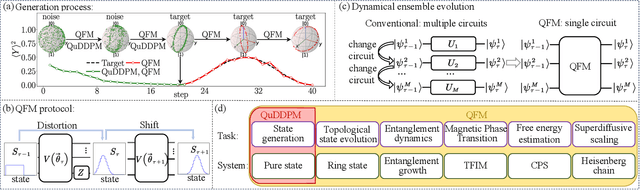
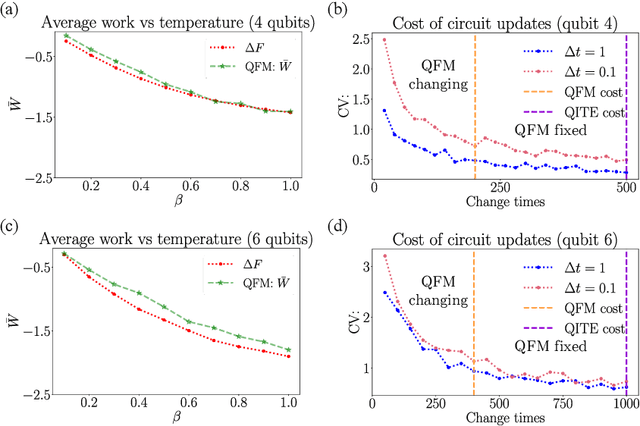
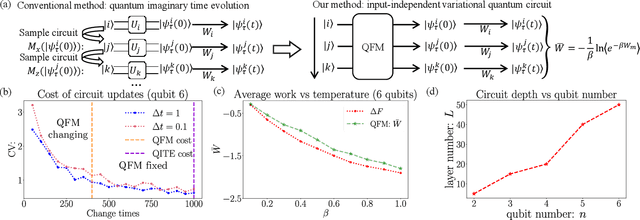
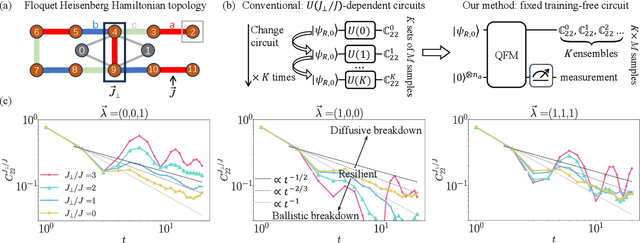
Flow matching has rapidly become a dominant paradigm in classical generative modeling, offering an efficient way to interpolate between two complex distributions. We extend this idea to the quantum realm and introduce Quantum Flow Matching (QFM)-a fully quantum-circuit realization that offers efficient interpolation between two density matrices. QFM offers systematic preparation of density matrices and generation of samples for accurately estimating observables, and can be realized on a quantum computer without the need for costly circuit redesigns. We validate its versatility on a set of applications: (i) generating target states with prescribed magnetization and entanglement entropy, (ii) estimating nonequilibrium free-energy differences to test the quantum Jarzynski equality, and (iii) expediting the study on superdiffusion breakdown. These results position QFM as a unifying and promising framework for generative modeling across quantum systems.
MHAF-YOLO: Multi-Branch Heterogeneous Auxiliary Fusion YOLO for accurate object detection
Feb 07, 2025Due to the effective multi-scale feature fusion capabilities of the Path Aggregation FPN (PAFPN), it has become a widely adopted component in YOLO-based detectors. However, PAFPN struggles to integrate high-level semantic cues with low-level spatial details, limiting its performance in real-world applications, especially with significant scale variations. In this paper, we propose MHAF-YOLO, a novel detection framework featuring a versatile neck design called the Multi-Branch Auxiliary FPN (MAFPN), which consists of two key modules: the Superficial Assisted Fusion (SAF) and Advanced Assisted Fusion (AAF). The SAF bridges the backbone and the neck by fusing shallow features, effectively transferring crucial low-level spatial information with high fidelity. Meanwhile, the AAF integrates multi-scale feature information at deeper neck layers, delivering richer gradient information to the output layer and further enhancing the model learning capacity. To complement MAFPN, we introduce the Global Heterogeneous Flexible Kernel Selection (GHFKS) mechanism and the Reparameterized Heterogeneous Multi-Scale (RepHMS) module to enhance feature fusion. RepHMS is globally integrated into the network, utilizing GHFKS to select larger convolutional kernels for various feature layers, expanding the vertical receptive field and capturing contextual information across spatial hierarchies. Locally, it optimizes convolution by processing both large and small kernels within the same layer, broadening the lateral receptive field and preserving crucial details for detecting smaller targets. The source code of this work is available at: https://github.com/yang0201/MHAF-YOLO.