 Add to Chrome
 Add to Firefox
 Add to Edge
xHC: Expanded Hyper-Connections
Jul 16, 2026
Hyper-Connections (HC) expand the residual stream of Transformers into $N$ parallel streams, providing a form of memory scaling beyond model width and depth. Manifold-Constrained HC (mHC) stabilizes this formulation at scale. The large gains from $N{=}1$ to $N{=}4$ suggest residual-stream expansion as a promising scaling axis. However, existing HC-family methods typically stop at $N{=}4$. Our experiments reveal why: scaling mHC beyond this point yields diminishing performance gains and rapidly increasing training cost. We attribute this limitation to two bottlenecks: insufficient write-back information for an expanding number of streams and residual-mixing generation whose cost scales cubically with $N$. To address both bottlenecks, we propose xHC (Expanded Hyper-Connections), the first HC-family method to achieve meaningful expansion beyond $N{=}4$. xHC combines temporal feature augmentation for richer write-back with a sparse residual-stream architecture that updates only $k=4$ of the $N=16$ streams while retaining dense access to the full residual state. Across 18B and 28B MoE models, xHC delivers strong and consistent downstream improvements. On an 18B MoE model, xHC improves the average downstream score by 4.0 points over mHC, while adding only modest training FLOPs over the vanilla baseline. Scaling-law experiments show that the vanilla and mHC require $1.50\times$ and $1.19\times$ the compute of xHC, respectively, to reach the same loss. Practical large-$N$ training also requires controlling memory traffic from the expanded residual state. We therefore introduce xHC-Flash, which reduces the per-sublayer memory traffic from $73.5C$ to $40C$, comparable to the $34C$ required by mHC at $N{=}4$, while retaining the gains of full xHC. Together, xHC and xHC-Flash make large-$N$ residual-stream expansion effective and practical for LLM pre-training.

InterEdit: Navigating Text-Guided Multi-Human 3D Motion Editing
Mar 13, 2026Text-guided 3D motion editing has seen success in single-person scenarios, but its extension to multi-person settings is less explored due to limited paired data and the complexity of inter-person interactions. We introduce the task of multi-person 3D motion editing, where a target motion is generated from a source and a text instruction. To support this, we propose InterEdit3D, a new dataset with manual two-person motion change annotations, and a Text-guided Multi-human Motion Editing (TMME) benchmark. We present InterEdit, a synchronized classifier-free conditional diffusion model for TMME. It introduces Semantic-Aware Plan Token Alignment with learnable tokens to capture high-level interaction cues and an Interaction-Aware Frequency Token Alignment strategy using DCT and energy pooling to model periodic motion dynamics. Experiments show that InterEdit improves text-to-motion consistency and edit fidelity, achieving state-of-the-art TMME performance. The dataset and code will be released at https://github.com/YNG916/InterEdit.
JTok: On Token Embedding as another Axis of Scaling Law via Joint Token Self-modulation
Jan 31, 2026LLMs have traditionally scaled along dense dimensions, where performance is coupled with near-linear increases in computational cost. While MoE decouples capacity from compute, it introduces large memory overhead and hardware efficiency challenges. To overcome these, we propose token-indexed parameters as a novel, orthogonal scaling axis that decouple model capacity from FLOPs. Specifically, we introduce Joint-Token (JTok) and Mixture of Joint-Token (JTok-M), which augment Transformer layers with modulation vectors retrieved from auxiliary embedding tables. These vectors modulate the backbone via lightweight, element-wise operations, incurring negligible FLOPs overhead. Extensive experiments on both dense and MoE backbones, spanning from 650M (190M + 460M embedding) to 61B (17B + 44B embedding) total parameters, demonstrate that our approach consistently reduces validation loss and significantly improves downstream task performance (e.g., +4.1 on MMLU, +8.3 on ARC, +8.9 on CEval). Rigorous isoFLOPs analysis further confirms that JTok-M fundamentally shifts the quality-compute Pareto frontier, achieving comparable model quality with 35% less compute relative to vanilla MoE architectures, and we validate that token-indexed parameters exhibit a predictable power-law scaling behavior. Moreover, our efficient implementation ensures that the overhead introduced by JTok and JTok-M remains marginal.
Xinyu AI Search: Enhanced Relevance and Comprehensive Results with Rich Answer Presentations
May 28, 2025Traditional search engines struggle to synthesize fragmented information for complex queries, while generative AI search engines face challenges in relevance, comprehensiveness, and presentation. To address these limitations, we introduce Xinyu AI Search, a novel system that incorporates a query-decomposition graph to dynamically break down complex queries into sub-queries, enabling stepwise retrieval and generation. Our retrieval pipeline enhances diversity through multi-source aggregation and query expansion, while filtering and re-ranking strategies optimize passage relevance. Additionally, Xinyu AI Search introduces a novel approach for fine-grained, precise built-in citation and innovates in result presentation by integrating timeline visualization and textual-visual choreography. Evaluated on recent real-world queries, Xinyu AI Search outperforms eight existing technologies in human assessments, excelling in relevance, comprehensiveness, and insightfulness. Ablation studies validate the necessity of its key sub-modules. Our work presents the first comprehensive framework for generative AI search engines, bridging retrieval, generation, and user-centric presentation.
FTII-Bench: A Comprehensive Multimodal Benchmark for Flow Text with Image Insertion
Oct 16, 2024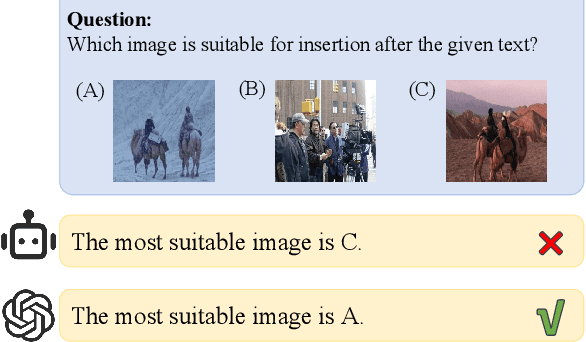
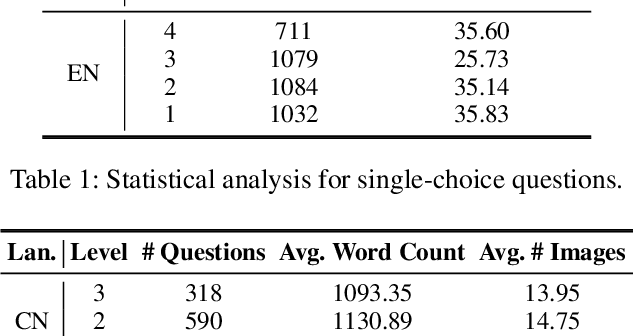
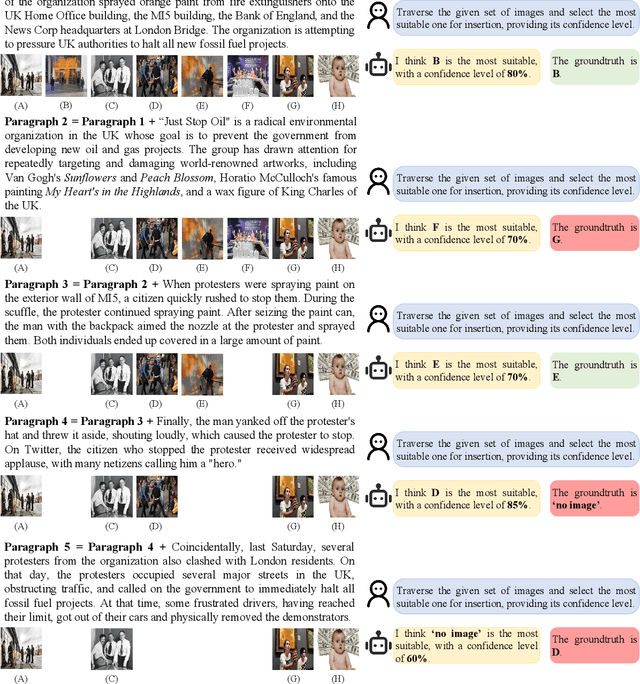
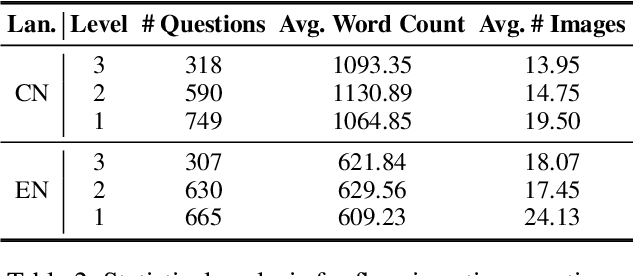
Benefiting from the revolutionary advances in large language models (LLMs) and foundational vision models, large vision-language models (LVLMs) have also made significant progress. However, current benchmarks focus on tasks that evaluating only a single aspect of LVLM capabilities (e.g., recognition, detection, understanding). These tasks fail to fully demonstrate LVLMs' potential in complex application scenarios. To comprehensively assess the performance of existing LVLMs, we propose a more challenging task called the Flow Text with Image Insertion task (FTII). This task requires LVLMs to simultaneously possess outstanding abilities in image comprehension, instruction understanding, and long-text interpretation. Specifically, given several text paragraphs and a set of candidate images, as the text paragraphs accumulate, the LVLMs are required to select the most suitable image from the candidates to insert after the corresponding paragraph. Constructing a benchmark for such a task is highly challenging, particularly in determining the sequence of flowing text and images. To address this challenge, we turn to professional news reports, which naturally contain a gold standard for image-text sequences. Based on this, we introduce the Flow Text with Image Insertion Benchmark (FTII-Bench), which includes 318 high-quality Chinese image-text news articles and 307 high-quality English image-text news articles, covering 10 different news domains. Using these 625 high-quality articles, we construct problems of two different types with multiple levels of difficulty. Furthermore, we establish two different evaluation pipelines based on the CLIP model and existing LVLMs. We evaluate 9 open-source and 2 closed-source LVLMs as well as 2 CLIP-based models. Results indicate that even the most advanced models (e.g., GPT-4o) face significant challenges when tackling the FTII task.