 Add to Chrome
 Add to Firefox
 Add to Edge
KoopmanFlow: Spectrally Decoupled Generative Control Policy via Koopman Structural Bias
Mar 14, 2026
Generative Control Policies (GCPs) show immense promise in robotic manipulation but struggle to simultaneously model stable global motions and high-frequency local corrections. While modern architectures extract multi-scale spatial features, their underlying Probability Flow ODEs apply a uniform temporal integration schedule. Compressed to a single step for real-time Receding Horizon Control (RHC), uniform ODE solvers mathematically smooth over sparse, high-frequency transients entangled within low-frequency steady states. To decouple these dynamics without accumulating pipelined errors, we introduce KoopmanFlow, a parameter-efficient generative policy guided by a Koopman-inspired structural inductive bias. Operating in a unified multimodal latent space with visual context, KoopmanFlow bifurcates generation at the terminal stage. Because visual conditioning occurs before spectral decomposition, both branches are visually guided yet temporally specialized. A macroscopic branch anchors slow-varying trajectories via single-step Consistency Training, while a transient branch uses Flow Matching to isolate high-frequency residuals stimulated by sudden visual cues (e.g., contacts or occlusions). Guided by an explicit spectral prior and optimized via a novel asymmetric consistency objective, KoopmanFlow establishes a fused co-training mechanism. This allows the variant branch to absorb localized dynamics without multi-stage error accumulation. Extensive experiments show KoopmanFlow significantly outperforms state-of-the-art baselines in contact-rich tasks requiring agile disturbance rejection. By trading a surplus latency buffer for a richer structural prior, KoopmanFlow achieves superior control fidelity and parameter efficiency within real-time deployment limits.

Cascading Hierarchical Networks with Multi-task Balanced Loss for Fine-grained hashing
Mar 20, 2023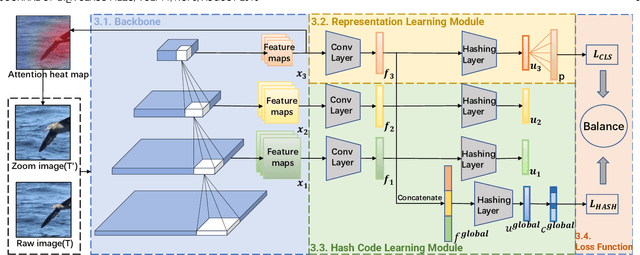
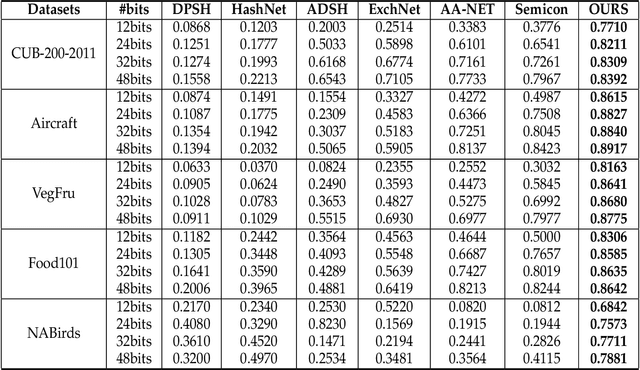
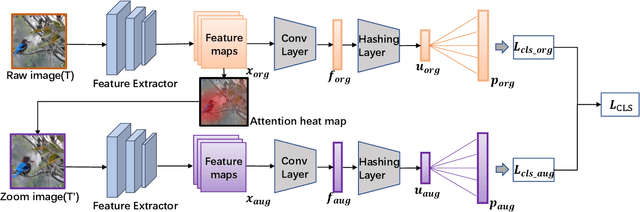
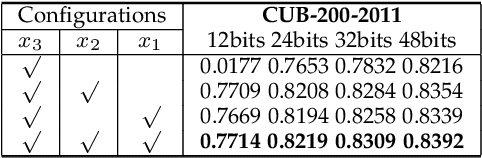
With the explosive growth in the number of fine-grained images in the Internet era, it has become a challenging problem to perform fast and efficient retrieval from large-scale fine-grained images. Among the many retrieval methods, hashing methods are widely used due to their high efficiency and small storage space occupation. Fine-grained hashing is more challenging than traditional hashing problems due to the difficulties such as low inter-class variances and high intra-class variances caused by the characteristics of fine-grained images. To improve the retrieval accuracy of fine-grained hashing, we propose a cascaded network to learn compact and highly semantic hash codes, and introduce an attention-guided data augmentation method. We refer to this network as a cascaded hierarchical data augmentation network. We also propose a novel approach to coordinately balance the loss of multi-task learning. We do extensive experiments on some common fine-grained visual classification datasets. The experimental results demonstrate that our proposed method outperforms several state-of-art hashing methods and can effectively improve the accuracy of fine-grained retrieval. The source code is publicly available: https://github.com/kaiba007/FG-CNET.