 Add to Chrome
 Add to Firefox
 Add to Edge
Generalized Pinching-Antenna Systems: A Radio-Stripe-Based Realization
Jun 18, 2026
This paper investigates radio stripes (RSs) as a practical realization of generalized pinching antennas and proposes an RS-based generalized pinching-antenna (RS-GPA) framework. Unlike dielectric-waveguide-based passive pinching antennas that rely on passive coupling from a guided wave into free space, RSs employ active antenna processing units (APUs) deployed along a shared cable for local transmission, reception, and signal processing. This cable-like active architecture offers flexible installation and broad frequency applicability, while allowing selected APUs to act as discrete and controllable radiation or reception points for location-flexible wireless access. Based on the proposed RS-GPA framework, we establish the system and channel models by accounting for the distance-dependent APU-user channels. For downlink transmission, we formulate a circuit-power-aware sparse APU activation and beamforming problem and develop a reweighted group-sparse beamforming algorithm. To reveal the activation principle, we analyze the single-user downlink case and characterize when an additional APU should be activated by balancing transmit-power saving and circuit-power cost. Inspired by this insight, a geometry-guided low-complexity multiuser algorithm is proposed. For uplink transmission, we formulate a joint APU activation and user power control problem and develop a geometry-guided sparse activation design. Numerical results show that the proposed RS-GPA framework substantially reduces the total consumed power compared with benchmark schemes, while the geometry-guided algorithm achieves near-identical consumed-power performance to the group-sparse design with significantly lower runtime.

Environment-Aware Network-Level Design of Generalized Pinching-Antenna Systems--Part II: Geometry-Aware Case
Feb 19, 2026This two-part paper aims to develop an environment-aware network-level design framework for generalized pinching-antenna systems to overcome the limitations of conventional link-level optimization, which is tightly coupled to instantaneous user geometry and thus sensitive to user mobility and localization errors. Part I investigates the traffic-aware case, where user presence is characterized statistically by a spatial traffic map and deployments are optimized using traffic-aware network-level metrics. Part II complements Part I by developing geometry-aware, blockage-aware network optimization for pinching-antenna systems in obstacle-rich environments. We introduce a grid-level average signal-to-noise (SNR) model with a deterministic LoS visibility indicator and a discrete activation architecture, where the geometry-dependent terms are computed offline in advance. Building on this model, we formulate two network-level activation problems: (i) average-SNR-threshold coverage maximization and (ii) fairness-oriented worst-grid average-SNR maximization. On the algorithmic side, we prove the coverage problem is NP-hard and derive an equivalent mix-integer linear programming reformulation through binary coverage variables and linear SNR linking constraints. To achieve scalability, we further develop a structure-exploiting coordinate-ascent method that updates one waveguide at a time using precomputed per-candidate SNR contributions. For the worst-grid objective, we adopt an epigraph reformulation and leverage the resulting monotone feasibility in the target SNR, enabling an efficient bisection-based solver with low-complexity feasibility checks over the discrete candidate set. Simulations results validate the proposed designs and quantify their gains under different environments and system parameters.
PEMNet: Towards Autonomous and Enhanced Environment-Aware Mobile Networks
Jan 16, 2026With 5G deployment and the evolution toward 6G, mobile networks must make decisions in highly dynamic environments under strict latency, energy, and spectrum constraints. Achieving this goal, however, depends on prior knowledge of spatial-temporal variations in wireless channels and traffic demands. This motivates a joint, site-specific representation of radio propagation and user demand that is queryable at low online overhead. In this work, we propose the perception embedding map (PEM), a localized framework that embeds fine-grained channel statistics together with grid-level spatial-temporal traffic patterns over a base station's coverage. PEM is built from standard-compliant measurements -- such as measurement report and scheduling/quality-of-service logs -- so it can be deployed and maintained at scale with low cost. Integrated into PEM, this joint knowledge supports enhanced environment-aware optimization across PHY, MAC, and network layers while substantially reducing training overhead and signaling. Compared with existing site-specific channel maps and digital-twin replicas, PEM distinctively emphasizes (i) joint channel-traffic embedding, which is essential for network optimization, and (ii) practical construction using standard measurements, enabling network autonomy while striking a favorable fidelity-cost balance.
Power Minimization in Pinching-Antenna Systems under Probabilistic LoS Blockage
Dec 31, 2025With great flexibility to adjust antenna positions, pinching antennas (PAs) are promising for alleviating large-scale attenuation in wireless networks. In this work, we investigate the antenna positioning and beamforming (AP-BF) design in a multi-PA multi-user system under probabilistic light-of-sight (LoS) blockage and formulate a power minimization problem subject to per-user signal-to-noise ratio (SNR) constraints. For a single PA, we prove the convexity of the simplified problem and obtain its global optimum. For multiple PAs, we derive closed-form BF structures and develop an efficient first-order algorithm to achieve high-quality local solutions. Extensive numerical results validate the efficacy of our proposed designs and the substantial performance advantage of PA systems compared with conventional fixed-antenna systems in a term of power saving.
Generalized Pinching-Antenna Systems: A Tutorial on Principles, Design Strategies, and Future Directions
Oct 15, 2025Pinching-antenna systems have emerged as a novel and transformative flexible-antenna architecture for next-generation wireless networks. They offer unprecedented flexibility and spatial reconfigurability by enabling dynamic positioning and activation of radiating elements along a signal-guiding medium (e.g., dielectric waveguides), which is not possible with conventional fixed antenna systems. In this paper, we introduce the concept of generalized pinching antenna systems, which retain the core principle of creating localized radiation points on demand, but can be physically realized in a variety of settings. These include implementations based on dielectric waveguides, leaky coaxial cables, surface-wave guiding structures, and other types of media, employing different feeding methods and activation mechanisms (e.g., mechanical, electronic, or hybrid). Despite differences in their physical realizations, they all share the same inherent ability to form, reposition, or deactivate radiation sites as needed, enabling user-centric and dynamic coverage. We first describe the underlying physical mechanisms of representative generalized pinching-antenna realizations and their associated wireless channel models, highlighting their unique propagation and reconfigurability characteristics compared with conventional antennas. Then, we review several representative pinching-antenna system architectures, ranging from single- to multiple-waveguide configurations, and discuss advanced design strategies tailored to these flexible deployments. Furthermore, we examine their integration with emerging wireless technologies to enable synergistic, user-centric solutions. Finally, we identify key open research challenges and outline future directions, charting a pathway toward the practical deployment of generalized pinching antennas in next-generation wireless networks.
Pinching-Antenna System Design with LoS Blockage: Does In-Waveguide Attenuation Matter?
Aug 10, 2025In the literature of pinching-antenna systems, in-waveguide attenuation is often neglected to simplify system design and enable more tractable analysis. However, its effect on overall system performance has received limited attention in the existing literature. While a recent study has shown that, in line-of-sight (LoS)-dominated environments, the data rate loss incurred by omitting in-waveguide attenuation is negligible when the communication area is not excessively large, its effect under more general conditions remains unclear. This work extends the analysis to more realistic scenarios involving arbitrary levels of LoS blockage. We begin by examining a single-user case and derive an explicit expression for the average data rate loss caused by neglecting in-waveguide attenuation. The results demonstrate that, even for large service areas, the rate loss remains negligible under typical LoS blockage conditions. We then consider a more general multi-user scenario, where multiple pinching antennas, each deployed on a separate waveguide, jointly serve multiple users. The objective is to maximize the average sum rate by jointly optimize antenna positions and transmit beamformers to maximize the average sum rate under probabilistic LoS blockage. To solve the resulting stochastic and nonconvex optimization problem, we propose a dynamic sample average approximation (SAA) algorithm. At each iteration, this method replaces the expected objective with an empirical average computed from dynamically regenerated random channel realizations, ensuring that the optimization accurately reflects the current antenna configuration. Extensive simulation results are provided to the proposed algorithm and demonstrate the substantial performance gains of pinching-antenna systems, particularly in environments with significant LoS blockage.
A Gradient Meta-Learning Joint Optimization for Beamforming and Antenna Position in Pinching-Antenna Systems
Jun 14, 2025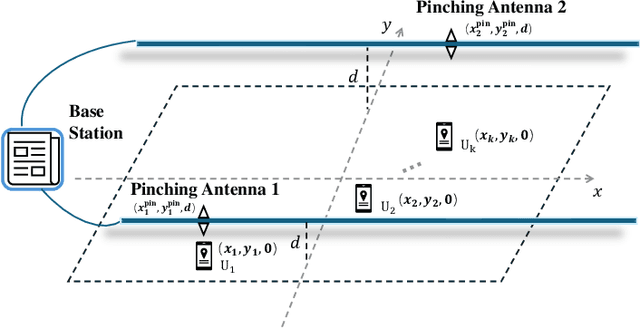
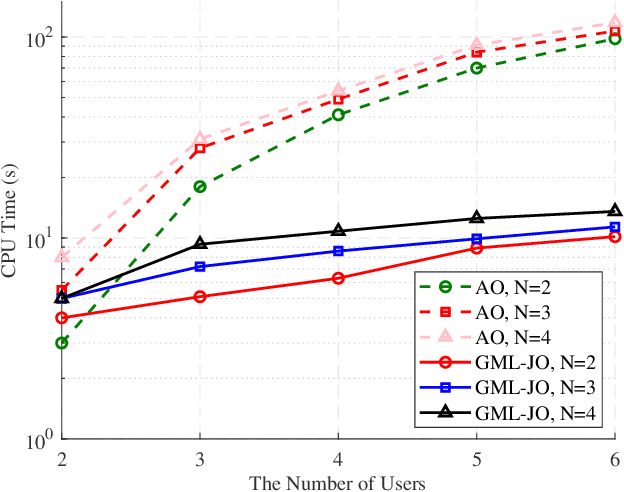
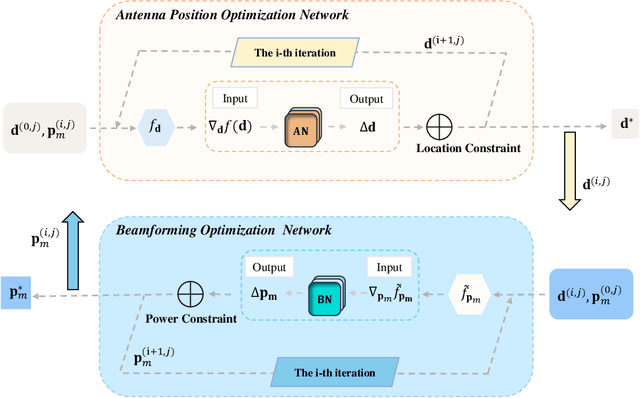
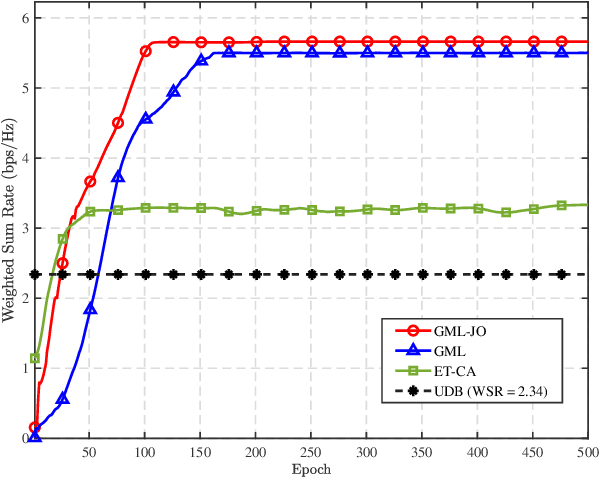
In this paper, we consider a novel optimization design for multi-waveguide pinching-antenna systems, aiming to maximize the weighted sum rate (WSR) by jointly optimizing beamforming coefficients and antenna position. To handle the formulated non-convex problem, a gradient-based meta-learning joint optimization (GML-JO) algorithm is proposed. Specifically, the original problem is initially decomposed into two sub-problems of beamforming optimization and antenna position optimization through equivalent substitution. Then, the convex approximation methods are used to deal with the nonconvex constraints of sub-problems, and two sub-neural networks are constructed to calculate the sub-problems separately. Different from alternating optimization (AO), where two sub-problems are solved alternately and the solutions are influenced by the initial values, two sub-neural networks of proposed GML-JO with fixed channel coefficients are considered as local sub-tasks and the computation results are used to calculate the loss function of joint optimization. Finally, the parameters of sub-networks are updated using the average loss function over different sub-tasks and the solution that is robust to the initial value is obtained. Simulation results demonstrate that the proposed GML-JO algorithm achieves 5.6 bits/s/Hz WSR within 100 iterations, yielding a 32.7\% performance enhancement over conventional AO with substantially reduced computational complexity. Moreover, the proposed GML-JO algorithm is robust to different choices of initialization and yields better performance compared with the existing optimization methods.
Multi-Waveguide Pinching Antennas for ISAC
May 30, 2025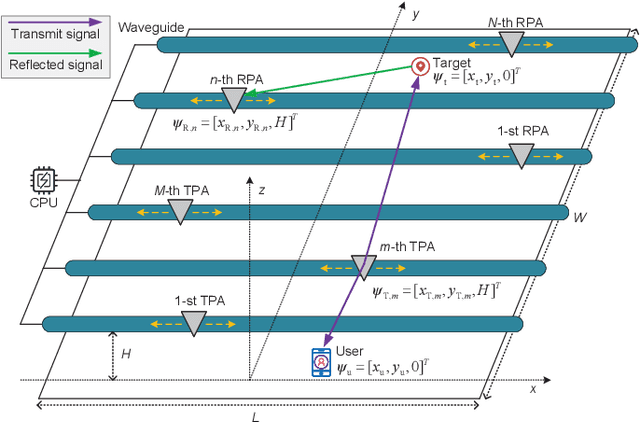
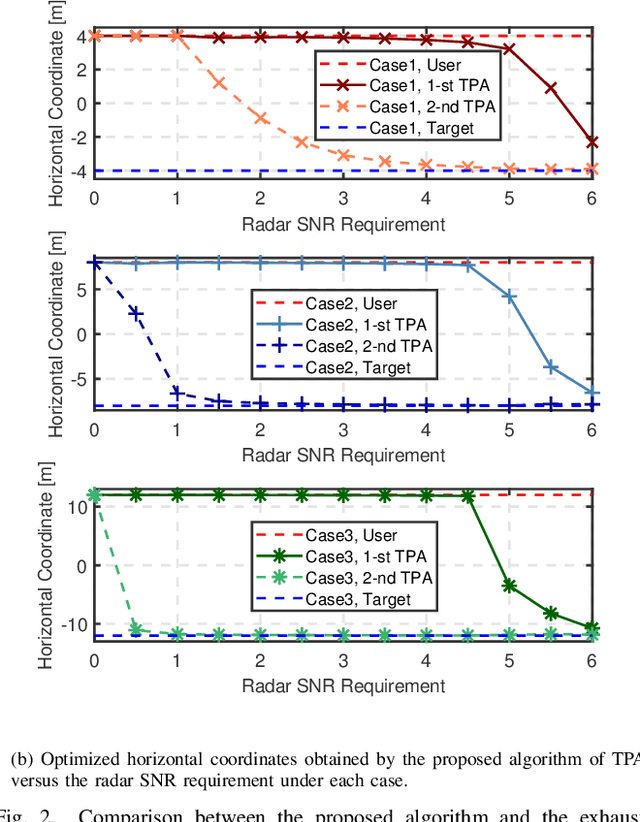
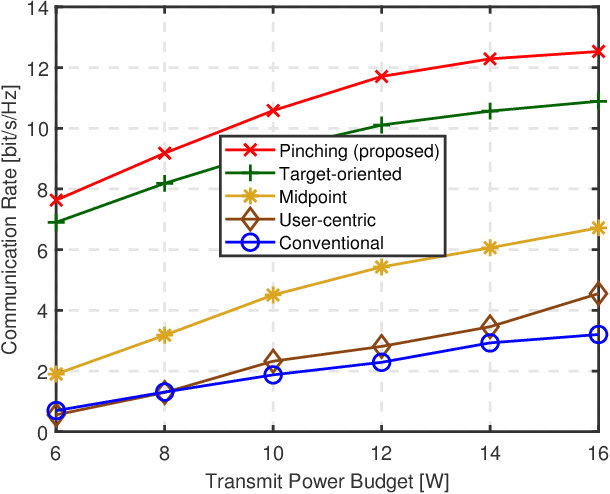
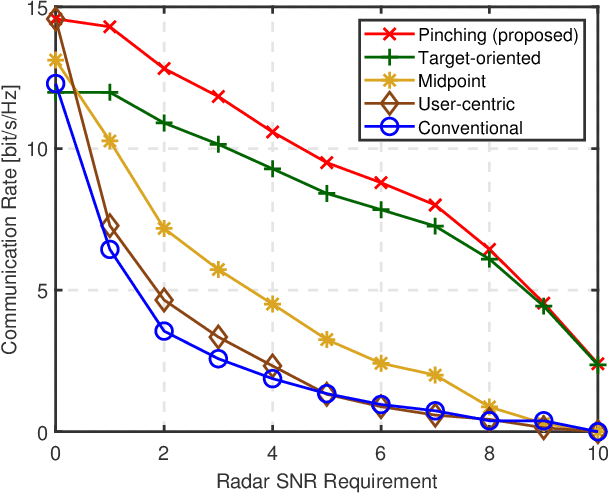
Recently, a novel flexible-antenna technology, called pinching antennas, has attracted growing academic interest. By inserting discrete dielectric materials, pinching antennas can be activated at arbitrary points along waveguides, allowing for flexible customization of large-scale path loss. This paper investigates a multi-waveguide pinching-antenna integrated sensing and communications (ISAC) system, where transmit pinching antennas (TPAs) and receive pinching antennas (RPAs) coordinate to simultaneously detect one potential target and serve one downlink user. We formulate a communication rate maximization problem subject to radar signal-to-noise ratio (SNR) requirement, transmit power budget, and the allowable movement region of the TPAs, by jointly optimizing TPA locations and transmit beamforming design. To address the non-convexity of the problem, we propose a novel fine-tuning approximation method to reformulate it into a tractable form, followed by a successive convex approximation (SCA)-based algorithm to obtain the solution efficiently. Extensive simulations validate both the system design and the proposed algorithm. Results show that the proposed method achieves near-optimal performance compared with the computational-intensive exhaustive search-based benchmark, and pinching-antenna ISAC systems exhibit a distinct communication-sensing trade-off compared with conventional systems.
QoS-Aware NOMA Design for Downlink Pinching-Antenna Systems
Apr 18, 2025Pinching antennas, implemented by applying small dielectric particles on a waveguide, have emerged as a promising flexible-antenna technology ideal for next-generation wireless communications systems. Unlike conventional flexible-antenna systems, pinching antennas offer the advantage of creating line-of-sight links by enabling antennas to be activated on the waveguide at a location close to the user. This paper investigates a typical two-user non-orthogonal multiple access (NOMA) downlink scenario, where multiple pinching antennas are activated on a single dielectric waveguide to assist NOMA transmission. We formulate the problem of maximizing the data rate of one user subject to the quality-of-service requirement of the other user by jointly optimizing the antenna locations and power allocation coefficients. The formulated problem is nonconvex and difficult to solve due to the impact of antenna locations on large-scale path loss and two types of phase shifts, namely in-waveguide phase shifts and free space propagation phase shifts. To this end, we propose an iterative algorithm based on block coordinate descent and successive convex approximation techniques. Moreover, we consider the special case with a single pinching antenna, which is a simplified version of the multi-antenna case. Although the formulated problem is still nonconvex, by using the inherent features of the formulated problem, we derive the global optimal solution in closed-form, which offers important insights on the performance of pinching-antenna systems. Simulation results demonstrate that the pinching-antenna system significantly outperforms conventional fixed-position antenna systems, and the proposed algorithm achieves performance comparable to the computationally intensive exhaustive search based approach.
Rate Maximization for Downlink Pinching-Antenna Systems
Feb 18, 2025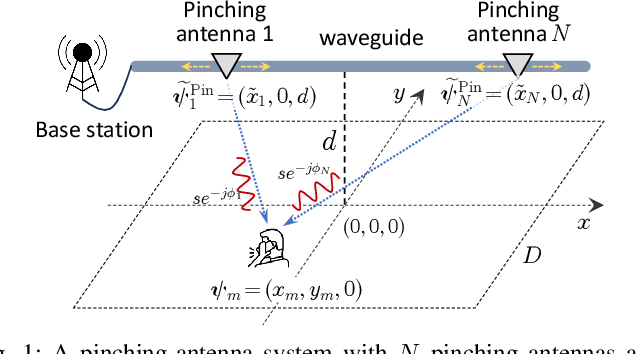
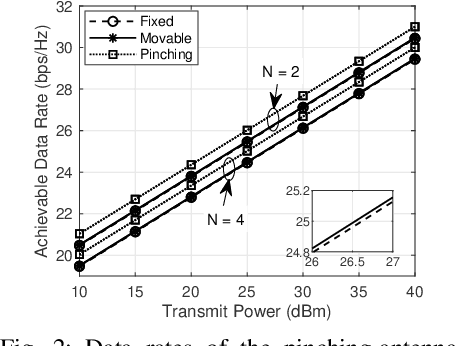
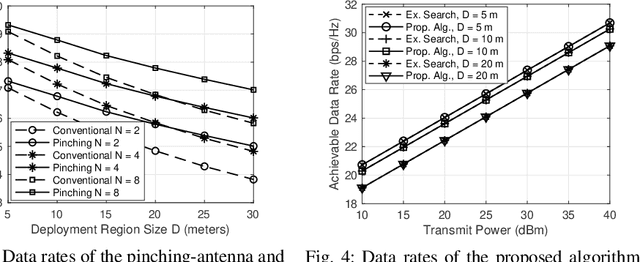
In this letter, we consider a new type of flexible-antenna system, termed pinching-antenna, where multiple low-cost pinching antennas, realized by activating small dielectric particles on a dielectric waveguide, are jointly used to serve a single-antenna user. Our goal is to maximize the downlink transmission rate by optimizing the locations of the pinching antennas. However, these locations affect both the path losses and the phase shifts of the user's effective channel gain, making the problem challenging to solve. To address this challenge and solve the problem in a low complexity manner, a relaxed optimization problem is developed that minimizes the impact of path loss while ensuring that the received signals at the user are constructive. This approach leads to a two-stage algorithm: in the first stage, the locations of the pinching antennas are optimized to minimize the large-scale path loss; in the second stage, the antenna locations are refined to maximize the received signal strength. Simulation results show that pinching-antenna systems significantly outperform conventional fixed-location antenna systems, and the proposed algorithm achieves nearly the same performance as the highly complex exhaustive search-based benchmark.