 Add to Chrome
 Add to Firefox
 Add to Edge
Ling and Ring 2.6 Technical Report: Efficient and Instant Agentic Intelligence at Trillion-Parameter Scale
Jun 13, 2026
Efficient and scalable agentic intelligence requires models that can deliver both low-latency responses and strong reasoning capabilities while remaining practical to train, serve, and deploy. In this report, we present Ling-2.6 and Ring-2.6, a family of models designed to address this challenge at scale. Ling-2.6 is optimized for instant response generation and high capability per output token, whereas Ring-2.6 is tailored for deeper reasoning and more advanced agentic workflows. Instead of training from scratch, we upgrade the Ling-2.0 base model through architectural migration pre-training and large-scale post-training. This upgrade is guided by a unified co-design of model architecture, optimization objectives, serving systems, and agent training environments, enabling improvements in both model capability and deployment efficiency. At the architectural level, we introduce a hybrid linear attention design that integrates Lightning Attention with MLA, improving the efficiency of long-context training and decoding. To further enhance token efficiency, we optimize capability per output token through Evolutionary Chain-of-Thought, Linguistic Unit Policy Optimization, bidirectional preference alignment, and shortest-correct-response distillation. For agentic capabilities, we propose KPop, a reinforcement learning framework designed to support stable training of Ring-2.6-1T on large-scale environment-grounded data. KPop improves training efficiency through asynchronous scheduling across coding, search, tool use, and workflow execution, enabling scalable learning from complex agent-environment interactions. Together, Ling-2.6 and Ring-2.6 provide a practical pathway toward efficient, scalable, and open agentic systems. We open-source all checkpoints in the 2.6 family to support further research and development in practical agentic intelligence.

ALT: An Automatic System for Long Tail Scenario Modeling
May 19, 2023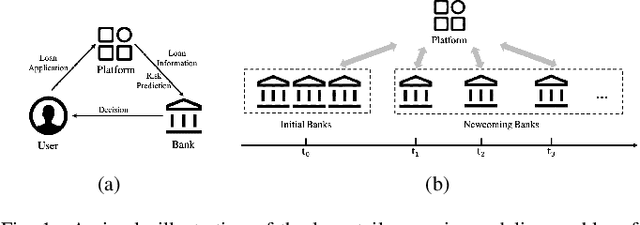
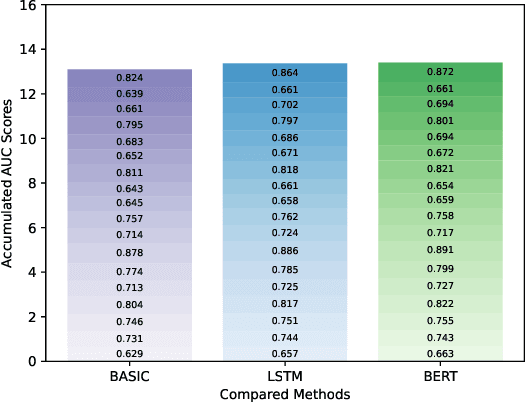
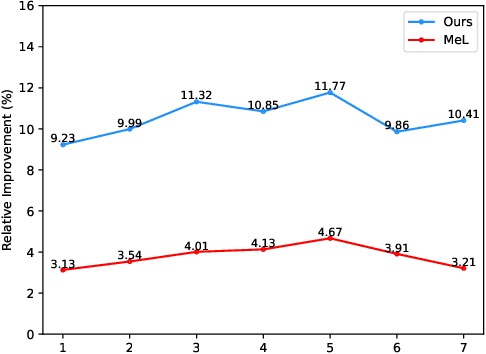
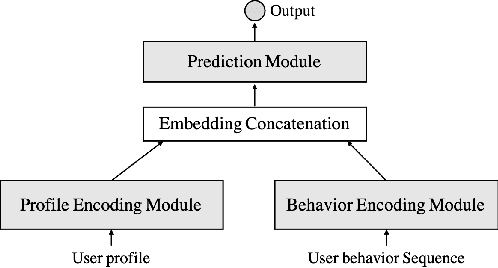
In this paper, we consider the problem of long tail scenario modeling with budget limitation, i.e., insufficient human resources for model training stage and limited time and computing resources for model inference stage. This problem is widely encountered in various applications, yet has received deficient attention so far. We present an automatic system named ALT to deal with this problem. Several efforts are taken to improve the algorithms used in our system, such as employing various automatic machine learning related techniques, adopting the meta learning philosophy, and proposing an essential budget-limited neural architecture search method, etc. Moreover, to build the system, many optimizations are performed from a systematic perspective, and essential modules are armed, making the system more feasible and efficient. We perform abundant experiments to validate the effectiveness of our system and demonstrate the usefulness of the critical modules in our system. Moreover, online results are provided, which fully verified the efficacy of our system.
Generating Natural Language Adversarial Examples on a Large Scale with Generative Models
Mar 10, 2020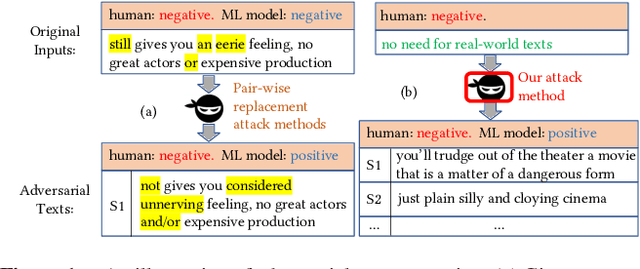
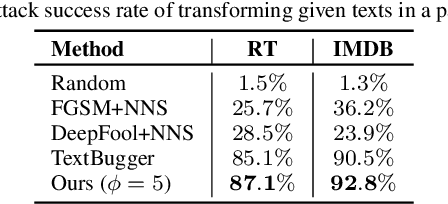
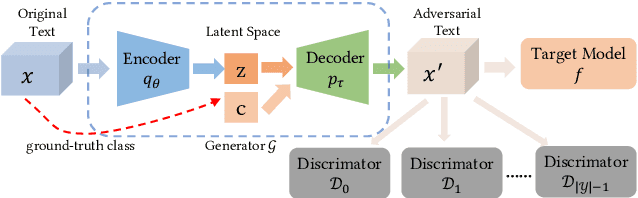

Today text classification models have been widely used. However, these classifiers are found to be easily fooled by adversarial examples. Fortunately, standard attacking methods generate adversarial texts in a pair-wise way, that is, an adversarial text can only be created from a real-world text by replacing a few words. In many applications, these texts are limited in numbers, therefore their corresponding adversarial examples are often not diverse enough and sometimes hard to read, thus can be easily detected by humans and cannot create chaos at a large scale. In this paper, we propose an end to end solution to efficiently generate adversarial texts from scratch using generative models, which are not restricted to perturbing the given texts. We call it unrestricted adversarial text generation. Specifically, we train a conditional variational autoencoder (VAE) with an additional adversarial loss to guide the generation of adversarial examples. Moreover, to improve the validity of adversarial texts, we utilize discrimators and the training framework of generative adversarial networks (GANs) to make adversarial texts consistent with real data. Experimental results on sentiment analysis demonstrate the scalability and efficiency of our method. It can attack text classification models with a higher success rate than existing methods, and provide acceptable quality for humans in the meantime.