 Add to Chrome
 Add to Firefox
 Add to Edge
FDDM: Frequency-Decomposed Diffusion Model for Rectum Cancer Dose Prediction in Radiotherapy
Oct 10, 2024
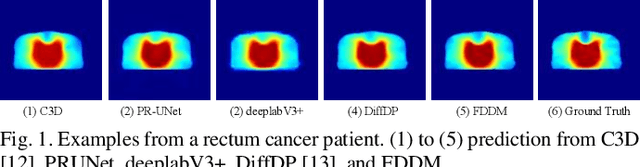
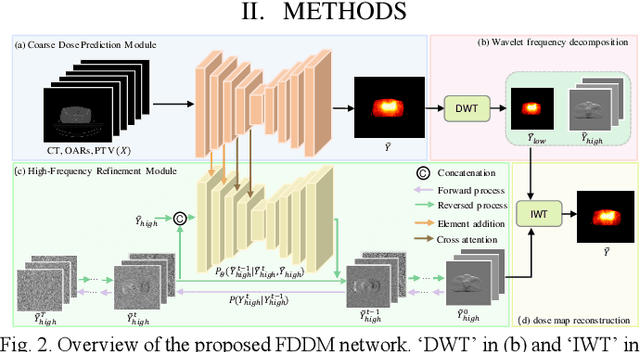
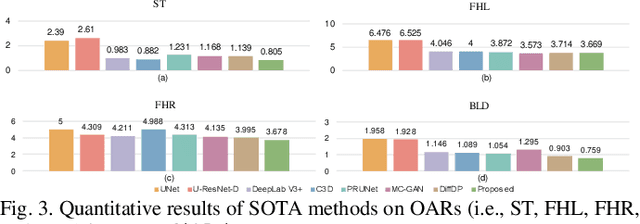
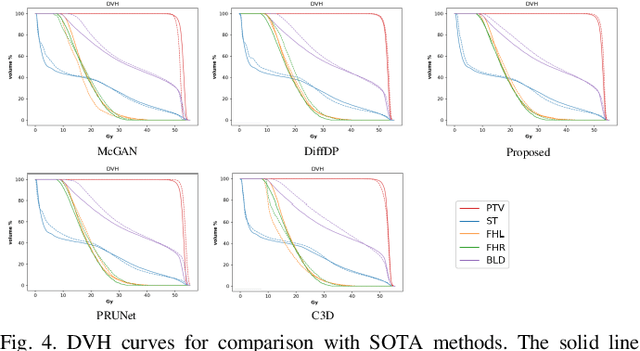
Accurate dose distribution prediction is crucial in the radiotherapy planning. Although previous methods based on convolutional neural network have shown promising performance, they have the problem of over-smoothing, leading to prediction without important high-frequency details. Recently, diffusion model has achieved great success in computer vision, which excels in generating images with more high-frequency details, yet suffers from time-consuming and extensive computational resource consumption. To alleviate these problems, we propose Frequency-Decomposed Diffusion Model (FDDM) that refines the high-frequency subbands of the dose map. To be specific, we design a Coarse Dose Prediction Module (CDPM) to first predict a coarse dose map and then utilize discrete wavelet transform to decompose the coarse dose map into a low-frequency subband and three high?frequency subbands. There is a notable difference between the coarse predicted results and ground truth in high?frequency subbands. Therefore, we design a diffusion-based module called High-Frequency Refinement Module (HFRM) that performs diffusion operation in the high?frequency components of the dose map instead of the original dose map. Extensive experiments on an in-house dataset verify the effectiveness of our approach.

CrossQuant: A Post-Training Quantization Method with Smaller Quantization Kernel for Precise Large Language Model Compression
Oct 10, 2024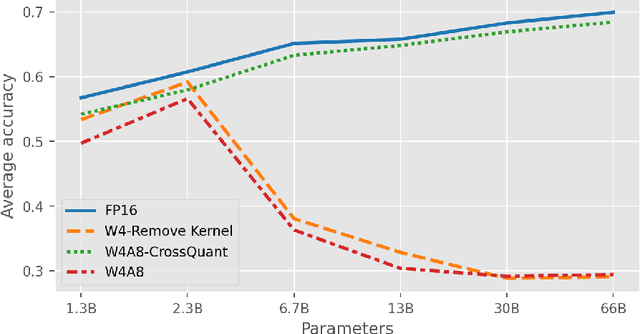
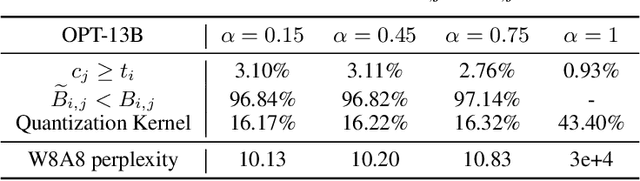
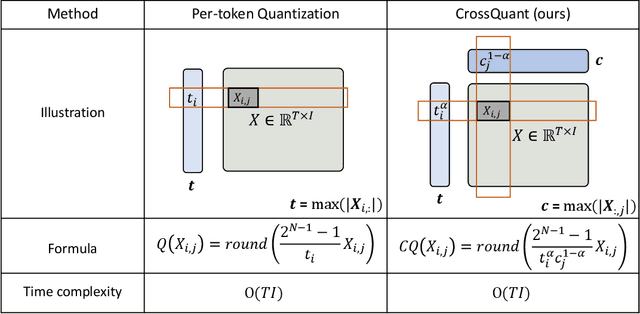
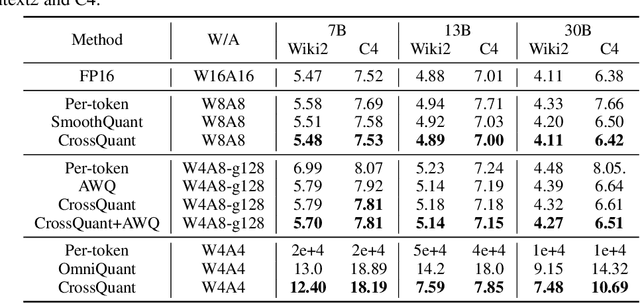
Post-Training Quantization (PTQ) is an effective technique for compressing Large Language Models (LLMs). While many studies focus on quantizing both weights and activations, it is still a challenge to maintain the accuracy of LLM after activating quantization. To investigate the primary cause, we extend the concept of kernel from linear algebra to quantization functions to define a new term, "quantization kernel", which refers to the set of elements in activations that are quantized to zero. Through quantitative analysis of the quantization kernel, we find that these elements are crucial for maintaining the accuracy of quantized LLMs. With the decrease of quantization kernel, the precision of quantized LLMs increases. If the quantization kernel proportion is kept below 19% for OPT models and below 1% for LLaMA models, the precision loss from quantizing activations to INT8 becomes negligible. Motivated by the goal of developing a quantization method with small quantization kernel, we propose CrossQuant: a simple yet effective method for quantizing activations. CrossQuant cross-quantizes elements using row and column-wise absolute maximum vectors, achieving a quantization kernel of approximately 16% for OPT models and less than 0.1% for LLaMA models. Experimental results on LLMs (LLaMA, OPT) ranging from 6.7B to 70B parameters demonstrate that CrossQuant improves or maintains perplexity and accuracy in language modeling, zero-shot, and few-shot tasks.
Performance Analysis of Local Partial MMSE Precoding Based User-Centric Cell-Free Massive MIMO Systems and Deployment Optimization
Oct 08, 2024


Cell-free massive multiple-input multiple-output (MIMO) systems, leveraging tight cooperation among wireless access points, exhibit remarkable signal enhancement and interference suppression capabilities, demonstrating significant performance advantages over traditional cellular networks. This paper investigates the performance and deployment optimization of a user-centric scalable cell-free massive MIMO system with imperfect channel information over correlated Rayleigh fading channels. Based on the large-dimensional random matrix theory, this paper presents the deterministic equivalent of the ergodic sum rate for this system when applying the local partial minimum mean square error (LP-MMSE) precoding method, along with its derivative with respect to the channel correlation matrix. Furthermore, utilizing the derivative of the ergodic sum rate, this paper designs a Barzilai-Borwein based gradient descent method to improve system deployment. Simulation experiments demonstrate that under various parameter settings and large-scale antenna configurations, the deterministic equivalent of the ergodic sum rate accurately approximates the Monte Carlo ergodic sum rate of the system. Furthermore, the deployment optimization algorithm effectively enhances the ergodic sum rate of this system by optimizing the positions of access points.
RenderWorld: World Model with Self-Supervised 3D Label
Sep 17, 2024



End-to-end autonomous driving with vision-only is not only more cost-effective compared to LiDAR-vision fusion but also more reliable than traditional methods. To achieve a economical and robust purely visual autonomous driving system, we propose RenderWorld, a vision-only end-to-end autonomous driving framework, which generates 3D occupancy labels using a self-supervised gaussian-based Img2Occ Module, then encodes the labels by AM-VAE, and uses world model for forecasting and planning. RenderWorld employs Gaussian Splatting to represent 3D scenes and render 2D images greatly improves segmentation accuracy and reduces GPU memory consumption compared with NeRF-based methods. By applying AM-VAE to encode air and non-air separately, RenderWorld achieves more fine-grained scene element representation, leading to state-of-the-art performance in both 4D occupancy forecasting and motion planning from autoregressive world model.
KVPruner: Structural Pruning for Faster and Memory-Efficient Large Language Models
Sep 17, 2024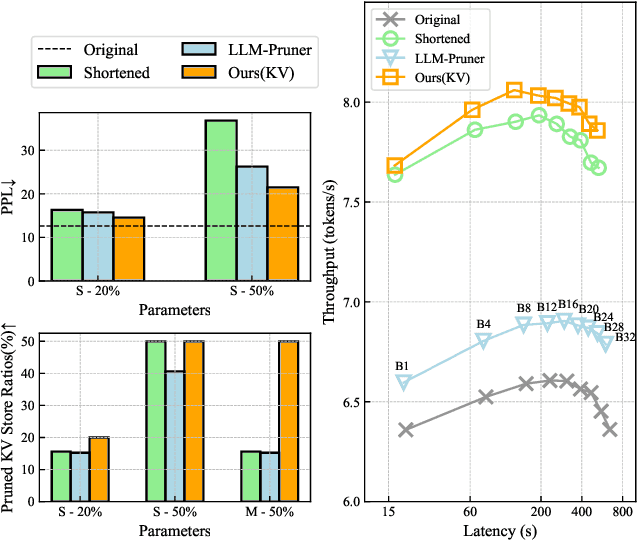
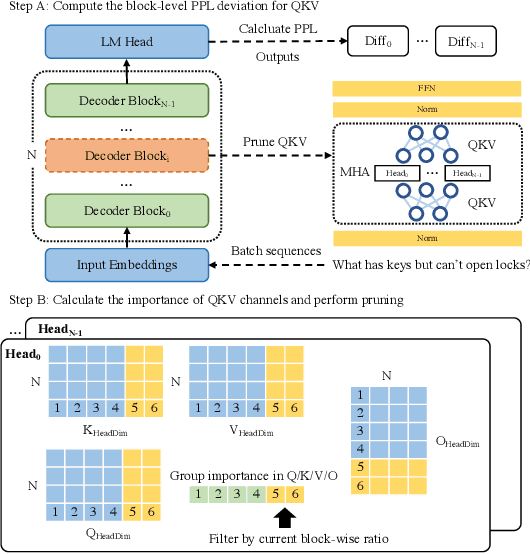
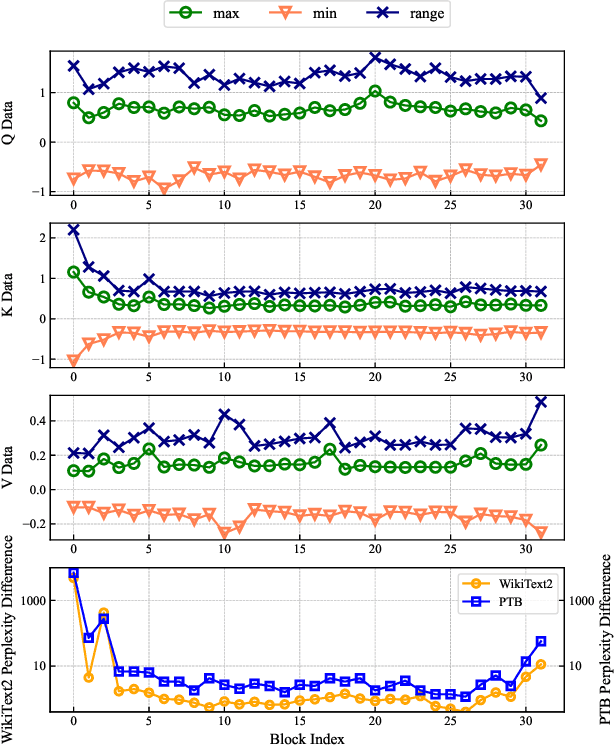
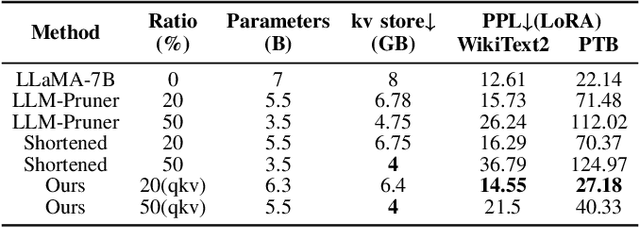
The bottleneck associated with the key-value(KV) cache presents a significant challenge during the inference processes of large language models. While depth pruning accelerates inference, it requires extensive recovery training, which can take up to two weeks. On the other hand, width pruning retains much of the performance but offers slight speed gains. To tackle these challenges, we propose KVPruner to improve model efficiency while maintaining performance. Our method uses global perplexity-based analysis to determine the importance ratio for each block and provides multiple strategies to prune non-essential KV channels within blocks. Compared to the original model, KVPruner reduces runtime memory usage by 50% and boosts throughput by over 35%. Additionally, our method requires only two hours of LoRA fine-tuning on small datasets to recover most of the performance.
ProteinBench: A Holistic Evaluation of Protein Foundation Models
Sep 10, 2024Recent years have witnessed a surge in the development of protein foundation models, significantly improving performance in protein prediction and generative tasks ranging from 3D structure prediction and protein design to conformational dynamics. However, the capabilities and limitations associated with these models remain poorly understood due to the absence of a unified evaluation framework. To fill this gap, we introduce ProteinBench, a holistic evaluation framework designed to enhance the transparency of protein foundation models. Our approach consists of three key components: (i) A taxonomic classification of tasks that broadly encompass the main challenges in the protein domain, based on the relationships between different protein modalities; (ii) A multi-metric evaluation approach that assesses performance across four key dimensions: quality, novelty, diversity, and robustness; and (iii) In-depth analyses from various user objectives, providing a holistic view of model performance. Our comprehensive evaluation of protein foundation models reveals several key findings that shed light on their current capabilities and limitations. To promote transparency and facilitate further research, we release the evaluation dataset, code, and a public leaderboard publicly for further analysis and a general modular toolkit. We intend for ProteinBench to be a living benchmark for establishing a standardized, in-depth evaluation framework for protein foundation models, driving their development and application while fostering collaboration within the field.
FS-MedSAM2: Exploring the Potential of SAM2 for Few-Shot Medical Image Segmentation without Fine-tuning
Sep 06, 2024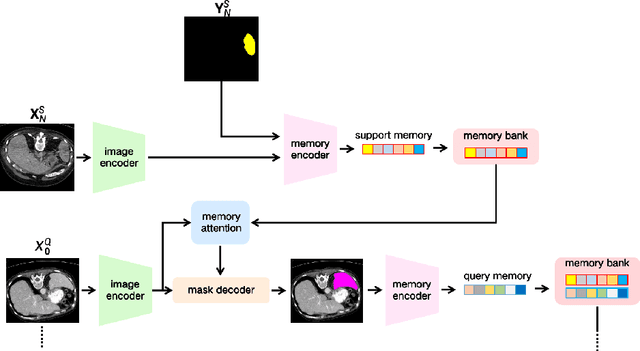


The Segment Anything Model 2 (SAM2) has recently demonstrated exceptional performance in zero-shot prompt segmentation for natural images and videos. However, it faces significant challenges when applied to medical images. Since its release, many attempts have been made to adapt SAM2's segmentation capabilities to the medical imaging domain. These efforts typically involve using a substantial amount of labeled data to fine-tune the model's weights. In this paper, we explore SAM2 from a different perspective via making the full use of its trained memory attention module and its ability of processing mask prompts. We introduce FS-MedSAM2, a simple yet effective framework that enables SAM2 to achieve superior medical image segmentation in a few-shot setting, without the need for fine-tuning. Our framework outperforms the current state-of-the-arts on two publicly available medical image datasets. The code is available at https://github.com/DeepMed-Lab-ECNU/FS_MedSAM2.
LongRecipe: Recipe for Efficient Long Context Generalization in Large Language Models
Sep 04, 2024Large language models (LLMs) face significant challenges in handling long-context tasks because of their limited effective context window size during pretraining, which restricts their ability to generalize over extended sequences. Meanwhile, extending the context window in LLMs through post-pretraining is highly resource-intensive. To address this, we introduce LongRecipe, an efficient training strategy for extending the context window of LLMs, including impactful token analysis, position index transformation, and training optimization strategies. It simulates long-sequence inputs while maintaining training efficiency and significantly improves the model's understanding of long-range dependencies. Experiments on three types of LLMs show that LongRecipe can utilize long sequences while requiring only 30% of the target context window size, and reduces computational training resource over 85% compared to full sequence training. Furthermore, LongRecipe also preserves the original LLM's capabilities in general tasks. Ultimately, we can extend the effective context window of open-source LLMs from 8k to 128k, achieving performance close to GPT-4 with just one day of dedicated training using a single GPU with 80G memory. Our code is released at https://github.com/zhiyuanhubj/LongRecipe.
BTMuda: A Bi-level Multi-source unsupervised domain adaptation framework for breast cancer diagnosis
Aug 30, 2024Deep learning has revolutionized the early detection of breast cancer, resulting in a significant decrease in mortality rates. However, difficulties in obtaining annotations and huge variations in distribution between training sets and real scenes have limited their clinical applications. To address these limitations, unsupervised domain adaptation (UDA) methods have been used to transfer knowledge from one labeled source domain to the unlabeled target domain, yet these approaches suffer from severe domain shift issues and often ignore the potential benefits of leveraging multiple relevant sources in practical applications. To address these limitations, in this work, we construct a Three-Branch Mixed extractor and propose a Bi-level Multi-source unsupervised domain adaptation method called BTMuda for breast cancer diagnosis. Our method addresses the problems of domain shift by dividing domain shift issues into two levels: intra-domain and inter-domain. To reduce the intra-domain shift, we jointly train a CNN and a Transformer as two paths of a domain mixed feature extractor to obtain robust representations rich in both low-level local and high-level global information. As for the inter-domain shift, we redesign the Transformer delicately to a three-branch architecture with cross-attention and distillation, which learns domain-invariant representations from multiple domains. Besides, we introduce two alignment modules - one for feature alignment and one for classifier alignment - to improve the alignment process. Extensive experiments conducted on three public mammographic datasets demonstrate that our BTMuda outperforms state-of-the-art methods.
CogVLM2: Visual Language Models for Image and Video Understanding
Aug 29, 2024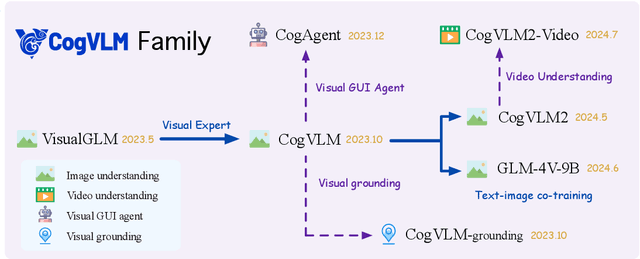


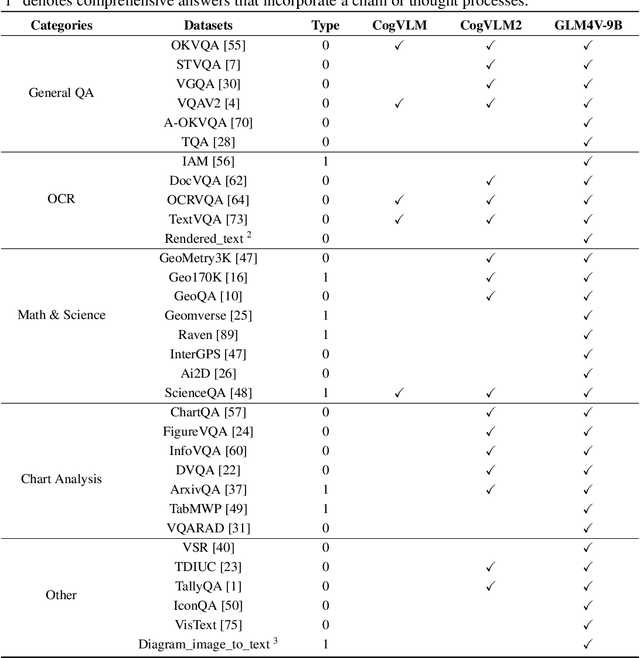
Beginning with VisualGLM and CogVLM, we are continuously exploring VLMs in pursuit of enhanced vision-language fusion, efficient higher-resolution architecture, and broader modalities and applications. Here we propose the CogVLM2 family, a new generation of visual language models for image and video understanding including CogVLM2, CogVLM2-Video and GLM-4V. As an image understanding model, CogVLM2 inherits the visual expert architecture with improved training recipes in both pre-training and post-training stages, supporting input resolution up to $1344 \times 1344$ pixels. As a video understanding model, CogVLM2-Video integrates multi-frame input with timestamps and proposes automated temporal grounding data construction. Notably, CogVLM2 family has achieved state-of-the-art results on benchmarks like MMBench, MM-Vet, TextVQA, MVBench and VCGBench. All models are open-sourced in https://github.com/THUDM/CogVLM2 and https://github.com/THUDM/GLM-4, contributing to the advancement of the field.