 Add to Chrome
 Add to Firefox
 Add to Edge
Joint Consistency: A Unified Test-Time Aggregation Framework via Energy Minimization
May 07, 2026
This paper studies test-time aggregation, an approach that generates multiple reasoning traces and aggregates them into a final answer. Most existing methods rely on evaluation signals collected from candidate traces in isolation or answer frequencies, while ignoring comparative interactions among candidates. We propose Joint Consistency (JC), formulated as a constrained Ising-type energy minimization problem, where independent evaluation signals act as external fields and pairwise comparisons act as interactions. JC provides a unified framework for test-time aggregation that subsumes existing voting and weighted aggregation methods as special cases. Our construction of the interaction matrix leverages LLM-as-a-judge comparisons, and admits a theoretical interpretation under answer-level homogeneity assumptions. Moreover, we develop an efficient approximation strategy that makes interaction modeling practical for large-scale test-time aggregation. Experiments on math and code reasoning benchmarks show that JC consistently outperforms existing baselines across tasks, judge models, trace budgets, and trace-generation settings.

Block-Sample MAC-Bayes Generalization Bounds
Feb 13, 2026We present a family of novel block-sample MAC-Bayes bounds (mean approximately correct). While PAC-Bayes bounds (probably approximately correct) typically give bounds for the generalization error that hold with high probability, MAC-Bayes bounds have a similar form but bound the expected generalization error instead. The family of bounds we propose can be understood as a generalization of an expectation version of known PAC-Bayes bounds. Compared to standard PAC-Bayes bounds, the new bounds contain divergence terms that only depend on subsets (or \emph{blocks}) of the training data. The proposed MAC-Bayes bounds hold the promise of significantly improving upon the tightness of traditional PAC-Bayes and MAC-Bayes bounds. This is illustrated with a simple numerical example in which the original PAC-Bayes bound is vacuous regardless of the choice of prior, while the proposed family of bounds are finite for appropriate choices of the block size. We also explore the question whether high-probability versions of our MAC-Bayes bounds (i.e., PAC-Bayes bounds of a similar form) are possible. We answer this question in the negative with an example that shows that in general, it is not possible to establish a PAC-Bayes bound which (a) vanishes with a rate faster than $\mathcal{O}(1/\log n)$ whenever the proposed MAC-Bayes bound vanishes with rate $\mathcal{O}(n^{-1/2})$ and (b) exhibits a logarithmic dependence on the permitted error probability.
LASER: Linear Compression in Wireless Distributed Optimization
Oct 19, 2023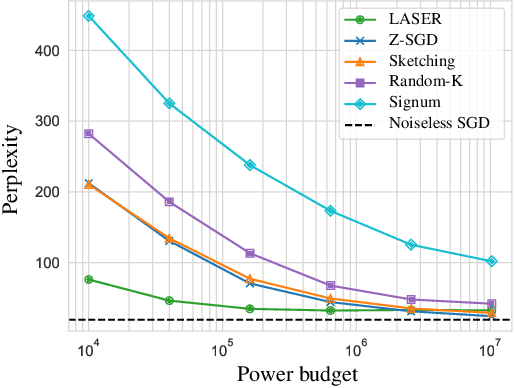
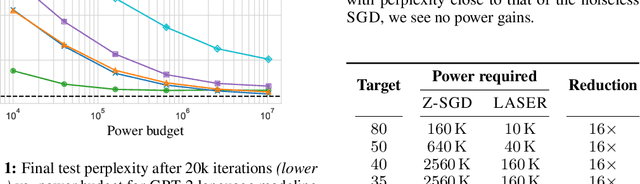

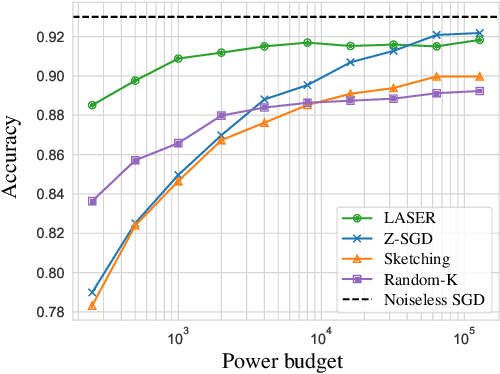
Data-parallel SGD is the de facto algorithm for distributed optimization, especially for large scale machine learning. Despite its merits, communication bottleneck is one of its persistent issues. Most compression schemes to alleviate this either assume noiseless communication links, or fail to achieve good performance on practical tasks. In this paper, we close this gap and introduce LASER: LineAr CompreSsion in WirEless DistRibuted Optimization. LASER capitalizes on the inherent low-rank structure of gradients and transmits them efficiently over the noisy channels. Whilst enjoying theoretical guarantees similar to those of the classical SGD, LASER shows consistent gains over baselines on a variety of practical benchmarks. In particular, it outperforms the state-of-the-art compression schemes on challenging computer vision and GPT language modeling tasks. On the latter, we obtain $50$-$64 \%$ improvement in perplexity over our baselines for noisy channels.