 Add to Chrome
 Add to Firefox
 Add to Edge
Generative Spatiotemporal Data Augmentation
Dec 14, 2025
We explore spatiotemporal data augmentation using video foundation models to diversify both camera viewpoints and scene dynamics. Unlike existing approaches based on simple geometric transforms or appearance perturbations, our method leverages off-the-shelf video diffusion models to generate realistic 3D spatial and temporal variations from a given image dataset. Incorporating these synthesized video clips as supplemental training data yields consistent performance gains in low-data settings, such as UAV-captured imagery where annotations are scarce. Beyond empirical improvements, we provide practical guidelines for (i) choosing an appropriate spatiotemporal generative setup, (ii) transferring annotations to synthetic frames, and (iii) addressing disocclusion - regions newly revealed and unlabeled in generated views. Experiments on COCO subsets and UAV-captured datasets show that, when applied judiciously, spatiotemporal augmentation broadens the data distribution along axes underrepresented by traditional and prior generative methods, offering an effective lever for improving model performance in data-scarce regimes.

PhyBench: A Physical Commonsense Benchmark for Evaluating Text-to-Image Models
Jun 17, 2024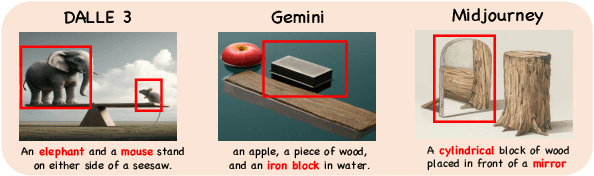
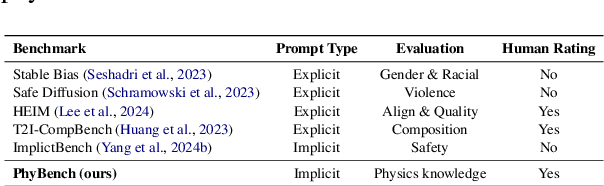
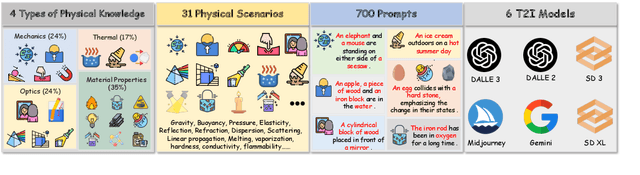
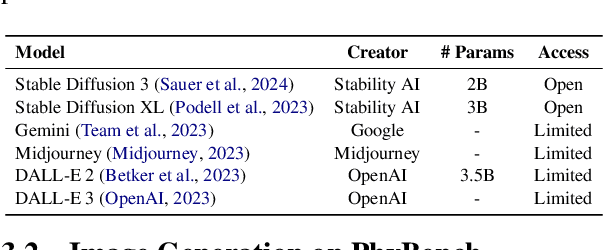
Text-to-image (T2I) models have made substantial progress in generating images from textual prompts. However, they frequently fail to produce images consistent with physical commonsense, a vital capability for applications in world simulation and everyday tasks. Current T2I evaluation benchmarks focus on metrics such as accuracy, bias, and safety, neglecting the evaluation of models' internal knowledge, particularly physical commonsense. To address this issue, we introduce PhyBench, a comprehensive T2I evaluation dataset comprising 700 prompts across 4 primary categories: mechanics, optics, thermodynamics, and material properties, encompassing 31 distinct physical scenarios. We assess 6 prominent T2I models, including proprietary models DALLE3 and Gemini, and demonstrate that incorporating physical principles into prompts enhances the models' ability to generate physically accurate images. Our findings reveal that: (1) even advanced models frequently err in various physical scenarios, except for optics; (2) GPT-4o, with item-specific scoring instructions, effectively evaluates the models' understanding of physical commonsense, closely aligning with human assessments; and (3) current T2I models are primarily focused on text-to-image translation, lacking profound reasoning regarding physical commonsense. We advocate for increased attention to the inherent knowledge within T2I models, beyond their utility as mere image generation tools. The code and data are available at https://github.com/OpenGVLab/PhyBench.