 Add to Chrome
 Add to Firefox
 Add to Edge
Towards Knowledgeable Deep Research: Framework and Benchmark
Apr 09, 2026
Deep Research (DR) requires LLM agents to autonomously perform multi-step information seeking, processing, and reasoning to generate comprehensive reports. In contrast to existing studies that mainly focus on unstructured web content, a more challenging DR task should additionally utilize structured knowledge to provide a solid data foundation, facilitate quantitative computation, and lead to in-depth analyses. In this paper, we refer to this novel task as Knowledgeable Deep Research (KDR), which requires DR agents to generate reports with both structured and unstructured knowledge. Furthermore, we propose the Hybrid Knowledge Analysis framework (HKA), a multi-agent architecture that reasons over both kinds of knowledge and integrates the texts, figures, and tables into coherent multimodal reports. The key design is the Structured Knowledge Analyzer, which utilizes both coding and vision-language models to produce figures, tables, and corresponding insights. To support systematic evaluation, we construct KDR-Bench, which covers 9 domains, includes 41 expert-level questions, and incorporates a large number of structured knowledge resources (e.g., 1,252 tables). We further annotate the main conclusions and key points for each question and propose three categories of evaluation metrics including general-purpose, knowledge-centric, and vision-enhanced ones. Experimental results demonstrate that HKA consistently outperforms most existing DR agents on general-purpose and knowledge-centric metrics, and even surpasses the Gemini DR agent on vision-enhanced metrics, highlighting its effectiveness in deep, structure-aware knowledge analysis. Finally, we hope this work can serve as a new foundation for structured knowledge analysis in DR agents and facilitate future multimodal DR studies.

UserLM-R1: Modeling Human Reasoning in User Language Models with Multi-Reward Reinforcement Learning
Jan 14, 2026User simulators serve as the critical interactive environment for agent post-training, and an ideal user simulator generalizes across domains and proactively engages in negotiation by challenging or bargaining. However, current methods exhibit two issues. They rely on static and context-unaware profiles, necessitating extensive manual redesign for new scenarios, thus limiting generalizability. Moreover, they neglect human strategic thinking, leading to vulnerability to agent manipulation. To address these issues, we propose UserLM-R1, a novel user language model with reasoning capability. Specifically, we first construct comprehensive user profiles with both static roles and dynamic scenario-specific goals for adaptation to diverse scenarios. Then, we propose a goal-driven decision-making policy to generate high-quality rationales before producing responses, and further refine the reasoning and improve strategic capabilities with supervised fine-tuning and multi-reward reinforcement learning. Extensive experimental results demonstrate that UserLM-R1 outperforms competitive baselines, particularly on the more challenging adversarial set.
KnowCoder-V2: Deep Knowledge Analysis
Jun 07, 2025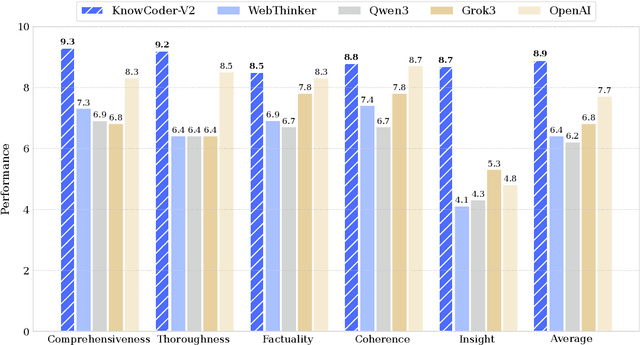
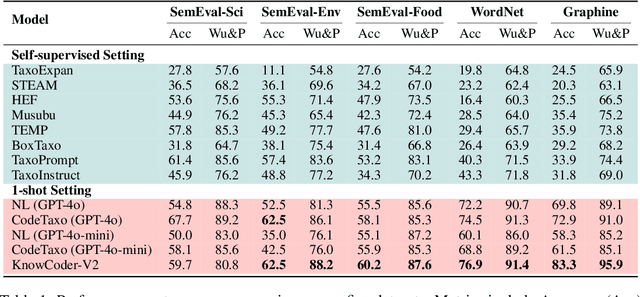
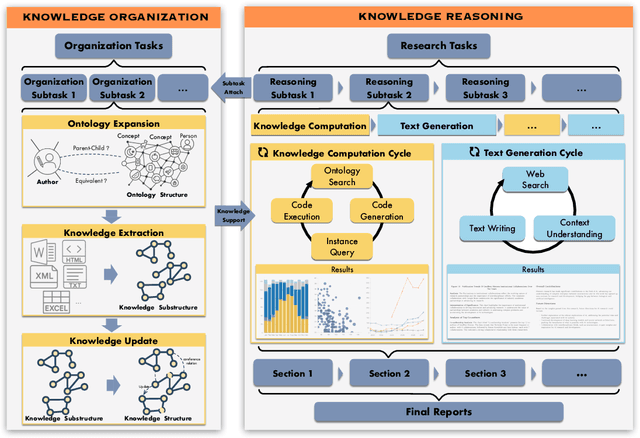
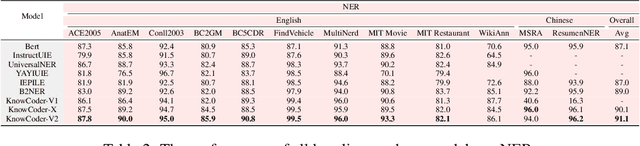
Deep knowledge analysis tasks always involve the systematic extraction and association of knowledge from large volumes of data, followed by logical reasoning to discover insights. However, to solve such complex tasks, existing deep research frameworks face three major challenges: 1) They lack systematic organization and management of knowledge; 2) They operate purely online, making it inefficient for tasks that rely on shared and large-scale knowledge; 3) They cannot perform complex knowledge computation, limiting their abilities to produce insightful analytical results. Motivated by these, in this paper, we propose a \textbf{K}nowledgeable \textbf{D}eep \textbf{R}esearch (\textbf{KDR}) framework that empowers deep research with deep knowledge analysis capability. Specifically, it introduces an independent knowledge organization phase to preprocess large-scale, domain-relevant data into systematic knowledge offline. Based on this knowledge, it extends deep research with an additional kind of reasoning steps that perform complex knowledge computation in an online manner. To enhance the abilities of LLMs to solve knowledge analysis tasks in the above framework, we further introduce \textbf{\KCII}, an LLM that bridges knowledge organization and reasoning via unified code generation. For knowledge organization, it generates instantiation code for predefined classes, transforming data into knowledge objects. For knowledge computation, it generates analysis code and executes on the above knowledge objects to obtain deep analysis results. Experimental results on more than thirty datasets across six knowledge analysis tasks demonstrate the effectiveness of \KCII. Moreover, when integrated into the KDR framework, \KCII can generate high-quality reports with insightful analytical results compared to the mainstream deep research framework.