 Add to Chrome
 Add to Firefox
 Add to Edge
Traverse the Non-Traversable: Estimating Traversability for Wheeled Mobility on Vertically Challenging Terrain
Sep 26, 2024
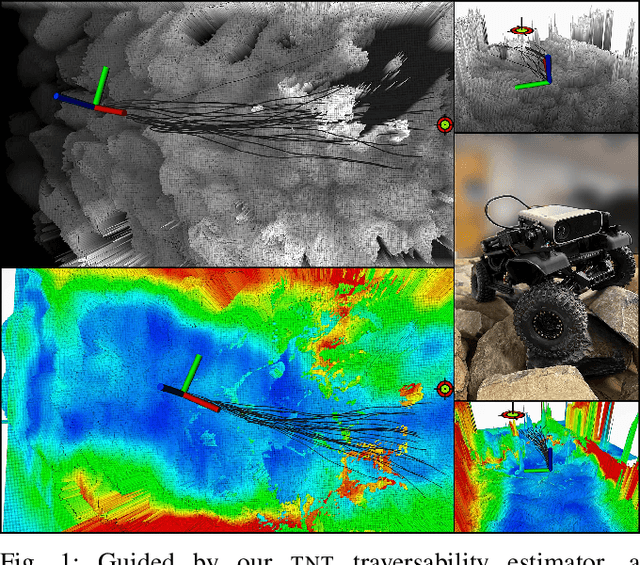
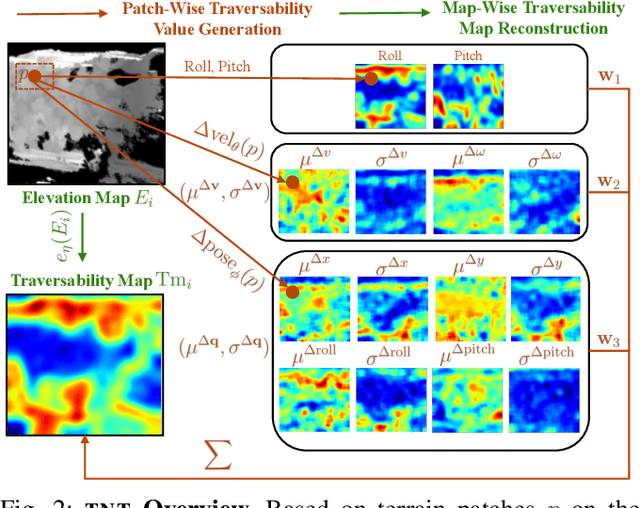
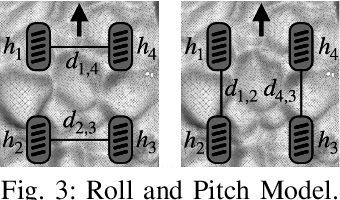
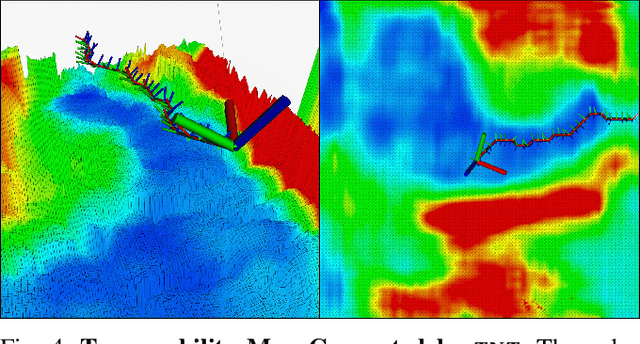
Most traversability estimation techniques divide off-road terrain into traversable (e.g., pavement, gravel, and grass) and non-traversable (e.g., boulders, vegetation, and ditches) regions and then inform subsequent planners to produce trajectories on the traversable part. However, recent research demonstrated that wheeled robots can traverse vertically challenging terrain (e.g., extremely rugged boulders comparable in size to the vehicles themselves), which unfortunately would be deemed as non-traversable by existing techniques. Motivated by such limitations, this work aims at identifying the traversable from the seemingly non-traversable, vertically challenging terrain based on past kinodynamic vehicle-terrain interactions in a data-driven manner. Our new Traverse the Non-Traversable(TNT) traversability estimator can efficiently guide a down-stream sampling-based planner containing a high-precision 6-DoF kinodynamic model, which becomes deployable onboard a small-scale vehicle. Additionally, the estimated traversability can also be used as a costmap to plan global and local paths without sampling. Our experiment results show that TNT can improve planning performance, efficiency, and stability by 50%, 26.7%, and 9.2% respectively on a physical robot platform.

Verti-Selector: Automatic Curriculum Learning for Wheeled Mobility on Vertically Challenging Terrain
Sep 26, 2024


Reinforcement Learning (RL) has the potential to enable extreme off-road mobility by circumventing complex kinodynamic modeling, planning, and control by simulated end-to-end trial-and-error learning experiences. However, most RL methods are sample-inefficient when training in a large amount of manually designed simulation environments and struggle at generalizing to the real world. To address these issues, we introduce Verti-Selector (VS), an automatic curriculum learning framework designed to enhance learning efficiency and generalization by selectively sampling training terrain. VS prioritizes vertically challenging terrain with higher Temporal Difference (TD) errors when revisited, thereby allowing robots to learn at the edge of their evolving capabilities. By dynamically adjusting the sampling focus, VS significantly boosts sample efficiency and generalization within the VW-Chrono simulator built on the Chrono multi-physics engine. Furthermore, we provide simulation and physical results using VS on a Verti-4-Wheeler platform. These results demonstrate that VS can achieve 23.08% improvement in terms of success rate by efficiently sampling during training and robustly generalizing to the real world.
GND: Global Navigation Dataset with Multi-Modal Perception and Multi-Category Traversability in Outdoor Campus Environments
Sep 21, 2024


Navigating large-scale outdoor environments requires complex reasoning in terms of geometric structures, environmental semantics, and terrain characteristics, which are typically captured by onboard sensors such as LiDAR and cameras. While current mobile robots can navigate such environments using pre-defined, high-precision maps based on hand-crafted rules catered for the specific environment, they lack commonsense reasoning capabilities that most humans possess when navigating unknown outdoor spaces. To address this gap, we introduce the Global Navigation Dataset (GND), a large-scale dataset that integrates multi-modal sensory data, including 3D LiDAR point clouds and RGB and 360-degree images, as well as multi-category traversability maps (pedestrian walkways, vehicle roadways, stairs, off-road terrain, and obstacles) from ten university campuses. These environments encompass a variety of parks, urban settings, elevation changes, and campus layouts of different scales. The dataset covers approximately 2.7km2 and includes at least 350 buildings in total. We also present a set of novel applications of GND to showcase its utility to enable global robot navigation, such as map-based global navigation, mapless navigation, and global place recognition.
VertiEncoder: Self-Supervised Kinodynamic Representation Learning on Vertically Challenging Terrain
Sep 17, 2024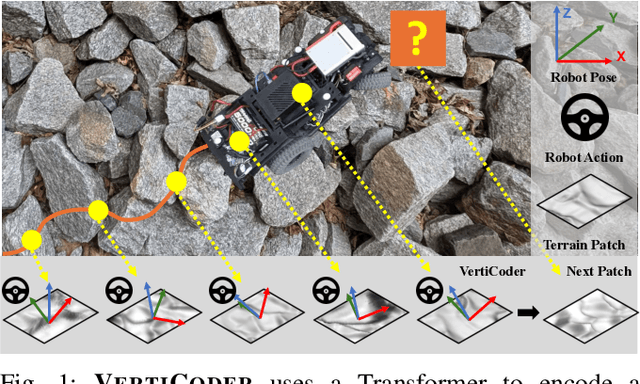
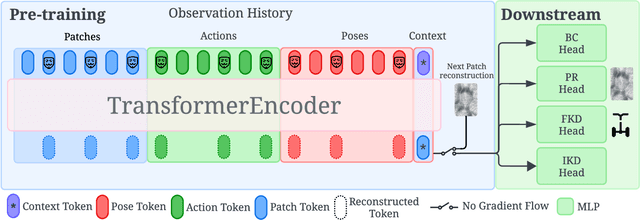
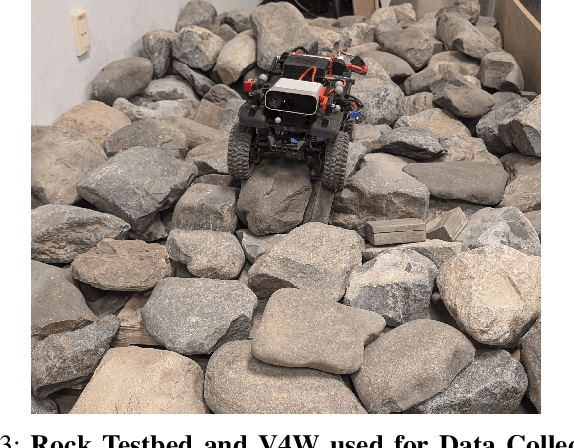
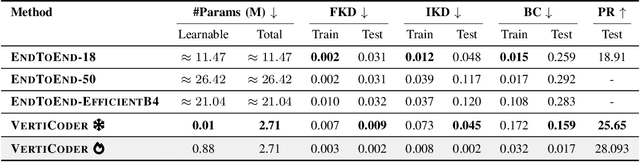
We present VertiEncoder, a self-supervised representation learning approach for robot mobility on vertically challenging terrain. Using the same pre-training process, VertiEncoder can handle four different downstream tasks, including forward kinodynamics learning, inverse kinodynamics learning, behavior cloning, and patch reconstruction with a single representation. VertiEncoder uses a TransformerEncoder to learn the local context of its surroundings by random masking and next patch reconstruction. We show that VertiEncoder achieves better performance across all four different tasks compared to specialized End-to-End models with 77% fewer parameters. We also show VertiEncoder's comparable performance against state-of-the-art kinodynamic modeling and planning approaches in real-world robot deployment. These results underscore the efficacy of VertiEncoder in mitigating overfitting and fostering more robust generalization across diverse environmental contexts and downstream vehicle kinodynamic tasks.
Multi-Robot Coordination Induced in Hazardous Environments through an Adversarial Graph-Traversal Game
Sep 12, 2024


This paper presents a game theoretic formulation of a graph traversal problem, with applications to robots moving through hazardous environments in the presence of an adversary, as in military and security applications. The blue team of robots moves in an environment modeled by a time-varying graph, attempting to reach some goal with minimum cost, while the red team controls how the graph changes to maximize the cost. The problem is formulated as a stochastic game, so that Nash equilibrium strategies can be computed numerically. Bounds are provided for the game value, with a guarantee that it solves the original problem. Numerical simulations demonstrate the results and the effectiveness of this method, particularly showing the benefit of mixing actions for both players, as well as beneficial coordinated behavior, where blue robots split up and/or synchronize to traverse risky edges.
Reinforcement Learning for Wheeled Mobility on Vertically Challenging Terrain
Sep 04, 2024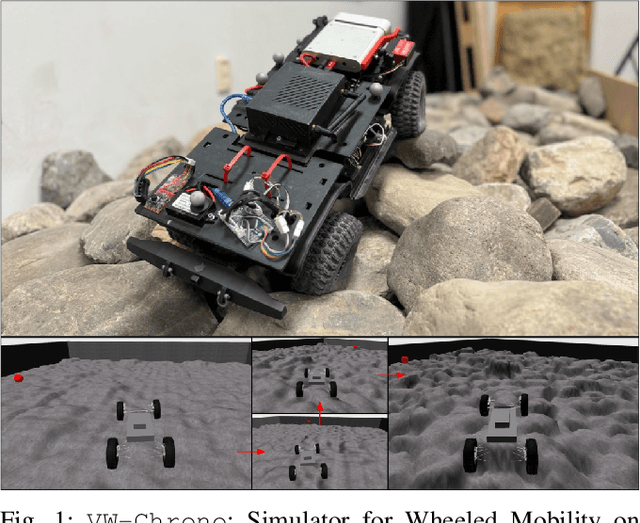
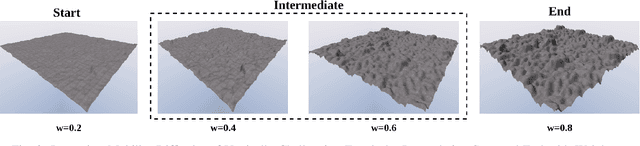
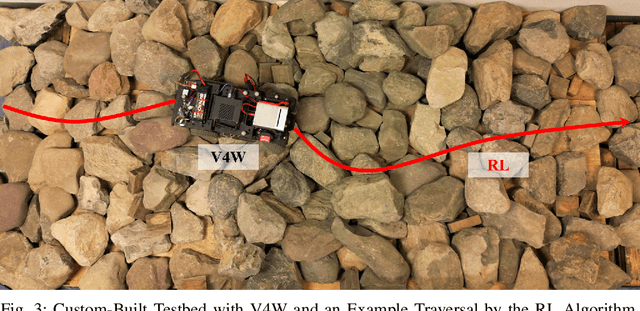
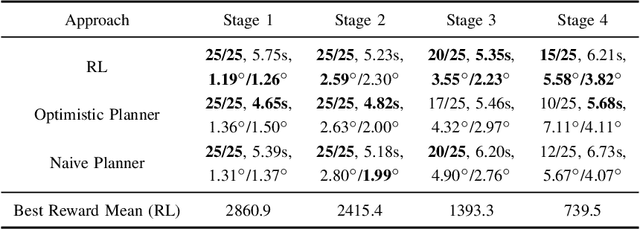
Off-road navigation on vertically challenging terrain, involving steep slopes and rugged boulders, presents significant challenges for wheeled robots both at the planning level to achieve smooth collision-free trajectories and at the control level to avoid rolling over or getting stuck. Considering the complex model of wheel-terrain interactions, we develop an end-to-end Reinforcement Learning (RL) system for an autonomous vehicle to learn wheeled mobility through simulated trial-and-error experiences. Using a custom-designed simulator built on the Chrono multi-physics engine, our approach leverages Proximal Policy Optimization (PPO) and a terrain difficulty curriculum to refine a policy based on a reward function to encourage progress towards the goal and penalize excessive roll and pitch angles, which circumvents the need of complex and expensive kinodynamic modeling, planning, and control. Additionally, we present experimental results in the simulator and deploy our approach on a physical Verti-4-Wheeler (V4W) platform, demonstrating that RL can equip conventional wheeled robots with previously unrealized potential of navigating vertically challenging terrain.
PIETRA: Physics-Informed Evidential Learning for Traversing Out-of-Distribution Terrain
Sep 04, 2024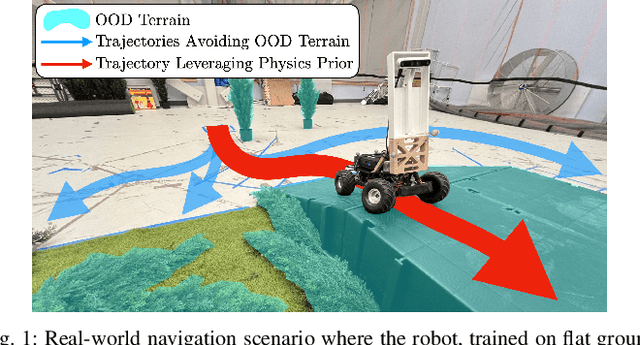
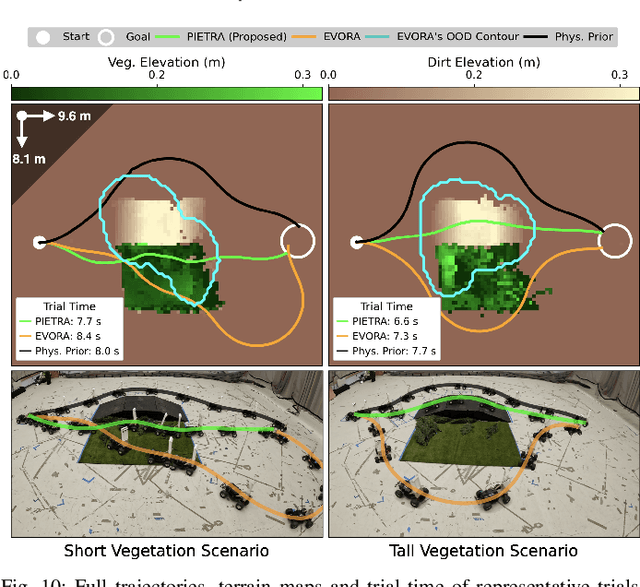
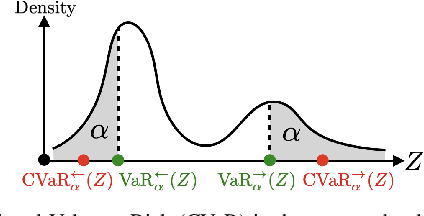
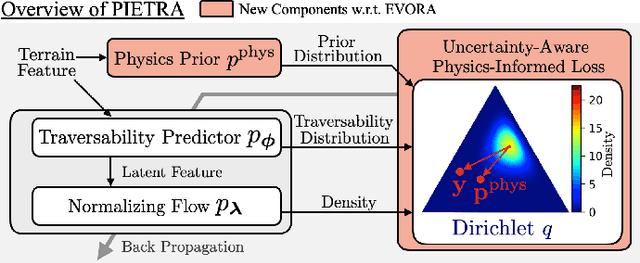
Self-supervised learning is a powerful approach for developing traversability models for off-road navigation, but these models often struggle with inputs unseen during training. Existing methods utilize techniques like evidential deep learning to quantify model uncertainty, helping to identify and avoid out-of-distribution terrain. However, always avoiding out-of-distribution terrain can be overly conservative, e.g., when novel terrain can be effectively analyzed using a physics-based model. To overcome this challenge, we introduce Physics-Informed Evidential Traversability (PIETRA), a self-supervised learning framework that integrates physics priors directly into the mathematical formulation of evidential neural networks and introduces physics knowledge implicitly through an uncertainty-aware, physics-informed training loss. Our evidential network seamlessly transitions between learned and physics-based predictions for out-of-distribution inputs. Additionally, the physics-informed loss regularizes the learned model, ensuring better alignment with the physics model. Extensive simulations and hardware experiments demonstrate that PIETRA improves both learning accuracy and navigation performance in environments with significant distribution shifts.
TGS: Trajectory Generation and Selection using Vision Language Models in Mapless Outdoor Environments
Aug 07, 2024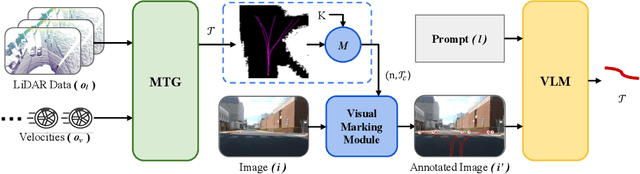
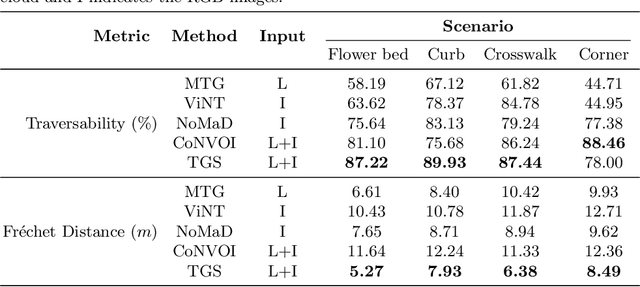
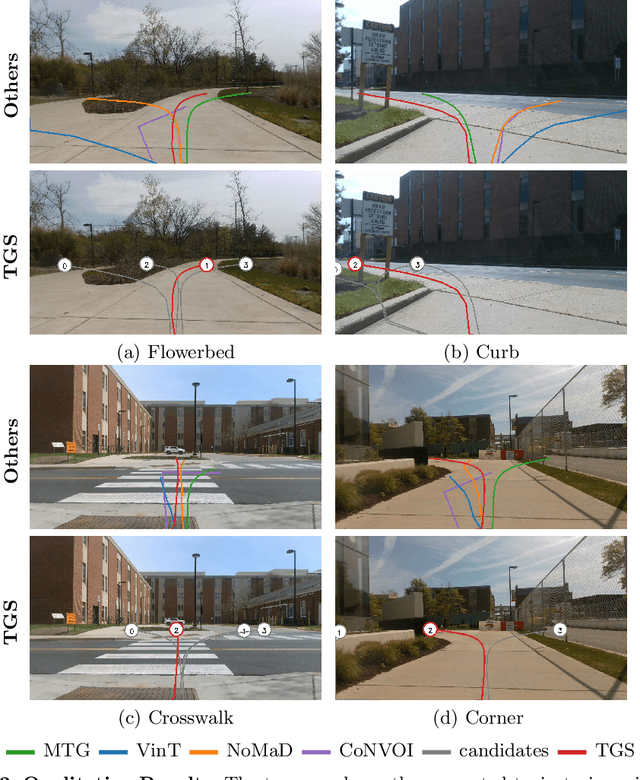
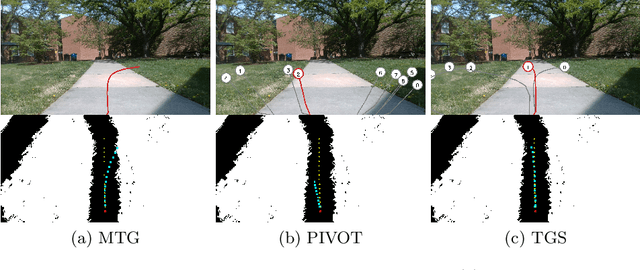
We present a multi-modal trajectory generation and selection algorithm for real-world mapless outdoor navigation in challenging scenarios with unstructured off-road features like buildings, grass, and curbs. Our goal is to compute suitable trajectories that (1) satisfy the environment-specific traversability constraints and (2) generate human-like paths while navigating in crosswalks, sidewalks, etc. Our formulation uses a Conditional Variational Autoencoder (CVAE) generative model enhanced with traversability constraints to generate multiple candidate trajectories for global navigation. We use VLMs and a visual prompting approach with their zero-shot ability of semantic understanding and logical reasoning to choose the best trajectory given the contextual information about the task. We evaluate our methods in various outdoor scenes with wheeled robots and compare the performance with other global navigation algorithms. In practice, we observe at least 3.35% improvement in traversability and 20.61% improvement in terms of human-like navigation in generated trajectories in challenging outdoor navigation scenarios.
Anticipatory Task and Motion Planning
Jul 18, 2024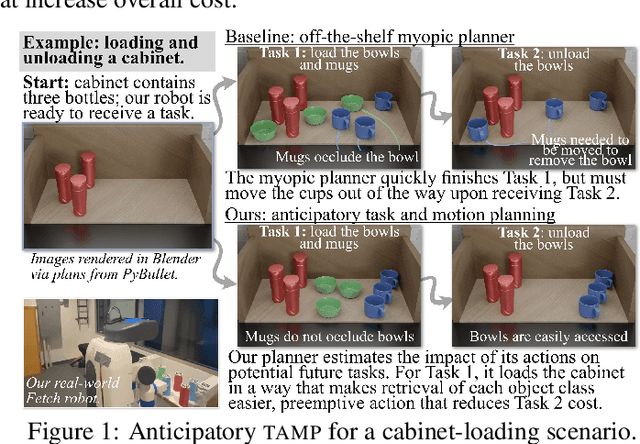

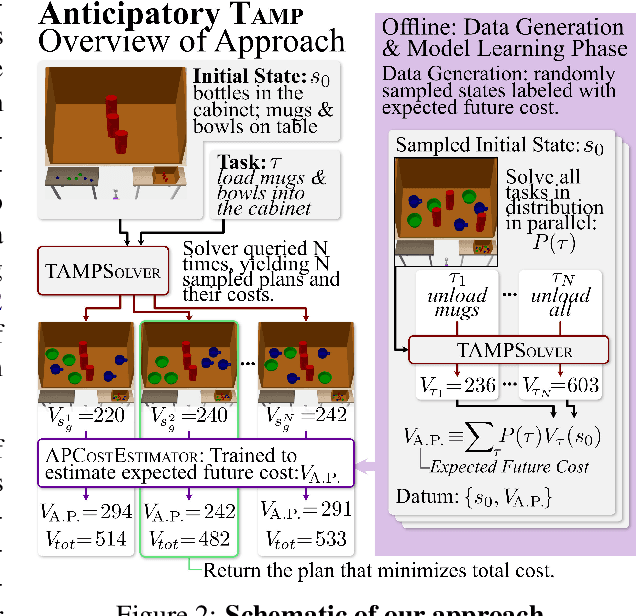

We consider a sequential task and motion planning (tamp) setting in which a robot is assigned continuous-space rearrangement-style tasks one-at-a-time in an environment that persists between each. Lacking advance knowledge of future tasks, existing (myopic) planning strategies unwittingly introduce side effects that impede completion of subsequent tasks: e.g., by blocking future access or manipulation. We present anticipatory task and motion planning, in which estimates of expected future cost from a learned model inform selection of plans generated by a model-based tamp planner so as to avoid such side effects, choosing configurations of the environment that both complete the task and minimize overall cost. Simulated multi-task deployments in navigation-among-movable-obstacles and cabinet-loading domains yield improvements of 32.7% and 16.7% average per-task cost respectively. When given time in advance to prepare the environment, our learning-augmented planning approach yields improvements of 83.1% and 22.3%. Both showcase the value of our approach. Finally, we also demonstrate anticipatory tamp on a real-world Fetch mobile manipulator.
Multi-Goal Motion Memory
Jul 16, 2024Autonomous mobile robots (e.g., warehouse logistics robots) often need to traverse complex, obstacle-rich, and changing environments to reach multiple fixed goals (e.g., warehouse shelves). Traditional motion planners need to calculate the entire multi-goal path from scratch in response to changes in the environment, which result in a large consumption of computing resources. This process is not only time-consuming but also may not meet real-time requirements in application scenarios that require rapid response to environmental changes. In this paper, we provide a novel Multi-Goal Motion Memory technique that allows robots to use previous planning experiences to accelerate future multi-goal planning in changing environments. Specifically, our technique predicts collision-free and dynamically-feasible trajectories and distances between goal pairs to guide the sampling process to build a roadmap, to inform a Traveling Salesman Problem (TSP) solver to compute a tour, and to efficiently produce motion plans. Experiments conducted with a vehicle and a snake-like robot in obstacle-rich environments show that the proposed Motion Memory technique can substantially accelerate planning speed by up to 90\%. Furthermore, the solution quality is comparable to state-of-the-art algorithms and even better in some environments.