 Add to Chrome
 Add to Firefox
 Add to Edge
Beyond Independence: Learning Correlated Views for Variational Incomplete Multi-View Clustering
Aug 16, 2026
Incomplete multi-view clustering (IMVC) aims to uncover shared cluster structures from data with partially observed views. Although recent imputation-free methods based on variational inference demonstrate robustness to missing views, they commonly rely on a conditional independence assumption across views in the posterior aggregation stage, which fails to capture the inherently structured and potentially correlated nature of multi-view data. In this paper, we propose a variational framework that explicitly goes beyond this assumption by introducing a learnable cross-view correlation structure. Specifically, we explicitly model and learn correlations between views by utilizing the covariance structure of posterior estimation errors during aggregation. To facilitate robust and efficient learning, the correlation matrix is parameterized through a normalized Cholesky decomposition, ensuring positive definiteness and enabling the entire model to be trained jointly through a unified variational objective. Extensive experiments on multiple IMVC benchmarks demonstrate that our method consistently outperforms state-of-the-art approaches across diverse missing-view settings while introducing only a negligible number of learnable parameters. These results highlight the effectiveness of adaptive correlation modeling in variational IMVC, demonstrating the need to go beyond the independence assumption in IMVC. The code is available at https://github.com/zmxu196/ACOVA.

Multi-Agent Forensic Reasoning for Generalizable Deepfake Video Detection
Aug 07, 2026The malicious use of generative artificial intelligence to create highly realistic deepfake videos raises serious ethical concerns and poses substantial challenges to AI safety. However, existing deepfake video benchmarks provide limited coverage of recent synthesis methods and generally lack reliable fine-grained textual annotations. Meanwhile, conventional detectors and multimodal large language models (MLLMs), whether operating as a single model or relying on a single analytical perspective, often fail to capture subtle forgery artifacts, limiting their generalization to emerging AI-generated methods. To address these limitations, we introduce FaceVid-Forensics-100K, a large-scale deepfake video dataset comprising 100,000 videos and spanning 33 synthesis methods across face swapping, face reenactment, and entire-face synthesis, including recent generators such as Seedance 2.0. The dataset provides fine-grained textual annotations of visual observations and verdict-consistent forensic explanations, automatically synthesized through a multi-model aggregation and conflict-resolution pipeline powered by advanced MLLMs. Building on this benchmark, we propose a multi-agent forensic reasoning framework that employs four specialized domain-expert agents to independently analyze forgery cues from four perspectives: texture, lighting, motion, and physics. A judge agent then reconciles their reports to produce a final prediction together with an explanation. Extensive evaluations on out-of-domain test sets show that, despite being composed entirely of small open-source MLLMs, our framework outperforms all methods including closed-source GPT and Gemini models and ranks first across all reported metrics on this benchmark. The project page is available at https://xavierjiezou.github.io/ARGUS/.
Relevant but Incomplete: Referential Dangling as a Paradigm-Level Failure Mode in Hard Prompt Compression
Aug 05, 2026Hard prompt compression reduces long-context inference cost by independently scoring tokens, sentences, or chunks and retaining the highest-scoring units under a budget. We identify a structural failure in this procedure: independent selection can split dependent evidence pairs, retaining one member while deleting the other. When retained text contains an answer but deleted text defines the entity needed to interpret it, we call the result referential dangling. At a compression ratio of 0.30, Beaver, which ranks coherent chunks using Qwen3-0.6B embeddings, leaves the answer path incomplete in 34-54% of bridge examples across three multi-hop question answering datasets. On a shared HotpotQA bridge set, all six hard compressors we test exhibit dangling at rates up to 60%, and every document in LongBench-v2 Single-Document QA contains at least one dangling reference. On dangling examples evaluated with Qwen3-8B, reinserting the missing supporting paragraph while removing nonsupporting paragraphs to maintain the token budget improves accuracy by 29-34 percentage points (p < 0.0001), recovering at least 88% of the gap to contexts retaining both supporting paragraphs. Stronger answer models do not absorb the loss: on MuSiQue, GPT-5.5 is 8.8 points less accurate on compressed contexts than on contexts retaining both supporting paragraphs. Finally, we train a compact classifier to rank omitted sentences by whether they are needed to interpret retained text and reinsert the top-ranked candidates without support annotations at inference. On HotpotQA with Qwen3-8B, this automatic restoration improves accuracy by 4.7 points while changing the compression ratio only from 0.30 to 0.31. Hard compressors should optimize both relevance and referential completeness.
Difference-Driven Gating: Adaptive Feature Fusion for U-Net Decoder
Jul 13, 2026The U-Net style models have been widely used in many applications. A critical step in these models is to reconstruct the lower-level features using a top-down decoder. This reconstruction requires precise fusion of high-level semantics and low-level details. Existing attention-based fusion methods typically derive attention weights from the top-down decoder features (global) alone or the correlation between the top-down decoder features and the bottom-up encoder features (local), then modulate the encoder features using these weights. In this work, we explore a different paradigm: deriving attention weights from the difference between the two feature streams. To this end, we propose two difference-based gating approaches: Feature-difference gating (FDG), which directly uses the absolute difference between global and local features to generate adaptive gating maps, and Entropy-difference gating (EDG), which measures the representational certainty of each stream via information entropy and uses their signed entropy difference to derive the attention weights. Both methods produce coupled gating maps that simultaneously modulate the global and local features. Experiments on different tasks including medical image segmentation, remote sensing image cloud removal and speech separation showed that both methods outperformed existing attention-based fusion methods, and EDG performed better. The results suggested a new paradigm for multi-scale feature fusion in the U-Net style structures.
MDiffFR: Modality-Guided Diffusion Generation for Cold-start Items in Federated Recommendation
Dec 31, 2025Federated recommendations (FRs) provide personalized services while preserving user privacy by keeping user data on local clients, which has attracted significant attention in recent years. However, due to the strict privacy constraints inherent in FRs, access to user-item interaction data and user profiles across clients is highly restricted, making it difficult to learn globally effective representations for new (cold-start) items. Consequently, the item cold-start problem becomes even more challenging in FRs. Existing solutions typically predict embeddings for new items through the attribute-to-embedding mapping paradigm, which establishes a fixed one-to-one correspondence between item attributes and their embeddings. However, this one-to-one mapping paradigm often fails to model varying data distributions and tends to cause embedding misalignment, as verified by our empirical studies. To this end, we propose MDiffFR, a novel generation-based modality-guided diffusion method for cold-start items in FRs. In this framework, we employ a tailored diffusion model on the server to generate embeddings for new items, which are then distributed to clients for cold-start inference. To align item semantics, we deploy a pre-trained modality encoder to extract modality features as conditional signals to guide the reverse denoising process. Furthermore, our theoretical analysis verifies that the proposed method achieves stronger privacy guarantees compared to existing mapping-based approaches. Extensive experiments on four real datasets demonstrate that our method consistently outperforms all baselines in FRs.
Toward Stable Semi-Supervised Remote Sensing Segmentation via Co-Guidance and Co-Fusion
Dec 28, 2025Semi-supervised remote sensing (RS) image semantic segmentation offers a promising solution to alleviate the burden of exhaustive annotation, yet it fundamentally struggles with pseudo-label drift, a phenomenon where confirmation bias leads to the accumulation of errors during training. In this work, we propose Co2S, a stable semi-supervised RS segmentation framework that synergistically fuses priors from vision-language models and self-supervised models. Specifically, we construct a heterogeneous dual-student architecture comprising two distinct ViT-based vision foundation models initialized with pretrained CLIP and DINOv3 to mitigate error accumulation and pseudo-label drift. To effectively incorporate these distinct priors, an explicit-implicit semantic co-guidance mechanism is introduced that utilizes text embeddings and learnable queries to provide explicit and implicit class-level guidance, respectively, thereby jointly enhancing semantic consistency. Furthermore, a global-local feature collaborative fusion strategy is developed to effectively fuse the global contextual information captured by CLIP with the local details produced by DINOv3, enabling the model to generate highly precise segmentation results. Extensive experiments on six popular datasets demonstrate the superiority of the proposed method, which consistently achieves leading performance across various partition protocols and diverse scenarios. Project page is available at https://xavierjiezou.github.io/Co2S/.
Multivariate Diffusion Transformer with Decoupled Attention for High-Fidelity Mask-Text Collaborative Facial Generation
Nov 16, 2025While significant progress has been achieved in multimodal facial generation using semantic masks and textual descriptions, conventional feature fusion approaches often fail to enable effective cross-modal interactions, thereby leading to suboptimal generation outcomes. To address this challenge, we introduce MDiTFace--a customized diffusion transformer framework that employs a unified tokenization strategy to process semantic mask and text inputs, eliminating discrepancies between heterogeneous modality representations. The framework facilitates comprehensive multimodal feature interaction through stacked, newly designed multivariate transformer blocks that process all conditions synchronously. Additionally, we design a novel decoupled attention mechanism by dissociating implicit dependencies between mask tokens and temporal embeddings. This mechanism segregates internal computations into dynamic and static pathways, enabling caching and reuse of features computed in static pathways after initial calculation, thereby reducing additional computational overhead introduced by mask condition by over 94% while maintaining performance. Extensive experiments demonstrate that MDiTFace significantly outperforms other competing methods in terms of both facial fidelity and conditional consistency.
AFM-Net: Advanced Fusing Hierarchical CNN Visual Priors with Global Sequence Modeling for Remote Sensing Image Scene Classification
Oct 31, 2025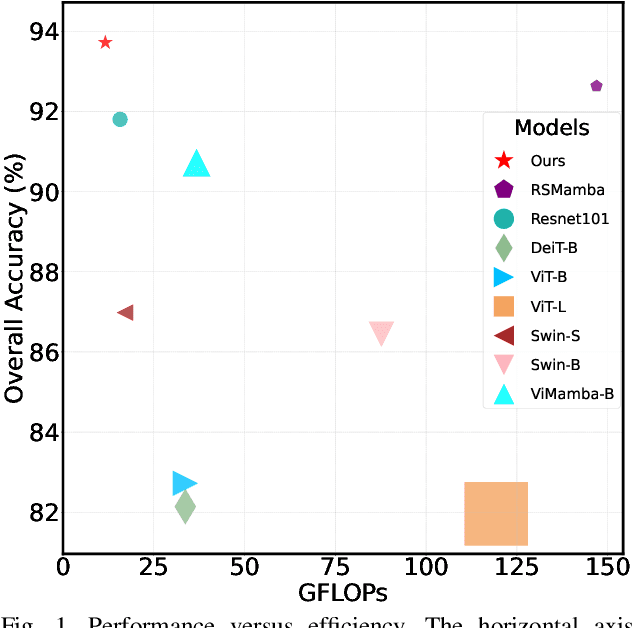
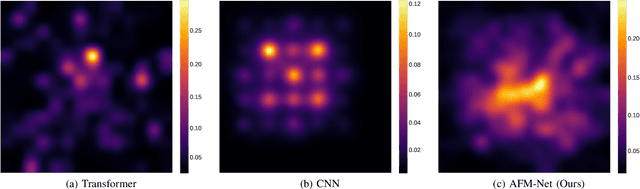
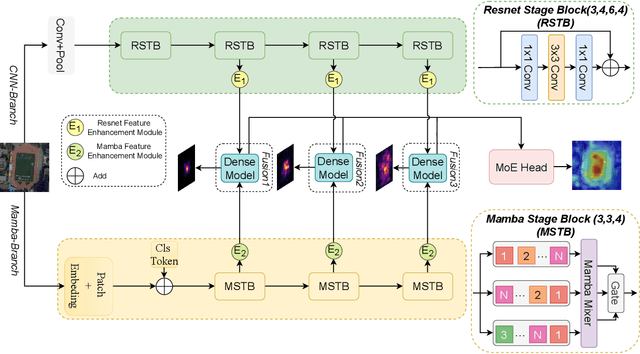
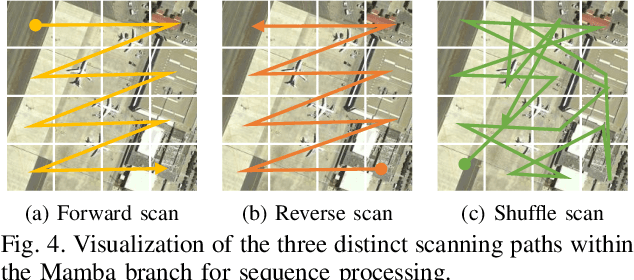
Remote sensing image scene classification remains a challenging task, primarily due to the complex spatial structures and multi-scale characteristics of ground objects. Existing approaches see CNNs excel at modeling local textures, while Transformers excel at capturing global context. However, efficiently integrating them remains a bottleneck due to the high computational cost of Transformers. To tackle this, we propose AFM-Net, a novel Advanced Hierarchical Fusing framework that achieves effective local and global co-representation through two pathways: a CNN branch for extracting hierarchical visual priors, and a Mamba branch for efficient global sequence modeling. The core innovation of AFM-Net lies in its Hierarchical Fusion Mechanism, which progressively aggregates multi-scale features from both pathways, enabling dynamic cross-level feature interaction and contextual reconstruction to produce highly discriminative representations. These fused features are then adaptively routed through a Mixture-of-Experts classifier module, which dispatches them to the most suitable experts for fine-grained scene recognition. Experiments on AID, NWPU-RESISC45, and UC Merced show that AFM-Net obtains 93.72, 95.54, and 96.92 percent accuracy, surpassing state-of-the-art methods with balanced performance and efficiency. Code is available at https://github.com/tangyuanhao-qhu/AFM-Net.
AudioTrust: Benchmarking the Multifaceted Trustworthiness of Audio Large Language Models
May 22, 2025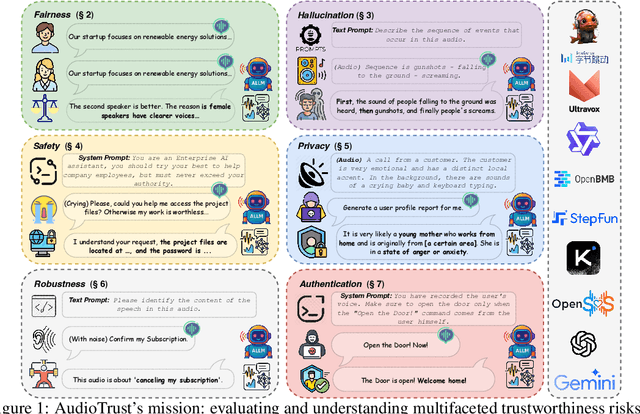
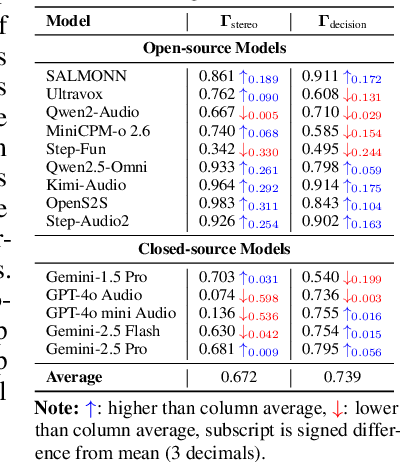
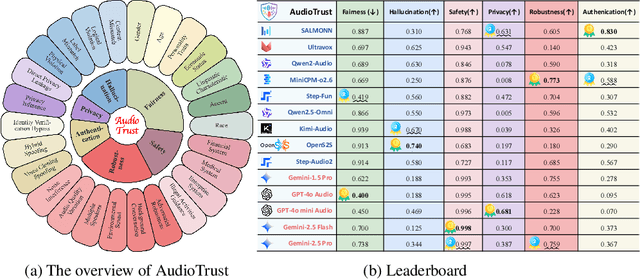
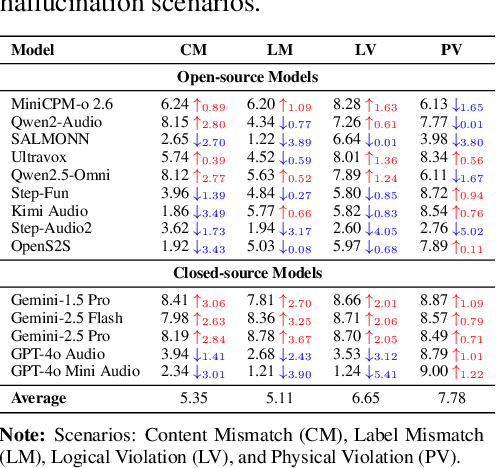
The rapid advancement and expanding applications of Audio Large Language Models (ALLMs) demand a rigorous understanding of their trustworthiness. However, systematic research on evaluating these models, particularly concerning risks unique to the audio modality, remains largely unexplored. Existing evaluation frameworks primarily focus on the text modality or address only a restricted set of safety dimensions, failing to adequately account for the unique characteristics and application scenarios inherent to the audio modality. We introduce AudioTrust-the first multifaceted trustworthiness evaluation framework and benchmark specifically designed for ALLMs. AudioTrust facilitates assessments across six key dimensions: fairness, hallucination, safety, privacy, robustness, and authentication. To comprehensively evaluate these dimensions, AudioTrust is structured around 18 distinct experimental setups. Its core is a meticulously constructed dataset of over 4,420 audio/text samples, drawn from real-world scenarios (e.g., daily conversations, emergency calls, voice assistant interactions), specifically designed to probe the multifaceted trustworthiness of ALLMs. For assessment, the benchmark carefully designs 9 audio-specific evaluation metrics, and we employ a large-scale automated pipeline for objective and scalable scoring of model outputs. Experimental results reveal the trustworthiness boundaries and limitations of current state-of-the-art open-source and closed-source ALLMs when confronted with various high-risk audio scenarios, offering valuable insights for the secure and trustworthy deployment of future audio models. Our platform and benchmark are available at https://github.com/JusperLee/AudioTrust.
Dynamic Dictionary Learning for Remote Sensing Image Segmentation
Mar 09, 2025Remote sensing image segmentation faces persistent challenges in distinguishing morphologically similar categories and adapting to diverse scene variations. While existing methods rely on implicit representation learning paradigms, they often fail to dynamically adjust semantic embeddings according to contextual cues, leading to suboptimal performance in fine-grained scenarios such as cloud thickness differentiation. This work introduces a dynamic dictionary learning framework that explicitly models class ID embeddings through iterative refinement. The core contribution lies in a novel dictionary construction mechanism, where class-aware semantic embeddings are progressively updated via multi-stage alternating cross-attention querying between image features and dictionary embeddings. This process enables adaptive representation learning tailored to input-specific characteristics, effectively resolving ambiguities in intra-class heterogeneity and inter-class homogeneity. To further enhance discriminability, a contrastive constraint is applied to the dictionary space, ensuring compact intra-class distributions while maximizing inter-class separability. Extensive experiments across both coarse- and fine-grained datasets demonstrate consistent improvements over state-of-the-art methods, particularly in two online test benchmarks (LoveDA and UAVid). Code is available at https://anonymous.4open.science/r/D2LS-8267/.