 Add to Chrome
 Add to Firefox
 Add to Edge
Never Too Late for Force: Accelerating VLA Post-Training with Reactive Force Injection
Jul 15, 2026
Pretrained vision-language-action (VLA) policies provide strong language-conditioned manipulation knowledge, but they remain largely vision-driven and can struggle once manipulation enters contact states where the scene is occluded, depth is ambiguous, or small force errors push execution off the offline demonstration distribution. We present LIFT (Late Reactive Injection of Force for VLA Post-Training), a force-aware post-training framework that adds contact reactivity to a pretrained VLA policy while preserving its general manipulation knowledge. LIFT grafts a reactive action expert beside the original action expert, initializes it from pretrained action weights, and injects recent 6D end-effector force through causal force memory and zero-initialized cross attention, enabling actions to be refreshed during execution. To address the policy-dependent distribution shift of contact feedback, LIFT further couples reactive force injection with an online DAgger loop that trains on a mixture of offline task-alignment data and human-corrected online rollouts. Across towel folding, book insertion, and Hanoi ring placement, LIFT learns faster and reaches higher performance than vision-only post-training, while ablations show that reactive force memory and online corrective data are both important for robust contact-rich manipulation. Our code and data will be publicly available.

Scaling by Diversified Experience for Vision-Language-Action Models
Jun 08, 2026Vision-Language-Action models face significant challenges in real-world deployment due to the entanglement of high-level reasoning with low-level control, and the instability of policy optimization. In this paper, we introduce SyVLA, a robust VLA model trained with diversified experiences. We propose an Intention Decoupling algorithm to isolate control-relevant features from reasoning contexts and a similar-sample guided RL pipeline to stabilize policy updates and mitigate distribution shift. Extensive experiments on real-world robotic tasks and multi-modal benchmarks demonstrate that SyVLA achieves superior task success rates and stronger out-of-distribution generalization compared to existing methods, while effectively preserving core vision-language capabilities. Codes and Datasets is released on \href{https://sy-vla.github.io/}{project page}.
World-Language-Action Model for Unified World Modeling, Language Reasoning, and Action Synthesis
Jun 04, 2026We propose world-language-action (WLA) models as a new class of embodied foundation models. WLA takes textual instructions, images, and robot states as inputs to jointly predict textual subtasks, subgoal images, and robot actions, conjoining the \emph{world modeling interface} to learn from extensive egocentric videos as in the world-action model (WAM) and the \emph{language reasoning} capacities to solve complex long-horizon tasks as in vision-language-action (VLA) models. At the core of WLA lies an \emph{autoregressive (AR)} Transformer backbone, instead of a bidirectional diffusion Transformer as in WAMs, to predict the \emph{next state}, comprising the \emph{semantic-level} textual intention and complementary \emph{fine-grained} physical dynamics. The physical dynamics are supervised by the world modeling objective based on a dedicated World Expert, and are leveraged to ease the characterization of the state-action correlation for the Action Expert. WLA leverages meta-queries to make the world prediction \emph{implicitly} impact the action generation so that the former can be disabled during inference. The world prediction can also be activated to enable test-time scaling for improved robot control. Our WLA-0 prototype, with 2B active parameters, achieves 40 ms per inference on an NVIDIA RTX 5090. Evaluations across simulated and real-world environments demonstrate that WLA-0 achieves state-of-the-art multi-task and long-horizon learning abilities, e.g., 92.94\% success rate on RoboTwin2.0 Clean and 56.5\% success rate on RMBench. WLA-0 also holds the promise to learn novel tasks directly from \emph{cross-embodiment robot videos} without action annotations.
Revision or Re-Solving? Decomposing Second-Pass Gains in Multi-LLM Pipelines
Apr 01, 2026Multi-LLM revision pipelines, in which a second model reviews and improves a draft produced by a first, are widely assumed to derive their gains from genuine error correction. We question this assumption with a controlled decomposition experiment that uses four matched conditions to separate second-pass gains into three additive components: re-solving, scaffold, and content. We evaluate this design across two model pairs on three benchmarks spanning knowledge-intensive MCQ and competitive programming. Our results show that the gains of multi-LLM revision are not monolithic, but depend on task structure, draft quality, and the type of draft information. On MCQ tasks, where the answer space is constrained and drafts provide little structural guidance, most gains are consistent with stronger-model re-solving, and directly routing queries to the stronger model can be more effective than revising a weak draft. On code generation tasks, however, two-stage prompting remains useful because even semantically null drafts can provide substantial structural scaffolding, while weak draft content can be harmful. Finally, role-reversed experiments show that strong drafts clearly benefit weak reviewers. Ultimately, our findings demonstrate that the utility of multi-LLM revision is dynamically bottlenecked by task structure and draft quality, necessitating more targeted pipeline designs rather than blanket revision strategies.
Multivariate Diffusion Transformer with Decoupled Attention for High-Fidelity Mask-Text Collaborative Facial Generation
Nov 16, 2025While significant progress has been achieved in multimodal facial generation using semantic masks and textual descriptions, conventional feature fusion approaches often fail to enable effective cross-modal interactions, thereby leading to suboptimal generation outcomes. To address this challenge, we introduce MDiTFace--a customized diffusion transformer framework that employs a unified tokenization strategy to process semantic mask and text inputs, eliminating discrepancies between heterogeneous modality representations. The framework facilitates comprehensive multimodal feature interaction through stacked, newly designed multivariate transformer blocks that process all conditions synchronously. Additionally, we design a novel decoupled attention mechanism by dissociating implicit dependencies between mask tokens and temporal embeddings. This mechanism segregates internal computations into dynamic and static pathways, enabling caching and reuse of features computed in static pathways after initial calculation, thereby reducing additional computational overhead introduced by mask condition by over 94% while maintaining performance. Extensive experiments demonstrate that MDiTFace significantly outperforms other competing methods in terms of both facial fidelity and conditional consistency.
Step-Audio 2 Technical Report
Jul 24, 2025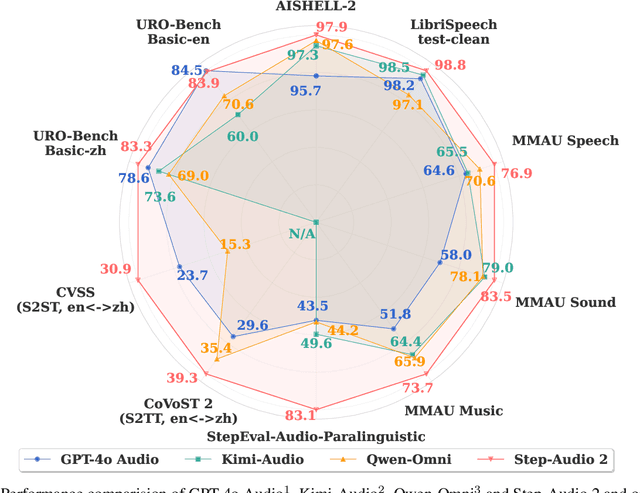
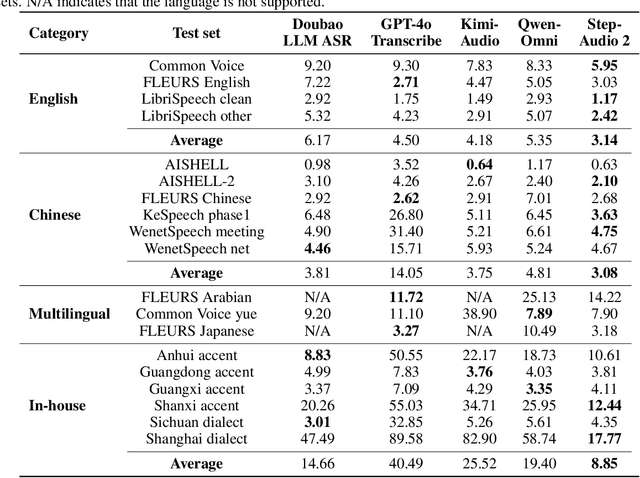
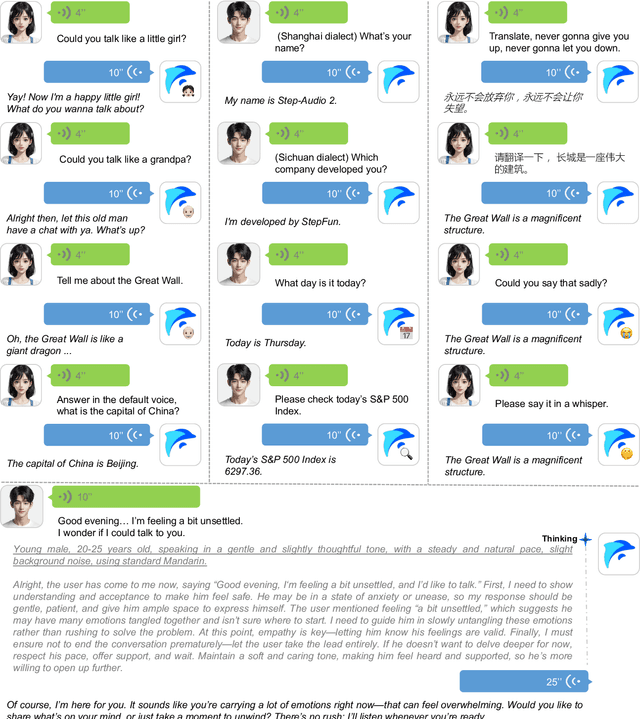
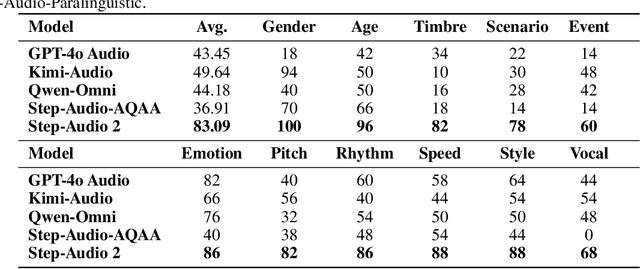
This paper presents Step-Audio 2, an end-to-end multi-modal large language model designed for industry-strength audio understanding and speech conversation. By integrating a latent audio encoder and reasoning-centric reinforcement learning (RL), Step-Audio 2 achieves promising performance in automatic speech recognition (ASR) and audio understanding. To facilitate genuine end-to-end speech conversation, Step-Audio 2 incorporates the generation of discrete audio tokens into language modeling, significantly enhancing its responsiveness to paralinguistic information such as speaking styles and emotions. To effectively leverage the rich textual and acoustic knowledge in real-world data, Step-Audio 2 integrates retrieval-augmented generation (RAG) and is able to call external tools such as web search to mitigate hallucination and audio search to switch timbres. Trained on millions of hours of speech and audio data, Step-Audio 2 delivers intelligence and expressiveness across diverse conversational scenarios. Evaluation results demonstrate that Step-Audio 2 achieves state-of-the-art performance on various audio understanding and conversational benchmarks compared to other open-source and commercial solutions. Please visit https://github.com/stepfun-ai/Step-Audio2 for more information.