 Add to Chrome
 Add to Firefox
 Add to Edge
AFM-Net: Advanced Fusing Hierarchical CNN Visual Priors with Global Sequence Modeling for Remote Sensing Image Scene Classification
Oct 31, 2025
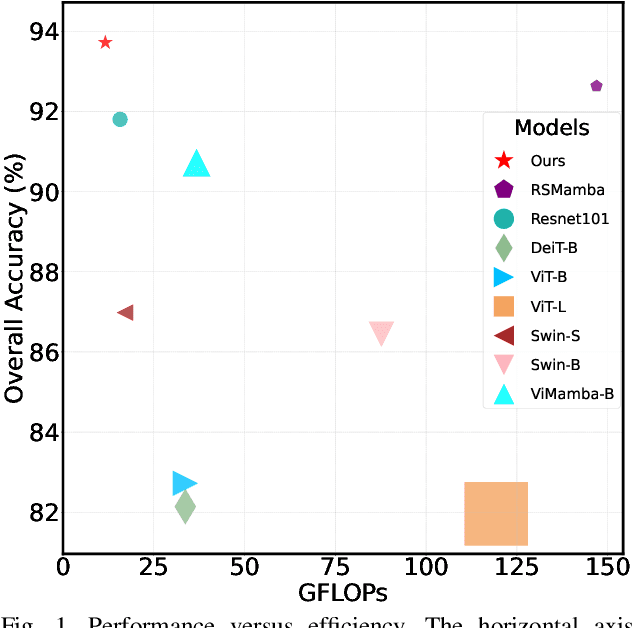
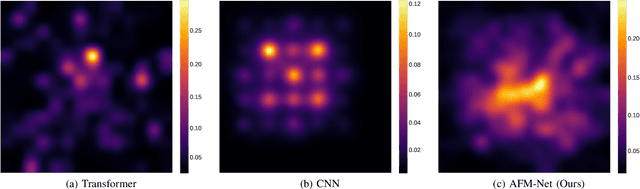
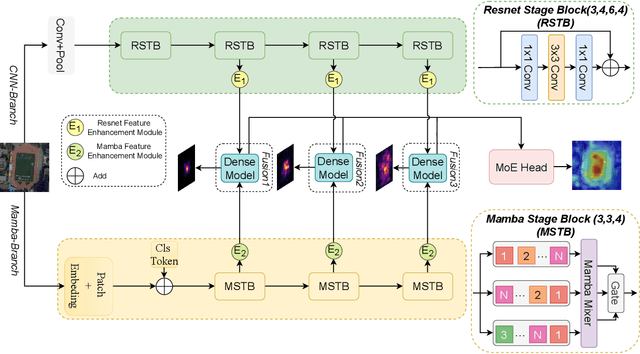
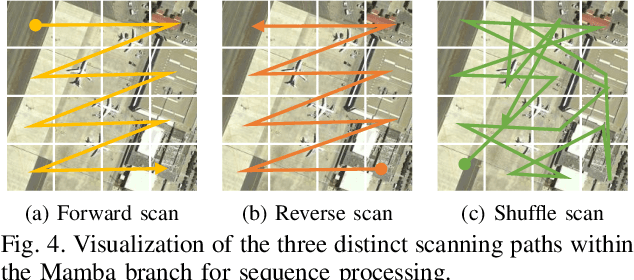
Remote sensing image scene classification remains a challenging task, primarily due to the complex spatial structures and multi-scale characteristics of ground objects. Existing approaches see CNNs excel at modeling local textures, while Transformers excel at capturing global context. However, efficiently integrating them remains a bottleneck due to the high computational cost of Transformers. To tackle this, we propose AFM-Net, a novel Advanced Hierarchical Fusing framework that achieves effective local and global co-representation through two pathways: a CNN branch for extracting hierarchical visual priors, and a Mamba branch for efficient global sequence modeling. The core innovation of AFM-Net lies in its Hierarchical Fusion Mechanism, which progressively aggregates multi-scale features from both pathways, enabling dynamic cross-level feature interaction and contextual reconstruction to produce highly discriminative representations. These fused features are then adaptively routed through a Mixture-of-Experts classifier module, which dispatches them to the most suitable experts for fine-grained scene recognition. Experiments on AID, NWPU-RESISC45, and UC Merced show that AFM-Net obtains 93.72, 95.54, and 96.92 percent accuracy, surpassing state-of-the-art methods with balanced performance and efficiency. Code is available at https://github.com/tangyuanhao-qhu/AFM-Net.

RoboBERT: An End-to-end Multimodal Robotic Manipulation Model
Feb 11, 2025Embodied intelligence integrates multiple modalities, enabling agents to understand images, language, and actions simultaneously. However, existing models always depend on additional datasets or extensive pre-training to maximize performance improvements, consuming abundant training time and expensive hardware cost. To tackle this issue, we present RoboBERT, a novel end-to-end robotic manipulation model integrated with a unique training strategy. This model utilizes a CNN-based diffusion policy, enhancing and stabilizing the effectiveness of this model by separating training processes for different modalities. It also underscores the importance of data augmentation, verifying various techniques to significantly boost performance. Unlike models that depend on extra data or large foundation models, RoboBERT achieves a highly competitive success rate while using only language-labeled expert demonstrations and maintaining a relatively smaller model size. Specifically, RoboBERT achieves an average length of 4.52 on the CALVIN benchmark for \(ABCD \rightarrow D\) task, setting a new state-of-the-art (SOTA) record. Furthermore, when tested on a real robot, the model demonstrates superior performance, achieving a higher success rate than other methods trained with the same data. We propose that these concepts and methodologies of RoboBERT demonstrate extensive versatility and compatibility, contributing significantly to the development of lightweight multimodal robotic models. The code can be accessed on https://github.com/PeterWangsicheng/RoboBERT
Design and Control of a Low-cost Non-backdrivable End-effector Upper Limb Rehabilitation Device
Jun 20, 2024This paper presents the development of an upper limb end-effector based rehabilitation device for stroke patients, offering assistance or resistance along any 2-dimensional trajectory during physical therapy. It employs a non-backdrivable ball-screw-driven mechanism for enhanced control accuracy. The control system features three novel algorithms: First, the Implicit Euler velocity control algorithm (IEVC) highlighted for its state-of-the-art accuracy, stability, efficiency and generalizability in motion restriction control. Second, an Admittance Virtual Dynamics simulation algorithm that achieves a smooth and natural human interaction with the non-backdrivable end-effector. Third, a generalized impedance force calculation algorithm allowing efficient impedance control on any trajectory or area boundary. Experimental validation demonstrated the system's effectiveness in accurate end-effector position control across various trajectories and configurations. The proposed upper limb end-effector-based rehabilitation device, with its high performance and adaptability, holds significant promise for extensive clinical application, potentially improving rehabilitation outcomes for stroke patients.