 Add to Chrome
 Add to Firefox
 Add to Edge
Relevant but Incomplete: Referential Dangling as a Paradigm-Level Failure Mode in Hard Prompt Compression
Aug 05, 2026
Hard prompt compression reduces long-context inference cost by independently scoring tokens, sentences, or chunks and retaining the highest-scoring units under a budget. We identify a structural failure in this procedure: independent selection can split dependent evidence pairs, retaining one member while deleting the other. When retained text contains an answer but deleted text defines the entity needed to interpret it, we call the result referential dangling. At a compression ratio of 0.30, Beaver, which ranks coherent chunks using Qwen3-0.6B embeddings, leaves the answer path incomplete in 34-54% of bridge examples across three multi-hop question answering datasets. On a shared HotpotQA bridge set, all six hard compressors we test exhibit dangling at rates up to 60%, and every document in LongBench-v2 Single-Document QA contains at least one dangling reference. On dangling examples evaluated with Qwen3-8B, reinserting the missing supporting paragraph while removing nonsupporting paragraphs to maintain the token budget improves accuracy by 29-34 percentage points (p < 0.0001), recovering at least 88% of the gap to contexts retaining both supporting paragraphs. Stronger answer models do not absorb the loss: on MuSiQue, GPT-5.5 is 8.8 points less accurate on compressed contexts than on contexts retaining both supporting paragraphs. Finally, we train a compact classifier to rank omitted sentences by whether they are needed to interpret retained text and reinsert the top-ranked candidates without support annotations at inference. On HotpotQA with Qwen3-8B, this automatic restoration improves accuracy by 4.7 points while changing the compression ratio only from 0.30 to 0.31. Hard compressors should optimize both relevance and referential completeness.

BEAVER: A Training-Free Hierarchical Prompt Compression Method via Structure-Aware Page Selection
Mar 20, 2026The exponential expansion of context windows in LLMs has unlocked capabilities for long-document understanding but introduced severe bottlenecks in inference latency and information utilization. Existing compression methods often suffer from high training costs or semantic fragmentation due to aggressive token pruning. In this paper, we propose BEAVER, a novel training-free framework that shifts compression from linear token removal to structure-aware hierarchical selection. BEAVER maximizes hardware parallelism by mapping variable-length contexts into dense page-level tensors via dual-path pooling, and preserves discourse integrity through a hybrid planner combining semantic and lexical dual-branch selection with sentence smoothing. Extensive evaluations on four long-context benchmarks demonstrate that BEAVER achieves comparable performance to state-of-the-art (SOTA) methods like LongLLMLingua. Notably, on the RULER benchmark, BEAVER maintains high fidelity in multi-needle retrieval where baselines deteriorate. Regarding efficiency, BEAVER reduces latency by 26.4x on 128k contexts, offering a scalable solution for high-throughput applications. Our code is available at https://cslikai.cn/BEAVER/.
AFM-Net: Advanced Fusing Hierarchical CNN Visual Priors with Global Sequence Modeling for Remote Sensing Image Scene Classification
Oct 31, 2025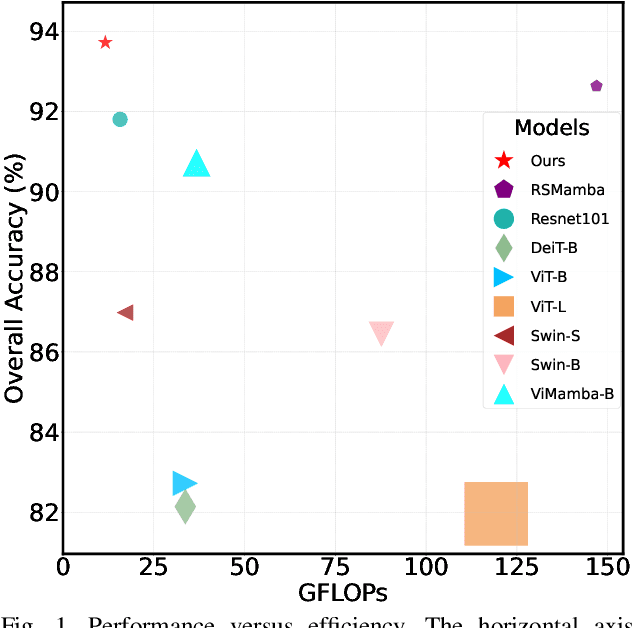
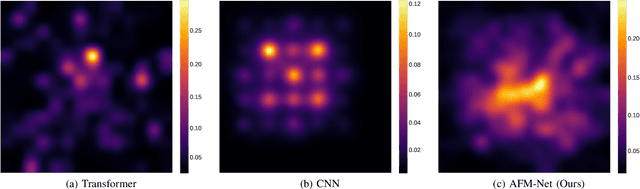
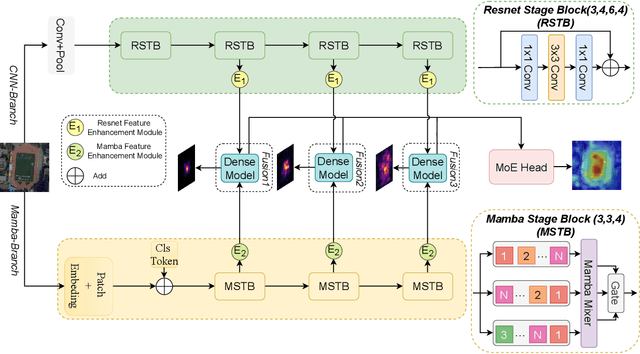
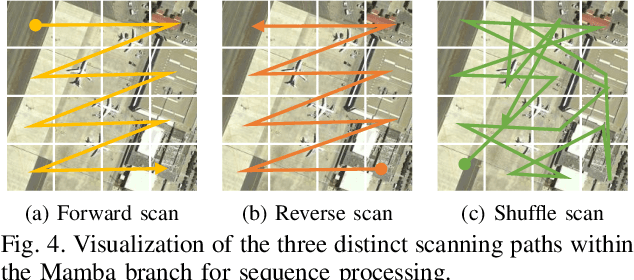
Remote sensing image scene classification remains a challenging task, primarily due to the complex spatial structures and multi-scale characteristics of ground objects. Existing approaches see CNNs excel at modeling local textures, while Transformers excel at capturing global context. However, efficiently integrating them remains a bottleneck due to the high computational cost of Transformers. To tackle this, we propose AFM-Net, a novel Advanced Hierarchical Fusing framework that achieves effective local and global co-representation through two pathways: a CNN branch for extracting hierarchical visual priors, and a Mamba branch for efficient global sequence modeling. The core innovation of AFM-Net lies in its Hierarchical Fusion Mechanism, which progressively aggregates multi-scale features from both pathways, enabling dynamic cross-level feature interaction and contextual reconstruction to produce highly discriminative representations. These fused features are then adaptively routed through a Mixture-of-Experts classifier module, which dispatches them to the most suitable experts for fine-grained scene recognition. Experiments on AID, NWPU-RESISC45, and UC Merced show that AFM-Net obtains 93.72, 95.54, and 96.92 percent accuracy, surpassing state-of-the-art methods with balanced performance and efficiency. Code is available at https://github.com/tangyuanhao-qhu/AFM-Net.