 Add to Chrome
 Add to Firefox
 Add to Edge
GroupVideo: Multi-Identity Customized Text-to-Video Generation
Jul 23, 2026
Current identity customized video generation methodologies are predominantly limited to single-identity scenarios, as the lack of explicit identity separation mechanisms often leads to identity confusion in multi-identity settings. Existing multi-identity approaches, which directly extend single-identity frameworks by concatenating face images as input conditions, frequently result in unnatural facial expressions and motions, manifesting as the "copy-paste" phenomenon. To overcome these limitations, we introduce GroupVideo, a novel framework that leverages multiple individual photographs to generate identitycustomized video. Built upon Video Diffusion Transformers, GroupVideo incorporates multimodal identity alignment: visual alignment jointly encodes multiple face images to provide robust identity references, while semantic alignment introduces a semantic perceiver to enhance the naturalness of motions. An ID localization module with spatial guidance is introduced to address identity blending and enhance identity fidelity, along with bounding box constraints and mask regularization loss, to focus on facial regions and improve training efficiency. In response to the shortage of multi-ID video datasets, we have curated a comprehensive high-quality dataset of 20,000 videos, thereby establishing a crucial resource to advance future research in multi-ID video generation. Extensive experiments demonstrate that GroupVideo outperforms existing methods in generating multi-character videos with consistent identities and natural motions.

WorldSample: Closed-loop Real-robot RL with World Modelling
Jul 02, 2026Reinforcement learning (RL) can overcome the demonstration-coverage limitation of imitation learning (IL) by allowing robots to improve through trial-and-error interaction beyond the states observed in demonstrations. However, deploying RL on real robots remains constrained by high interaction costs, since each physical rollout is costly and reflects only one realized action-outcome path. To address this challenge, we propose WorldSample, a physically grounded data augmentation framework for real-robot RL that closes a real-synthetic loop between physical rollouts, world-model generation, and policy improvement. Grounded on real rollouts, WorldSample generates high-fidelity synthetic transitions through a post-trained world model, which greatly lowers the visual hallucination. Specifically, rather than simply using these transitions as real-world experience, WorldSample introduces Policy-Paced Learning (PPL) to regulate the training process through sample selection and scheduling, balancing useful augmentation against value overestimation and mitigating the hallucination-induced noise. Experiments on robot manipulation tasks involving contact-rich and precise tasks show that WorldSample improves policy success rate by 28% while reducing training steps by 59% compared with baselines. Furthermore, WorldSample improves world model visual fidelity by 19.4dB in PSNR and 0.47 in SSIM over demonstration-only post-training, validating the effectiveness of the real-synthetic loop for both policy and world model performance.
IV-CoT: Implicit Visual Chain-of-Thought for Structure-Aware Text-to-Image Generation
Jun 23, 2026Unified multi-modal large language models (MLLMs) have achieved strong text-to-image generation quality, but still struggle with structure-aware prompt following, where object counts, spatial relations, attribute bindings, and coarse layouts must be preserved. We attribute this limitation in part to the entanglement of structural planning and appearance rendering within a single conditioning stream. To address this issue, we propose Implicit Visual Chain-of-Thought (IV-CoT), a latent visual reasoning framework for query-conditioned image generation. IV-CoT decomposes the visual conditioning queries into a structural-to-semantic cascade, where structural queries first form a latent visual plan and semantic queries then render appearance conditioned on this plan. To guide the structural queries, we introduce training-only sketch supervision, which encourages them to capture structure from sketches without requiring sketch extraction or intermediate decoding at inference time. IV-CoT performs implicit CoT reasoning in a single forward pass and achieves superior results on GenEval and T2I-CompBench. Visualizations and analyses demonstrate that the learned structural and semantic queries play complementary roles in structure-aware generation.
Dual-Phase LLM Reasoning: Self-Evolved Mathematical Frameworks
Jan 09, 2026In recent years, large language models (LLMs) have demonstrated significant potential in complex reasoning tasks like mathematical problem-solving. However, existing research predominantly relies on reinforcement learning (RL) frameworks while overlooking supervised fine-tuning (SFT) methods. This paper proposes a new two-stage training framework that enhances models' self-correction capabilities through self-generated long chain-of-thought (CoT) data. During the first stage, a multi-turn dialogue strategy guides the model to generate CoT data incorporating verification, backtracking, subgoal decomposition, and backward reasoning, with predefined rules filtering high-quality samples for supervised fine-tuning. The second stage employs a difficulty-aware rejection sampling mechanism to dynamically optimize data distribution, strengthening the model's ability to handle complex problems. The approach generates reasoning chains extended over 4 times longer while maintaining strong scalability, proving that SFT effectively activates models' intrinsic reasoning capabilities and provides a resource-efficient pathway for complex task optimization. Experimental results demonstrate performance improvements on mathematical benchmarks including GSM8K and MATH500, with the fine-tuned model achieving a substantial improvement on competition-level problems like AIME24. Code will be open-sourced.
3SGen: Unified Subject, Style, and Structure-Driven Image Generation with Adaptive Task-specific Memory
Dec 22, 2025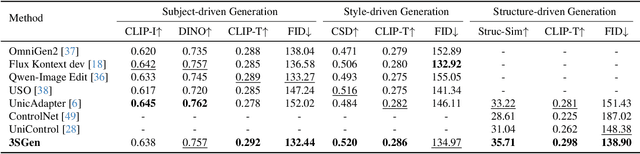
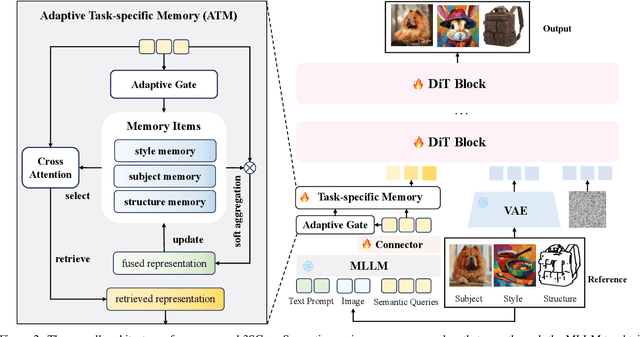
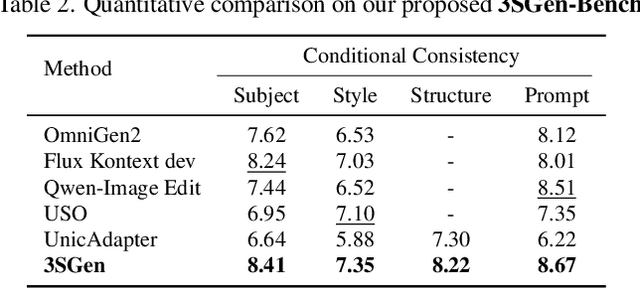
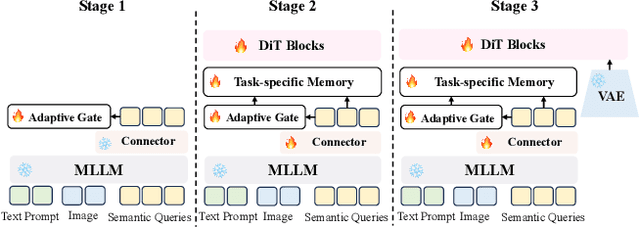
Recent image generation approaches often address subject, style, and structure-driven conditioning in isolation, leading to feature entanglement and limited task transferability. In this paper, we introduce 3SGen, a task-aware unified framework that performs all three conditioning modes within a single model. 3SGen employs an MLLM equipped with learnable semantic queries to align text-image semantics, complemented by a VAE branch that preserves fine-grained visual details. At its core, an Adaptive Task-specific Memory (ATM) module dynamically disentangles, stores, and retrieves condition-specific priors, such as identity for subjects, textures for styles, and spatial layouts for structures, via a lightweight gating mechanism along with several scalable memory items. This design mitigates inter-task interference and naturally scales to compositional inputs. In addition, we propose 3SGen-Bench, a unified image-driven generation benchmark with standardized metrics for evaluating cross-task fidelity and controllability. Extensive experiments on our proposed 3SGen-Bench and other public benchmarks demonstrate our superior performance across diverse image-driven generation tasks.
Follow-Your-MultiPose: Tuning-Free Multi-Character Text-to-Video Generation via Pose Guidance
Dec 21, 2024



Text-editable and pose-controllable character video generation is a challenging but prevailing topic with practical applications. However, existing approaches mainly focus on single-object video generation with pose guidance, ignoring the realistic situation that multi-character appear concurrently in a scenario. To tackle this, we propose a novel multi-character video generation framework in a tuning-free manner, which is based on the separated text and pose guidance. Specifically, we first extract character masks from the pose sequence to identify the spatial position for each generating character, and then single prompts for each character are obtained with LLMs for precise text guidance. Moreover, the spatial-aligned cross attention and multi-branch control module are proposed to generate fine grained controllable multi-character video. The visualized results of generating video demonstrate the precise controllability of our method for multi-character generation. We also verify the generality of our method by applying it to various personalized T2I models. Moreover, the quantitative results show that our approach achieves superior performance compared with previous works.