 Add to Chrome
 Add to Firefox
 Add to Edge
Clustering as Reasoning: A $k$-Means Interpretation of Chain-of-Thought Graph Learning
May 24, 2026
Chain-of-Thought (CoT) prompting has shown promise in enhancing the reasoning capabilities of large language models (LLMs) on text-attributed graphs (TAGs). This work reframes CoT-based graph learning through the principle of clustering as reasoning, offering a $k$-means interpretation of how iterative reasoning operates over graph-structured data. We observe that existing graph CoT methods rely on disjoint architectures and fixed graph representations, limiting step-by-step semantic-topological interaction and interpretability. To overcome this limitation, we propose a unified framework named KCoT that integrates CoT reasoning with graph representation learning. Our key theoretical result reveals a formal mathematical correspondence between a Transformer block and the $k$-means algorithm, allowing reasoning to be interpreted as iterative assignment and update steps. Based on this insight, we introduce a Semantic Discriminating Prompt that explicitly formulates these steps as structured CoT reasoning, together with a structure-grounded alignment strategy to fuse topological priors with evolving thought-conditioned representations. Experiments on standard benchmarks demonstrate consistent improvements over state-of-the-art methods, validating clustering as a principled mechanism for CoT-based graph learning.

ROSClaw: A Hierarchical Semantic-Physical Framework for Heterogeneous Multi-Agent Collaboration
Apr 06, 2026The integration of large language models (LLMs) with embodied agents has improved high-level reasoning capabilities; however, a critical gap remains between semantic understanding and physical execution. While vision-language-action (VLA) and vision-language-navigation (VLN) systems enable robots to perform manipulation and navigation tasks from natural language instructions, they still struggle with long-horizon sequential and temporally structured tasks. Existing frameworks typically adopt modular pipelines for data collection, skill training, and policy deployment, resulting in high costs in experimental validation and policy optimization. To address these limitations, we propose ROSClaw, an agent framework for heterogeneous robots that integrates policy learning and task execution within a unified vision-language model (VLM) controller. The framework leverages e-URDF representations of heterogeneous robots as physical constraints to construct a sim-to-real topological mapping, enabling real-time access to the physical states of both simulated and real-world agents. We further incorporate a data collection and state accumulation mechanism that stores robot states, multimodal observations, and execution trajectories during real-world execution, enabling subsequent iterative policy optimization. During deployment, a unified agent maintains semantic continuity between reasoning and execution, and dynamically assigns task-specific control to different agents, thereby improving robustness in multi-policy execution. By establishing an autonomous closed-loop framework, ROSClaw minimizes the reliance on robot-specific development workflows. The framework supports hardware-level validation, automated generation of SDK-level control programs, and tool-based execution, enabling rapid cross-platform transfer and continual improvement of robotic skills. Ours project page: https://www.rosclaw.io/.
PACC: Protocol-Aware Cross-Layer Compression for Compact Network Traffic Representation
Feb 09, 2026Network traffic classification is a core primitive for network security and management, yet it is increasingly challenged by pervasive encryption and evolving protocols. A central bottleneck is representation: hand-crafted flow statistics are efficient but often too lossy, raw-bit encodings can be accurate but are costly, and recent pre-trained embeddings provide transfer but frequently flatten the protocol stack and entangle signals across layers. We observe that real traffic contains substantial redundancy both across network layers and within each layer; existing paradigms do not explicitly identify and remove this redundancy, leading to wasted capacity, shortcut learning, and degraded generalization. To address this, we propose PACC, a redundancy-aware, layer-aware representation framework. PACC treats the protocol stack as multi-view inputs and learns compact layer-wise projections that remain faithful to each layer while explicitly factorizing representations into shared (cross-layer) and private (layer-specific) components. We operationalize these goals with a joint objective that preserves layer-specific information via reconstruction, captures shared structure via contrastive mutual-information learning, and maximizes task-relevant information via supervised losses, yielding compact latents suitable for efficient inference. Across datasets covering encrypted application classification, IoT device identification, and intrusion detection, PACC consistently outperforms feature-engineered and raw-bit baselines. On encrypted subsets, it achieves up to a 12.9% accuracy improvement over nPrint. PACC matches or surpasses strong foundation-model baselines. At the same time, it improves end-to-end efficiency by up to 3.16x.
One Node One Model: Featuring the Missing-Half for Graph Clustering
Dec 13, 2024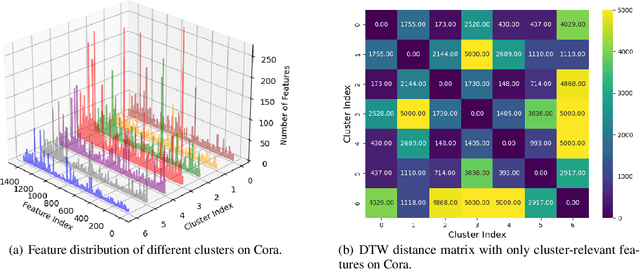
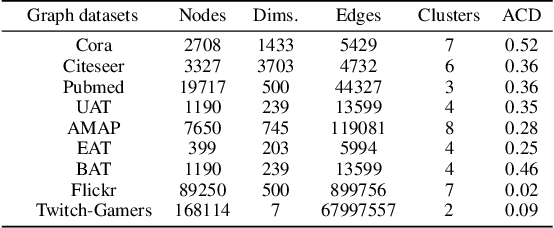
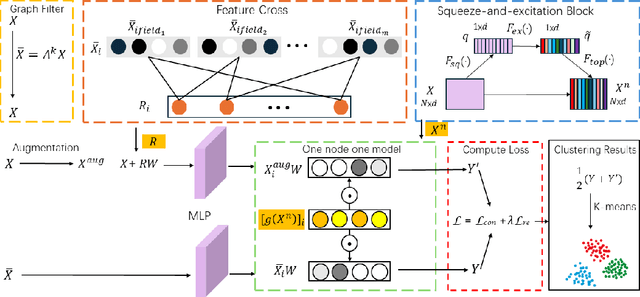
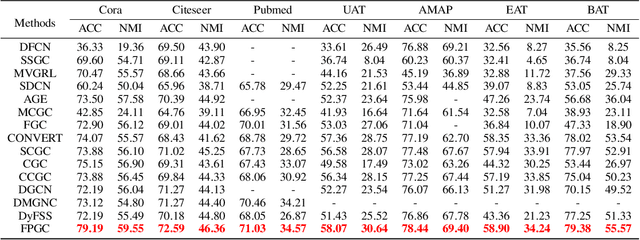
Most existing graph clustering methods primarily focus on exploiting topological structure, often neglecting the ``missing-half" node feature information, especially how these features can enhance clustering performance. This issue is further compounded by the challenges associated with high-dimensional features. Feature selection in graph clustering is particularly difficult because it requires simultaneously discovering clusters and identifying the relevant features for these clusters. To address this gap, we introduce a novel paradigm called ``one node one model", which builds an exclusive model for each node and defines the node label as a combination of predictions for node groups. Specifically, the proposed ``Feature Personalized Graph Clustering (FPGC)" method identifies cluster-relevant features for each node using a squeeze-and-excitation block, integrating these features into each model to form the final representations. Additionally, the concept of feature cross is developed as a data augmentation technique to learn low-order feature interactions. Extensive experimental results demonstrate that FPGC outperforms state-of-the-art clustering methods. Moreover, the plug-and-play nature of our method provides a versatile solution to enhance GNN-based models from a feature perspective.