 Add to Chrome
 Add to Firefox
 Add to Edge
CMKL: Modality-Aware Continual Learning for Evolving Biomedical Knowledge Graphs
May 11, 2026
Biomedical knowledge graphs are increasingly large, dynamic, and multimodal, driven by rapid advances in biotechnology such as high-throughput sequencing. Machine learning models can infer previously unobserved biomedical relationships and characterize biomedical entities in these graphs, but existing knowledge graph embedding methods and their continual learning extensions either assume static graph structure or fail to exploit multimodal information under evolving data distributions. They also apply uniform regularization across all model parameters, ignoring that different modalities may exhibit distinct forgetting dynamics as the graph evolves. We propose the Continual Multimodal Knowledge Graph Learner (CMKL), a CL framework for biomedical KGs that natively encodes structure, text, and molecules, fuses them through a Mixture-of-Experts (MoE) router, and protects previously learned knowledge with standard EWC regularization and a K-means-diverse multimodal replay buffer. We evaluate CMKL on a 129K-entity biomedical continual benchmark with 10 tasks. On continual biomedical entity classification, CMKL reaches AP 0.591 versus 0.370 for the strongest structural baseline, a 60% gain that is driven by access to multimodal features and preserved across the sequence with near-zero forgetting (AF 0.008). On continual relationship prediction, CMKL reaches AP $0.062$, matching Naive Sequential and EWC (0.058) within seed noise and outperforming Joint Training (0.047, p=0.045) and LKGE (0.039). A frozen-text ablation reaches AP 0.136, more than double any jointly trained model, yet that signal is unreachable by margin-ranking gradients: the greedy-modality asymmetry lives at the representation level, not the fusion level, and MoE routing manages it by suppressing the unreachable modality without forcing it through a learned bottleneck. Code: github.com/yradwan147/cmkl-neurips2026

PrimeKG-CL: A Continual Graph Learning Benchmark on Evolving Biomedical Knowledge Graphs
May 11, 2026Biomedical knowledge graphs underwrite drug repurposing and clinical decision support, yet the upstream ontologies they depend on update on independent cycles that add millions of edges and deprecate hundreds of thousands more between releases. Yet existing continual graph learning has been studied almost exclusively on synthetic random splits of static, generic KGs, a regime that cannot reproduce the asynchronous, structured evolution real biomedical KGs undergo. To this end, we introduce PrimeKG-CL, a CGL benchmark built from nine authoritative biomedical databases (129K+ nodes, 8.1M+ edges, 10 node types, 30 relation types) with two genuine temporal snapshots (June 2021, July 2023; 5.83M edges added, 889K removed, 7.21M persistent), 10 entity-type-grouped tasks, multimodal node features, and a per-task persistent/added/removed test stratification. On three tasks (biomedical relationship prediction, entity classification, KGQA), we evaluate six CL strategies across four KGE decoders, plus LKGE, an LLM-RAG agent, and CMKL. We find that decoder choice and continual learning strategy interact strongly: no single strategy performs best across all decoders, and mismatched combinations can significantly degrade performance. Moreover, only DistMult exhibits a clear separation between persistent and deprecated knowledge, indicating that standard metrics conflate retention of still-valid facts with failure to forget outdated ones; this effect is absent under RotatE. In addition, multimodal features improve entity-level tasks by up to 60%, and a recent CKGE framework (IncDE) failed to scale to our 5.67M-triple base task across five attempts up to 350GB RAM. Data, pipeline, baselines, and the stratified split are released openly. Dataset:huggingface.co/datasets/yradwan147/PrimeKGCL|Code:github.com/yradwan147/primekg-cl-neurips2026
A Comparison of Recent Algorithms for Symbolic Regression to Genetic Programming
Jun 05, 2024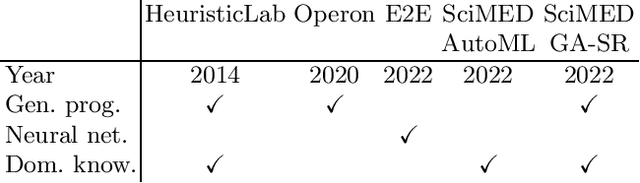

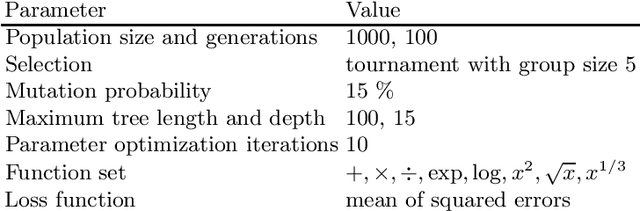
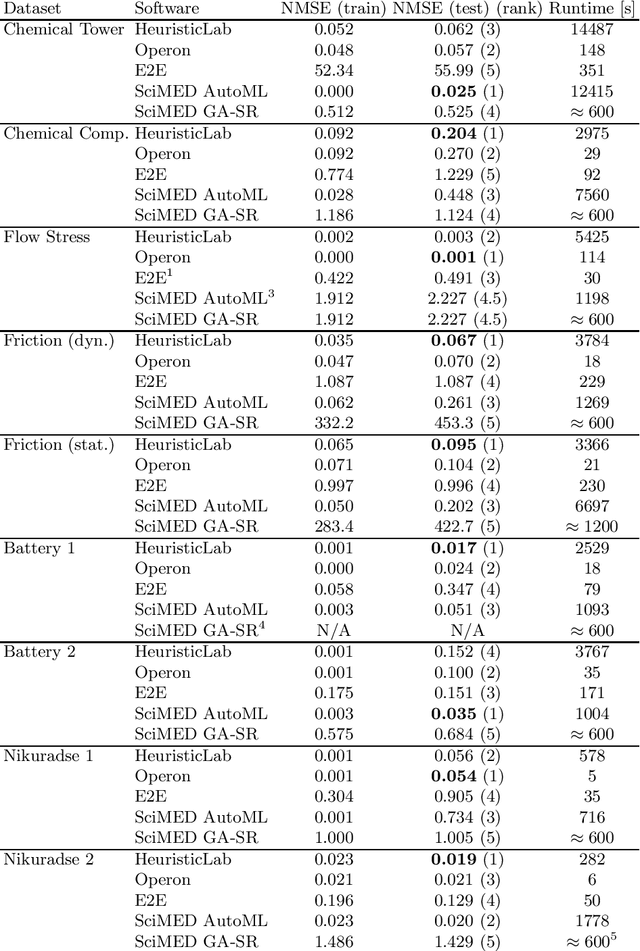
Symbolic regression is a machine learning method with the goal to produce interpretable results. Unlike other machine learning methods such as, e.g. random forests or neural networks, which are opaque, symbolic regression aims to model and map data in a way that can be understood by scientists. Recent advancements, have attempted to bridge the gap between these two fields; new methodologies attempt to fuse the mapping power of neural networks and deep learning techniques with the explanatory power of symbolic regression. In this paper, we examine these new emerging systems and test the performance of an end-to-end transformer model for symbolic regression versus the reigning traditional methods based on genetic programming that have spearheaded symbolic regression throughout the years. We compare these systems on novel datasets to avoid bias to older methods who were improved on well-known benchmark datasets. Our results show that traditional GP methods as implemented e.g., by Operon still remain superior to two recently published symbolic regression methods.