 Add to Chrome
 Add to Firefox
 Add to Edge
Dynamic Graph Prompting via Topology-Routed Mixed-Curvature Experts
Aug 06, 2026
Dynamic graph prompting freezes a pre-trained temporal backbone and adapts it to label-scarce downstream tasks using lightweight prompts. However, existing methods operate within a single, fixed embedding space. In this work, we reveal that temporal shifts in local clustering and degree heterogeneity actively reorganize the edge curvature spectrum---indicating that the optimal representation geometry dynamically evolves with local topology over time. We formalize this unaddressed mismatch as geometry under-adaptation. To overcome this limitation, we propose CurvPrompt, a topology-routed geometry prompting framework for dynamic graphs. Instead of relying on a single space, CurvPrompt maintains a bank of curvature-diverse Riemannian experts, each paired with a learnable prompt. A topology-aware gate dynamically routes each node--time instance to a sparse subset of experts, constructing a personalized mixed-curvature representation. To ensure parameter efficiency and training stability under extreme label scarcity, CurvPrompt employs soft routing during pre-training to build a continuous topology--geometry mapping, and transitions to hard Top-K routing with uniform weights during downstream adaptation. Extensive experiments across four benchmark datasets show that CurvPrompt significantly advances few-shot link prediction while delivering strong, consistent performance on node classification tasks, validating the necessity of geometry-adaptive prompting.

Full spectrum Unlearnable Examples via Spectral Equalization
Jun 25, 2026Unlearnable examples (UEs) protect training data by injecting imperceptible perturbations so that models fail to extract exploitable representations. In this paper, we reveal that existing UEs exhibit a critical failure once low-pass filtering is applied, indicating that the effective perturbation signals for unlearnability concentrate predominantly in high frequencies. Hence, we argue that reliable UEs should remain effective across the full spectrum. To this end, we propose Full-spectrum Unlearnable examples via Spectral Equalization (FUSE), which aims to generate spectrum-agnostic perturbations by equalizing the contributions from different bands and enforcing cross-band consistency. Specifically, FUSE adopts a Random Spectral Masking (RSM) strategy during generator training, which randomly removes a contiguous frequency band, forcing the remaining bands to maintain unlearnability. In addition, FUSE further integrates Cross-Band Guidance (CBG), which enforces mutual consistency between high- and low-frequency components, thereby further enhancing low-frequency unlearnability and regulating high-frequency perturbations to preserve the semantic fidelity of images. Extensive experiments across multiple datasets, architectures, and spectral filtering demonstrate the strong protection achieved by FUSE.
The Post-GCN Decade Revisited: Curvature-Stratified Evaluation of Relational Learning
Jun 04, 2026Current evaluation practices in relational learning rely heavily on flat leaderboards that average performance across heterogeneous datasets, implicitly assuming a uniform underlying structure. We show that this assumption introduces systematic bias: it obscures geometry-dependent performance variations and can lead to misleading conclusions about model generalization. In this work, we identify intrinsic geometry as a key latent factor governing model effectiveness. We demonstrate that conventional aggregated metrics mask critical performance trade-offs that only become visible when datasets are stratified by their geometric properties. To address this issue, we introduce a curvature-stratified evaluation framework that partitions datasets into positive, negative, and near-zero curvature regimes. Our benchmark evaluates 18 representative models including Graph Convolutional Networks (GCNs), Graph Foundation Models (GFMs), and tabular learning methods across 14 datasets. We find that model rankings are highly stable within each curvature regime but shift significantly across regimes, indicating that performance is fundamentally geometry-dependent rather than universally transferable. Notably, we identify regimes where GFMs offer diminishing returns compared to geometry-aligned GNNs. Based on these findings, we propose a geometry-aware evaluation protocol that yields more reliable and interpretable comparisons than standard aggregated benchmarks. We release all code, curvature-stratified dataset splits, and evaluation tools to support reproducible and rigorous assessment of future relational learning methods. Code and datasets are provided in our project homepage: https://sirbabbage.github.io/CurvBench_HOME/.
When Priors Backfire: On the Vulnerability of Unlearnable Examples to Pretraining
Mar 05, 2026Unlearnable Examples (UEs) serve as a data protection strategy that generates imperceptible perturbations to mislead models into learning spurious correlations instead of underlying semantics. In this paper, we uncover a fundamental vulnerability of UEs that emerges when learning starts from a pretrained model. Crucially, our empirical analysis shows that even when data are protected by carefully crafted perturbations, pretraining priors still furnish rich semantic representations that allow the model to circumvent the shortcuts introduced by UEs and capture genuine features, thereby nullifying unlearnability. To address this, we propose BAIT (Binding Artificial perturbations to Incorrect Targets), a novel bi-level optimization formulation. Specifically, the inner level aims at associating the perturbed samples with real labels to simulate standard data-label alignment, while the outer level actively disrupts this alignment by enforcing a mislabel-perturbation binding that maps samples to designated incorrect targets. This mechanism effectively overrides the semantic guidance of priors, forcing the model to rely on the injected perturbations and consequently preventing the acquisition of true semantics. Extensive experiments on standard benchmarks and multiple pretrained backbones demonstrate that BAIT effectively mitigates the influence of pretraining priors and maintains data unlearnability.
Graph Domain Adaptation via Homophily-Agnostic Reconstructing Structure
Feb 07, 2026Graph Domain Adaptation (GDA) transfers knowledge from labeled source graphs to unlabeled target graphs, addressing the challenge of label scarcity. However, existing GDA methods typically assume that both source and target graphs exhibit homophily, leading existing methods to perform poorly when heterophily is present. Furthermore, the lack of labels in the target graph makes it impossible to assess its homophily level beforehand. To address this challenge, we propose a novel homophily-agnostic approach that effectively transfers knowledge between graphs with varying degrees of homophily. Specifically, we adopt a divide-and-conquer strategy that first separately reconstructs highly homophilic and heterophilic variants of both the source and target graphs, and then performs knowledge alignment separately between corresponding graph variants. Extensive experiments conducted on five benchmark datasets demonstrate the superior performance of our approach, particularly highlighting its substantial advantages on heterophilic graphs.
A Study of Adaptive Modeling Towards Robust Generalization
Feb 05, 2026Large language models (LLMs) increasingly support reasoning over biomolecular structures, but most existing approaches remain modality-specific and rely on either sequence-style encodings or fixed-length connector tokens for structural inputs. These designs can under-expose explicit geometric cues and impose rigid fusion bottlenecks, leading to over-compression and poor token allocation as structural complexity grows. We present a unified all-atom framework that grounds language reasoning in geometric information while adaptively scaling structural tokens. The method first constructs variable-size structural patches on molecular graphs using an instruction-conditioned gating policy, enabling complexity-aware allocation of query tokens. It then refines the resulting patch tokens via cross-attention with modality embeddings and injects geometry-informed tokens into the language model to improve structure grounding and reduce structural hallucinations. Across diverse all-atom benchmarks, the proposed approach yields consistent gains in heterogeneous structure-grounded reasoning. An anonymized implementation is provided in the supplementary material.
Entropy-Guided Dynamic Tokens for Graph-LLM Alignment in Molecular Understanding
Feb 02, 2026Molecular understanding is central to advancing areas such as scientific discovery, yet Large Language Models (LLMs) struggle to understand molecular graphs effectively. Existing graph-LLM bridges often adapt the Q-Former-style connector with fixed-length static tokens, which is originally designed for vision tasks. These designs overlook stereochemistry and substructural context and typically require costly LLM-backbone fine-tuning, limiting efficiency and generalization. We introduce EDT-Former, an Entropy-guided Dynamic Token Transformer that generates tokens aligned with informative molecular patches, thereby preserving both local and global structural features for molecular graph understanding. Beyond prior approaches, EDT-Former enables alignment between frozen graph encoders and LLMs without tuning the LLM backbone (excluding the embedding layer), resulting in computationally efficient finetuning, and achieves stateof-the-art results on MoleculeQA, Molecule-oriented Mol-Instructions, and property prediction benchmarks (TDC, MoleculeNet), underscoring its effectiveness for scalable and generalizable multimodal molecular understanding
Scaling-Aware Adapter for Structure-Grounded LLM Reasoning
Feb 02, 2026Large language models (LLMs) are enabling reasoning over biomolecular structures, yet existing methods remain modality-specific and typically compress structural inputs through sequence-based tokenization or fixed-length query connectors. Such architectures either omit the geometric groundings requisite for mitigating structural hallucinations or impose inflexible modality fusion bottlenecks that concurrently over-compress and suboptimally allocate structural tokens, thereby impeding the realization of generalized all-atom reasoning. We introduce Cuttlefish, a unified all-atom LLM that grounds language reasoning in geometric cues while scaling modality tokens with structural complexity. First, Scaling-Aware Patching leverages an instruction-conditioned gating mechanism to generate variable-size patches over structural graphs, adaptively scaling the query token budget with structural complexity to mitigate fixed-length connector bottlenecks. Second, Geometry Grounding Adapter refines these adaptive tokens via cross-attention to modality embeddings and injects the resulting modality tokens into the LLM, exposing explicit geometric cues to reduce structural hallucination. Experiments across diverse all-atom benchmarks demonstrate that Cuttlefish achieves superior performance in heterogeneous structure-grounded reasoning. Code is available at the project repository.
Homophily Enhanced Graph Domain Adaptation
May 26, 2025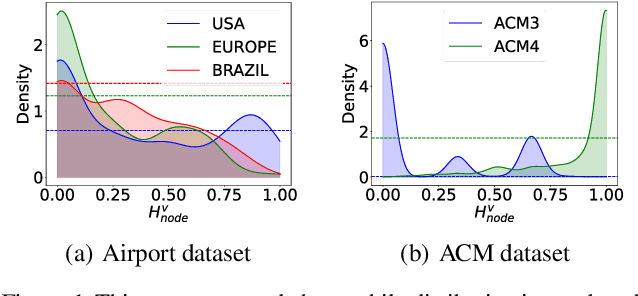
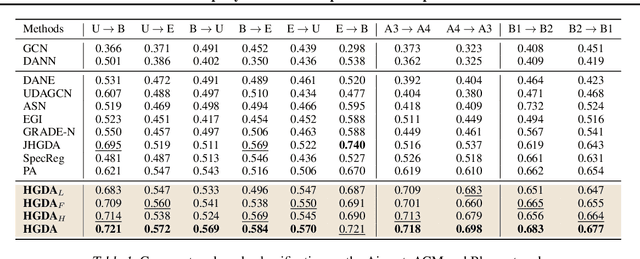
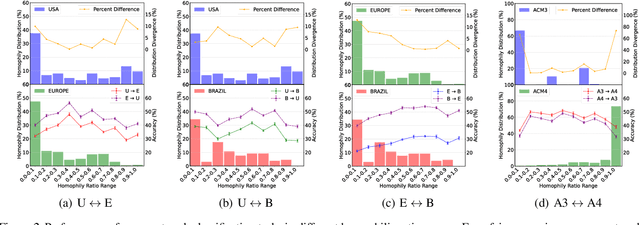
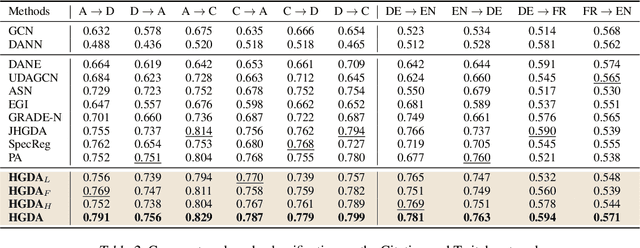
Graph Domain Adaptation (GDA) transfers knowledge from labeled source graphs to unlabeled target graphs, addressing the challenge of label scarcity. In this paper, we highlight the significance of graph homophily, a pivotal factor for graph domain alignment, which, however, has long been overlooked in existing approaches. Specifically, our analysis first reveals that homophily discrepancies exist in benchmarks. Moreover, we also show that homophily discrepancies degrade GDA performance from both empirical and theoretical aspects, which further underscores the importance of homophily alignment in GDA. Inspired by this finding, we propose a novel homophily alignment algorithm that employs mixed filters to smooth graph signals, thereby effectively capturing and mitigating homophily discrepancies between graphs. Experimental results on a variety of benchmarks verify the effectiveness of our method.
Leveraging Group Classification with Descending Soft Labeling for Deep Imbalanced Regression
Dec 16, 2024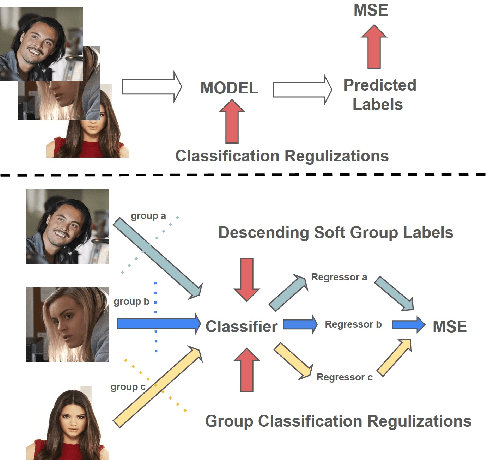
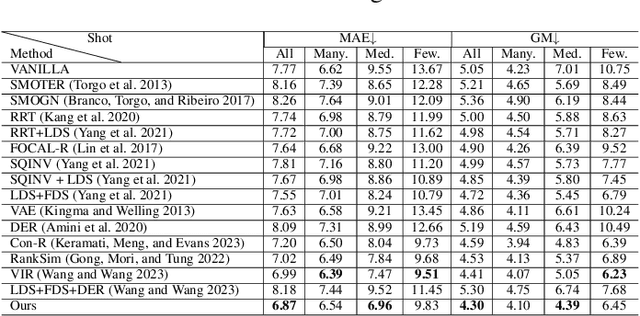
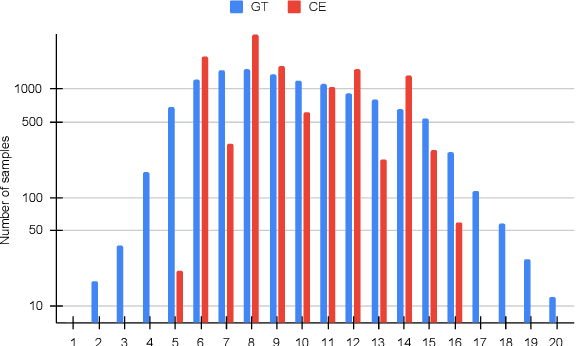
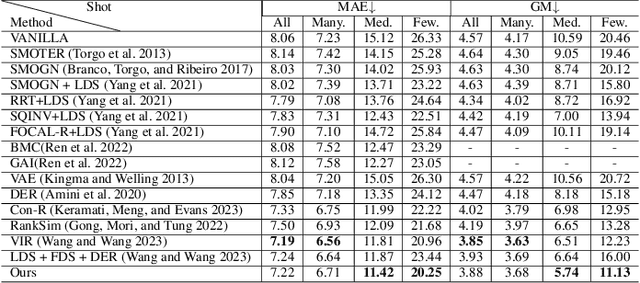
Deep imbalanced regression (DIR), where the target values have a highly skewed distribution and are also continuous, is an intriguing yet under-explored problem in machine learning. While recent works have already shown that incorporating various classification-based regularizers can produce enhanced outcomes, the role of classification remains elusive in DIR. Moreover, such regularizers (e.g., contrastive penalties) merely focus on learning discriminative features of data, which inevitably results in ignorance of either continuity or similarity across the data. To address these issues, we first bridge the connection between the objectives of DIR and classification from a Bayesian perspective. Consequently, this motivates us to decompose the objective of DIR into a combination of classification and regression tasks, which naturally guides us toward a divide-and-conquer manner to solve the DIR problem. Specifically, by aggregating the data at nearby labels into the same groups, we introduce an ordinal group-aware contrastive learning loss along with a multi-experts regressor to tackle the different groups of data thereby maintaining the data continuity. Meanwhile, considering the similarity between the groups, we also propose a symmetric descending soft labeling strategy to exploit the intrinsic similarity across the data, which allows classification to facilitate regression more effectively. Extensive experiments on real-world datasets also validate the effectiveness of our method.