 Add to Chrome
 Add to Firefox
 Add to Edge
KV-Control: Parameter-Efficient K/V Injection for Trajectory-Controlled Text-to-Motion
Jun 04, 2026
Text-conditioned 3D human motion models now synthesize plausible motions from prompts, but practical animation and embodied-agent workflows rarely stop at text: a character may need to follow a sketched root path, hit an end-effector target, or satisfy a multi-joint trajectory while still preserving the gait, style, and intent described by language. This exposes a control trade-off. A trajectory controller should be precise without overwriting the pretrained text-conditioned motion prior, yet existing solutions either duplicate large portions of the generator to regain per-layer control access or move much of the cost to test-time optimization. We introduce KV-Control, a compact attention-side control interface for frozen masked text-to-motion transformers. The key idea is to make geometric constraints available as memory inside self-attention rather than injecting them through a global pose token or enforcing them only at the output side. To support this interface, we co-design a part-tokenized motion substrate and controller: \textbf{PartVQ} learns anatomy-aligned part codebooks, T-Concat exposes each frame--part token as an attention-addressable site, and KV-Control injects control-conditioned key/value memories at every self-attention layer while preserving the pretrained query stream, text cross-attention, FFN, and all backbone weights. The resulting adapter adds only trainable injection parameters atop a shared trajectory encoder, yet tracks root and multi-joint constraints with sub-centimeter accuracy under the inherited refinement protocol while retaining text-conditioned motion quality. KV-Control reframes trajectory conditioning as lightweight memory retrieval, providing a small, precise, and transparent control interface for text-to-motion generation.

UMo: Unified Sparse Motion Modeling for Real-Time Co-Speech Avatars
May 14, 2026Speech-driven gestures and facial animations are fundamental to expressive digital avatars in games, virtual production, and interactive media. However, existing methods are either limited to a single modality for audio motion alignment, failing to fully utilize the potential of massive human motion data, or are constrained by the representation ability and throughput of multimodal models, which makes it difficult to achieve high-quality motion generation or real-time performance. We present UMo, a unified sparse motion modeling architecture for real-time co-speech avatars, which processes text, audio, and motion tokens within a unified formulation. Leveraging a spatially sparse Mixture-of-Experts framework and a temporally sparse, keyframe-centric design, UMo efficiently performs real-time dense reconstruction, enabling temporally coherent and high-fidelity animation generation for both facial expressions and gestures. Furthermore, we implement a multi-stage training strategy with targeted audio augmentation to enhance acoustic diversity and semantic consistency. Consequently, UMo preserves fine-grained speech-motion alignment even under strict latency constraints. Extensive quantitative and qualitative evaluations show that UMo achieves better output quality under low latency and real-time performance constraints, offering a practical solution for high-fidelity real-time co-speech avatars.
AnchorRoute: Human Motion Synthesis with Interval-Routed Sparse Contro
May 14, 2026Sparse anchors provide a compact interface for human motion authoring: users specify a few root positions, planar trajectory samples, or body-point targets, while the system synthesizes the full-body motion that completes the under-specified intent. We present AnchorRoute, a sparse-anchor motion synthesis framework that uses anchors as a shared scaffold for both generation and refinement. Before generation, AnchorRoute converts sparse anchors into anchor-condition features and injects the resulting condition memory into a frozen Transition Masked Diffusion prior through AnchorKV and dual-context conditioning. This preserves the generation quality of the pretrained text-to-motion prior while learning sparse spatial control. After generation, the same anchors are evaluated as residuals: their timestamps define refinement intervals, and their residuals determine where correction should be concentrated. RouteSolver then refines the motion by projecting soft-token updates onto anchor-defined piecewise-affine interval bases. This couples generation-time anchor conditioning with residual-routed refinement under one anchor scaffold. AnchorRoute supports root-3D, planar-root, and body-point control within the same formulation. In benchmark evaluations, AnchorRoute outperforms prior sparse-control methods under the sparse keyjoint protocol and consistently improves anchor adherence across control families. The results show that the learned anchor-conditioned generator and RouteSolver refinement are complementary: the generator preserves text-motion quality, while RouteSolver provides a controllable path toward stronger anchor adherence.
WiSparse: Boosting LLM Inference Efficiency with Weight-Aware Mixed Activation Sparsity
Feb 16, 2026Large Language Models (LLMs) offer strong capabilities but incur high inference costs due to dense computation and memory access. Training-free activation sparsity is a promising approach for efficient LLM inference, yet existing methods often rely solely on activation information and uniform sparsity ratios. This overlooks the critical interplay with weights and inter-block sensitivity variation, leading to suboptimal performance. We identify two key phenomena in modern LLMs: 1) less significant activations may align with highly important weights, and 2) sparsity sensitivity varies non-monotonically across model blocks. We propose Weight-aware Mixed-Granularity Training-free Activation Sparsity (WiSparse), which leverages both activation and weight information for adaptive sparsity allocation. Specifically, we introduce a weight-aware mechanism integrating activation magnitudes with precomputed weight norms to accurately identify salient channels. This is combined with a mixed-granularity allocation scheme: a global budget is distributed across blocks via evolutionary search to protect sensitive regions, then refined within blocks to minimize reconstruction error. We improve sparse kernels and demonstrate effectiveness on three representative models. Notably, at 50% sparsity, WiSparse preserves 97% of Llama3.1's dense performance, surpassing the strongest baseline by 2.23 percentage points while achieving a 21.4% acceleration in end-to-end inference speed. Our research advances the limits of training-free approaches for efficient LLM inference, pushing the boundaries of achievable speedup without training.
Learning to Decode in Parallel: Self-Coordinating Neural Network for Real-Time Quantum Error Correction
Jan 14, 2026Fast, reliable decoders are pivotal components for enabling fault-tolerant quantum computation (FTQC). Neural network decoders like AlphaQubit have demonstrated potential, achieving higher accuracy than traditional human-designed decoding algorithms. However, existing implementations of neural network decoders lack the parallelism required to decode the syndrome stream generated by a superconducting logical qubit in real time. Moreover, integrating AlphaQubit with sliding window-based parallel decoding schemes presents non-trivial challenges: AlphaQubit is trained solely to output a single bit corresponding to the global logical correction for an entire memory experiment, rather than local physical corrections that can be easily integrated. We address this issue by training a recurrent, transformer-based neural network specifically tailored for parallel window decoding. While it still outputs a single bit, we derive training labels from a consistent set of local corrections and train on various types of decoding windows simultaneously. This approach enables the network to self-coordinate across neighboring windows, facilitating high-accuracy parallel decoding of arbitrarily long memory experiments. As a result, we overcome the throughput bottleneck that previously precluded the use of AlphaQubit-type decoders in FTQC. Our work presents the first scalable, neural-network-based parallel decoding framework that simultaneously achieves SOTA accuracy and the stringent throughput required for real-time quantum error correction. Using an end-to-end experimental workflow, we benchmark our decoder on the Zuchongzhi 3.2 superconducting quantum processor on surface codes with distances up to 7, demonstrating its superior accuracy. Moreover, we demonstrate that, using our approach, a single TPU v6e is capable of decoding surface codes with distances up to 25 within 1us per decoding round.
Test-Time-Matching: Decouple Personality, Memory, and Linguistic Style in LLM-based Role-Playing Language Agent
Jul 23, 2025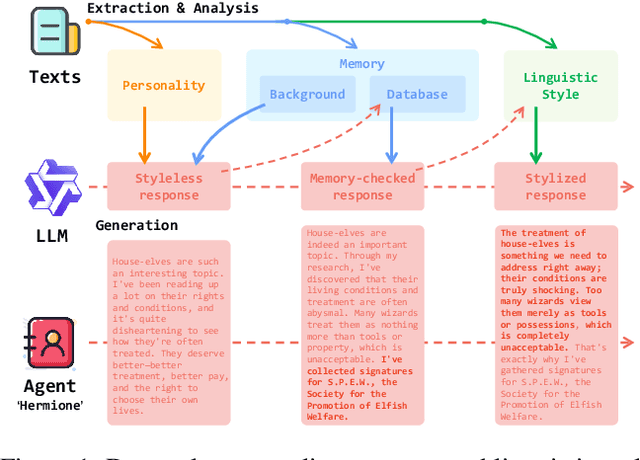
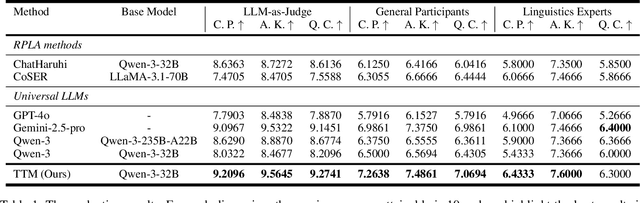
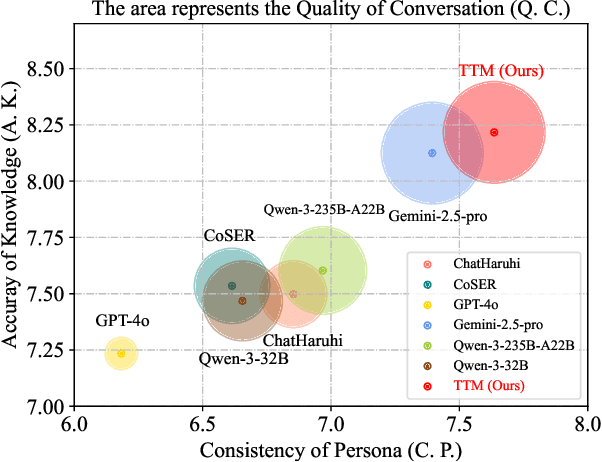
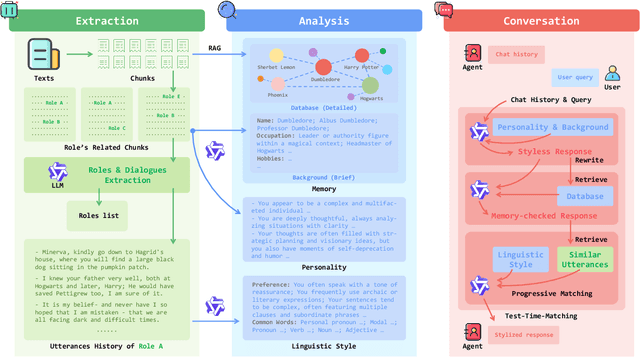
The rapid advancement of large language models (LLMs) has enabled role-playing language agents to demonstrate significant potential in various applications. However, relying solely on prompts and contextual inputs often proves insufficient for achieving deep immersion in specific roles, particularly well-known fictional or public figures. On the other hand, fine-tuning-based approaches face limitations due to the challenges associated with data collection and the computational resources required for training, thereby restricting their broader applicability. To address these issues, we propose Test-Time-Matching (TTM), a training-free role-playing framework through test-time scaling and context engineering. TTM uses LLM agents to automatically decouple a character's features into personality, memory, and linguistic style. Our framework involves a structured, three-stage generation pipeline that utilizes these features for controlled role-playing. It achieves high-fidelity role-playing performance, also enables seamless combinations across diverse linguistic styles and even variations in personality and memory. We evaluate our framework through human assessment, and the results demonstrate that our method achieves the outstanding performance in generating expressive and stylistically consistent character dialogues.
Semantic Human Mesh Reconstruction with Textures
Mar 05, 2024The field of 3D detailed human mesh reconstruction has made significant progress in recent years. However, current methods still face challenges when used in industrial applications due to unstable results, low-quality meshes, and a lack of UV unwrapping and skinning weights. In this paper, we present SHERT, a novel pipeline that can reconstruct semantic human meshes with textures and high-precision details. SHERT applies semantic- and normal-based sampling between the detailed surface (eg mesh and SDF) and the corresponding SMPL-X model to obtain a partially sampled semantic mesh and then generates the complete semantic mesh by our specifically designed self-supervised completion and refinement networks. Using the complete semantic mesh as a basis, we employ a texture diffusion model to create human textures that are driven by both images and texts. Our reconstructed meshes have stable UV unwrapping, high-quality triangle meshes, and consistent semantic information. The given SMPL-X model provides semantic information and shape priors, allowing SHERT to perform well even with incorrect and incomplete inputs. The semantic information also makes it easy to substitute and animate different body parts such as the face, body, and hands. Quantitative and qualitative experiments demonstrate that SHERT is capable of producing high-fidelity and robust semantic meshes that outperform state-of-the-art methods.