 Add to Chrome
 Add to Firefox
 Add to Edge
Learning to Decode in Parallel: Self-Coordinating Neural Network for Real-Time Quantum Error Correction
Jan 14, 2026
Fast, reliable decoders are pivotal components for enabling fault-tolerant quantum computation (FTQC). Neural network decoders like AlphaQubit have demonstrated potential, achieving higher accuracy than traditional human-designed decoding algorithms. However, existing implementations of neural network decoders lack the parallelism required to decode the syndrome stream generated by a superconducting logical qubit in real time. Moreover, integrating AlphaQubit with sliding window-based parallel decoding schemes presents non-trivial challenges: AlphaQubit is trained solely to output a single bit corresponding to the global logical correction for an entire memory experiment, rather than local physical corrections that can be easily integrated. We address this issue by training a recurrent, transformer-based neural network specifically tailored for parallel window decoding. While it still outputs a single bit, we derive training labels from a consistent set of local corrections and train on various types of decoding windows simultaneously. This approach enables the network to self-coordinate across neighboring windows, facilitating high-accuracy parallel decoding of arbitrarily long memory experiments. As a result, we overcome the throughput bottleneck that previously precluded the use of AlphaQubit-type decoders in FTQC. Our work presents the first scalable, neural-network-based parallel decoding framework that simultaneously achieves SOTA accuracy and the stringent throughput required for real-time quantum error correction. Using an end-to-end experimental workflow, we benchmark our decoder on the Zuchongzhi 3.2 superconducting quantum processor on surface codes with distances up to 7, demonstrating its superior accuracy. Moreover, we demonstrate that, using our approach, a single TPU v6e is capable of decoding surface codes with distances up to 25 within 1us per decoding round.

TEAFormers: TEnsor-Augmented Transformers for Multi-Dimensional Time Series Forecasting
Oct 27, 2024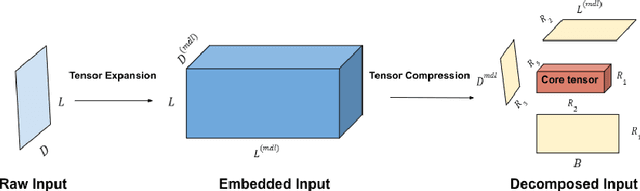
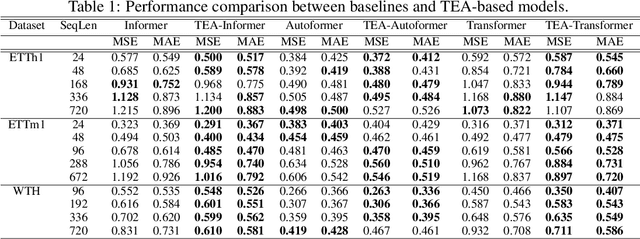
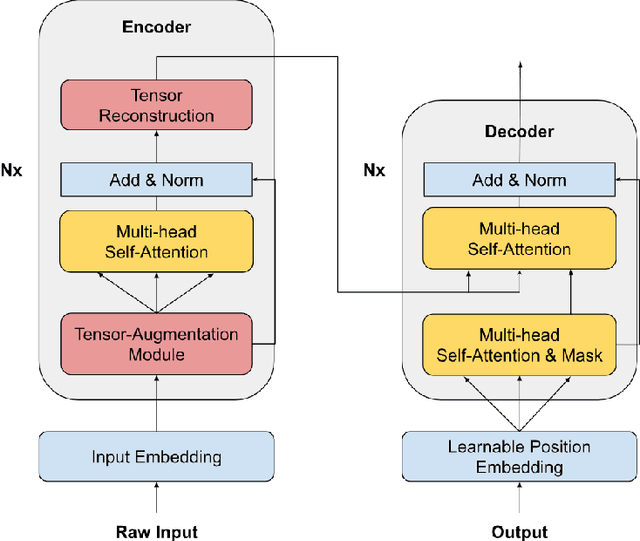
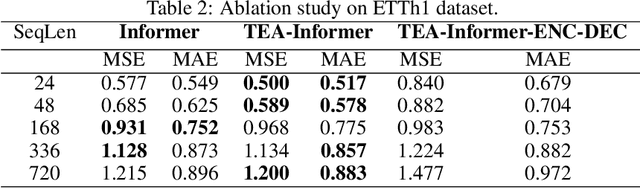
Multi-dimensional time series data, such as matrix and tensor-variate time series, are increasingly prevalent in fields such as economics, finance, and climate science. Traditional Transformer models, though adept with sequential data, do not effectively preserve these multi-dimensional structures, as their internal operations in effect flatten multi-dimensional observations into vectors, thereby losing critical multi-dimensional relationships and patterns. To address this, we introduce the Tensor-Augmented Transformer (TEAFormer), a novel method that incorporates tensor expansion and compression within the Transformer framework to maintain and leverage the inherent multi-dimensional structures, thus reducing computational costs and improving prediction accuracy. The core feature of the TEAFormer, the Tensor-Augmentation (TEA) module, utilizes tensor expansion to enhance multi-view feature learning and tensor compression for efficient information aggregation and reduced computational load. The TEA module is not just a specific model architecture but a versatile component that is highly compatible with the attention mechanism and the encoder-decoder structure of Transformers, making it adaptable to existing Transformer architectures. Our comprehensive experiments, which integrate the TEA module into three popular time series Transformer models across three real-world benchmarks, show significant performance enhancements, highlighting the potential of TEAFormers for cutting-edge time series forecasting.