 Add to Chrome
 Add to Firefox
 Add to Edge
Ventor-QTest: Threat-Model-Driven Verification of Vendor-Hosted LLM APIs
Aug 17, 2026
As large language models become increasingly widespread, third-party providers that deploy open-weight models have become an important part of the ecosystem. Auditing the quality of their inference APIs is therefore an open problem. We formalize hosted model routing as a stochastic process and propose \mbox{\textbf{Ventor-QTest}}, a composite black-box audit that requires no probability information from the target API. Its repeated-request component sends each frozen constrained context to the target multiple times, reconstructs a categorical output distribution from the returned text counts, and reports \emph{average fidelity loss} (AFL) as a null-bias-corrected, within-window mean coarsened-KL statistic. Its long-sequence component uses independent runs to report \emph{extreme fidelity loss} (EFL) through the empirical upper tail of a run-level reference-centered-surprisal statistic. Across three logprob-capable route conditions, AFL shows strong linear descriptive agreement with a logprob-derived coarsened-KL comparator. Across seven route snapshots, 20-run sequence probes reveal route-specific EFL variation. AFL and EFL have little detectable route-level association with GPQA-Diamond accuracy. In contrast, pronounced EFL coincides with a decline in Terminal-Bench pass rate as task exposure increases. This pattern may arise because correctness in long-horizon tasks is more sensitive to extreme fidelity loss. These results motivate reporting AFL and EFL jointly, particularly when auditing long-horizon agentic tasks. The open-source implementation is available at https://github.com/Tencent/AI-Infra-Guard/tree/main/services/api_checker/ventor_qtest.

LanFL: Differentially Private Federated Learning with Large Language Models using Synthetic Samples
Oct 24, 2024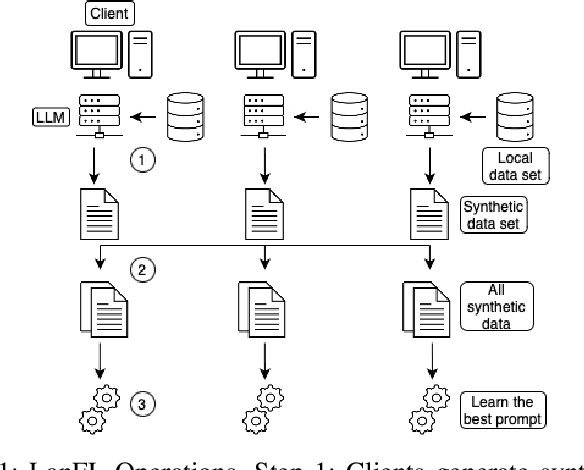
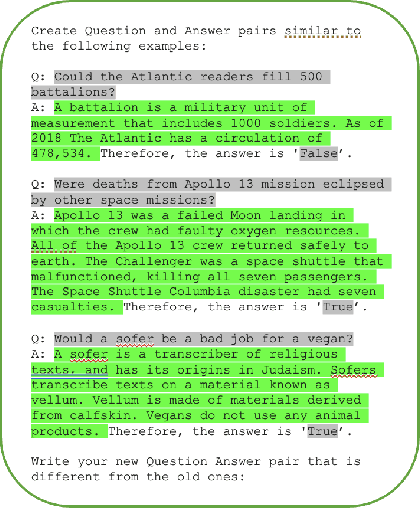
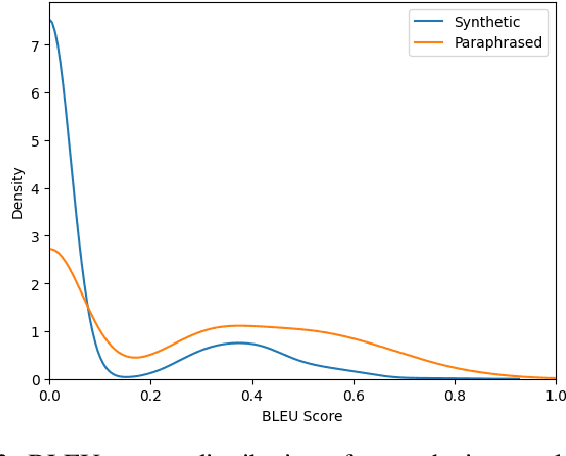
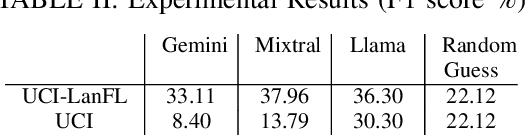
Federated Learning (FL) is a collaborative, privacy-preserving machine learning framework that enables multiple participants to train a single global model. However, the recent advent of powerful Large Language Models (LLMs) with tens to hundreds of billions of parameters makes the naive application of traditional FL methods to LLMs impractical due to high computational and communication costs. Furthermore, end users of LLMs often lack access to full architectures and weights of the models, making it impossible for participants to fine-tune these models directly. This paper introduces a novel FL scheme for LLMs, named LanFL, which is purely prompt-based and treats the underlying LLMs as black boxes. We have developed a differentially private synthetic sample generation mechanism to facilitate knowledge sharing among participants, along with a prompt optimization scheme that enables learning from synthetic samples. Our extensive experiments demonstrate that LanFL successfully facilitates learning among participants while preserving the privacy of local datasets across various tasks.
Logit-based Uncertainty Measure in Classification
Jul 06, 2021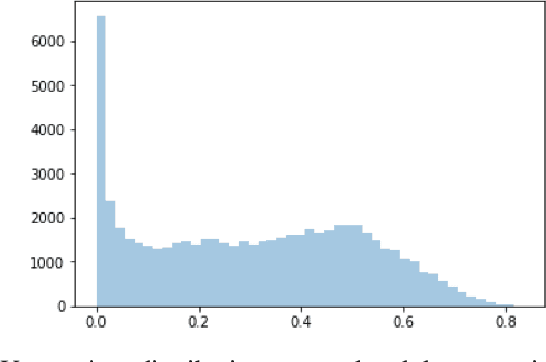
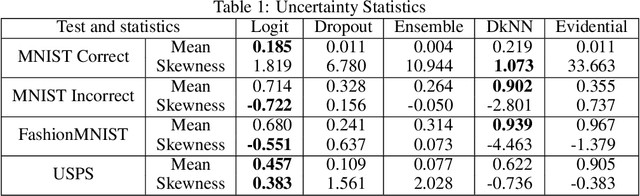
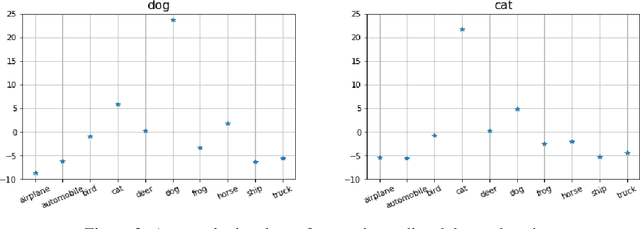
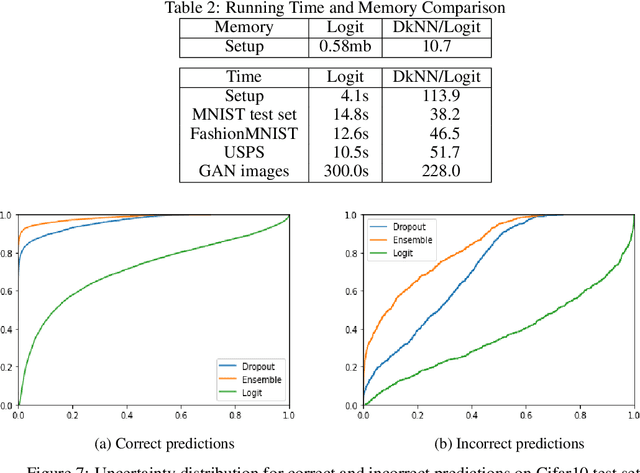
We introduce a new, reliable, and agnostic uncertainty measure for classification tasks called logit uncertainty. It is based on logit outputs of neural networks. We in particular show that this new uncertainty measure yields a superior performance compared to existing uncertainty measures on different tasks, including out of sample detection and finding erroneous predictions. We analyze theoretical foundations of the measure and explore a relationship with high density regions. We also demonstrate how to test uncertainty using intermediate outputs in training of generative adversarial networks. We propose two potential ways to utilize logit-based uncertainty in real world applications, and show that the uncertainty measure outperforms.