 Add to Chrome
 Add to Firefox
 Add to Edge
IGGT4D: Streaming 4D Instance-Grounded Geometry Transformer
Jul 21, 2026
Real-world spatial intelligence requires agents to understand scenes from continuous video streams, where objects move, persist, disappear, and reappear over time. While recent spatial foundation models have enabled generalizable feed-forward 3D reconstruction, most streaming methods remain geometry-centric and lack temporally consistent object-level understanding. Meanwhile, existing semantic reconstruction and 3D-aware vision-language methods largely rely on externally extracted 2D semantic cues or loosely coupled geometry inputs, limiting unified geometry-instance learning in long dynamic scenes. In this paper, we propose IGGT4D, a streaming instance-grounded geometry Transformer for online 4D scene understanding. IGGT4D processes video frames sequentially, reuses historical context through causal spatial-temporal modeling, and incrementally updates a unified representation of camera motion, geometry, and object identity. This enables long-sequence feed-forward reconstruction with geometry-instance consistency in dynamic environments. To address the lack of high-quality 4D supervision, we further construct InsScene4D-147K, a large-scale dataset spanning real/synthetic and static/dynamic scenes, with RGB images, depth, poses, and temporally consistent instance masks generated by an automated geometry-guided annotation pipeline. Experiments on 3D reconstruction, pose estimation, instance spatial tracking, and open-vocabulary segmentation demonstrate that IGGT4D outperforms existing streaming baselines while maintaining scalable online inference for long dynamic sequences.

GeoFlow-SLAM++: A Robust Multi-Camera Visual-Inertial SLAM System with Relocalization
Jun 24, 2026Monocular and RGB-D visual-inertial SLAM systems remain susceptible to limited field of view, sensor-specific failure modes, and unreliable cross-session relocalization. To address these issues, we present GeoFlow-SLAM++, a tightly coupled multi-camera visual-inertial SLAM system that extends GeoFlow-SLAM from a single RGB-D sensor to a calibrated multi-camera rig with a unified body-centric formulation. Within this multi-camera framework, GeoFlow-SLAM++ supports two interchangeable visual front-ends: a conventional ORB front-end and a neural network feature (NN-Feature) front-end built on SuperPoint and LightGlue. The system unifies tracking, mapping, and relocalization on a shared body state, and combines multi-camera reprojection constraints, IMU pre-integration, cross-view place recognition, and dual-stream optical flow/NN-Feature tracking for robust localization. As an optional extension, the system can further incorporate cross-view-consistent pseudo-depth predictions from RGB images as auxiliary geometric constraints. We evaluate GeoFlow-SLAM++ on EuRoC, OpenLORIS, TUM, Hilti, and a self-collected handheld multi-camera dataset. Results show that the NN-Feature front-end improves robustness in appearance-challenging scenarios, the multi-camera formulation achieves competitive localization accuracy on Hilti, and the unified cross-view relocalization design reaches LiDAR-comparable performance on the handheld dataset.
HoloAgent-0: A Unified Embodied Agent Framework with 3D Spatial Memory
Jun 22, 2026LLM agents follow a practical execution loop in digital environments: they reason over structured states, invoke tools, inspect feedback, and revise actions. Extending this loop to physical robots is difficult because physical execution is continuous, embodiment-dependent, uncertain, and constrained by safety. Existing embodied-AI systems have advanced manipulation, spatial understanding, navigation, and humanoid control, but these capabilities often remain specialized modules or loosely coupled decision loops. In this work, we introduce HoloAgent-0, a unified embodied agent framework for real-world robot deployment. Embodied AgentOS converts language instructions into executable skill graphs, schedules robot resources, monitors execution, and triggers clarification or re-planning from runtime feedback. HoloAgent-0 organizes heterogeneous robot models and controllers through three coupled layers: Embodied AgentOS for closed-loop execution, 3D spatial memory for physical world grounding, and embodied skills for robot action. We deploy HoloAgent-0 on real hardware and evaluate its spatial memory, long-horizon navigation, and closed-loop execution across motion generation, object search, cross-robot coordination, and mobile manipulation.
IstGPT: LLM-based Anomaly Detection for Spatial-Temporal Graph in Industrial Systems
Jun 01, 2026Industrial Internet systems face increasing threats from sophisticated industrial control system (ICS) attacks, resulting in critical safety incidents. However, existing tools exhibit limited effectiveness in real-time anomaly detection due to the complex dependencies among sensors and actuators. To tackle this, we present IstGPT, the first industrial anomaly detection tool based on LLMs and graph learning to provide real-time protection against a wide range of ICS attacks. IstGPT achieves fine-grained and precise modeling on spatial-temporal dependencies in industrial cyber-physical systems. It first leverages industrial multi-modal knowledge, including operational data, technical documents, and system diagrams, to extract sensor-actuator dependency graphs via multi-stage prompt engineering. Then, LLM-Optimation iteratively refines the graph based on node accuracy, edge consistency, and logical coherence. Finally, IstGPT integrated improved graph neural networks with an encoder-decoder architecture to detect anomalies via reconstruction errors. We evaluate IstGPT against 12 state-of-the-art baselines on 9 datasets, including 2 public, 6 simulated, and a real-world robotic arm dataset. IstGPT achieves the best F1-scores and eTaF1 (a newer time-aware metric) across nine datasets. We further discuss the feasibility of deploying IstGPT in real-world industrial scenarios.
Counterfactual Trace Auditing of LLM Agent Skills
May 12, 2026Large Language Model agents are increasingly augmented with agent skills. Current evaluation methods for skills remain limited. Most deployed benchmarks report only pass rate before and after a skill is attached, treating the skill as a black box change to agent behavior. We introduce Counterfactual Trace Auditing (CTA), a framework for measuring how a skill changes agent behavior. CTA pairs each with skill agent trace with a without skill counterpart on the same task, segments both traces into goal directed phases, aligns the phases, and emits structured Skill Influence Pattern (SIP) annotations. These annotations describe the behavioral effect of a skill rather than only its task outcome. We instantiate CTA on SWE-Skills-Bench with Claude across 49 software engineering tasks. The resulting audit reveals a clear evaluation gap. Pass rate changes by only +0.3 percentage points on average, suggesting little aggregate effect. Yet CTA identifies 522 SIP instances across the same paired traces, showing that the skills substantially reshape agent behavior even when pass rate is nearly unchanged. The audit also separates several recurring effects that pass rate cannot detect, including literal template copying, off task artifact creation, excess planning, and task recovery. Three findings emerge. First, high baseline tasks contain most of the observed skill effects, although their pass rate is already saturated and therefore cannot reflect those effects. Second, tasks with moderate baseline performance show the most recoverable gain, but often at substantially higher token cost. Third, the dominant SIP type can be identified by baseline bucket: surface anchoring is most common on ceiling tasks and edge-case prompting is most common on mid-range and floor tasks. These regularities turn informal failure mode observations into reproducible behavioral measurements.
When Simulation Lies: A Sim-to-Real Benchmark and Domain-Randomized RL Recipe for Tool-Use Agents
May 12, 2026Tool-use language agents are evaluated on benchmarks that assume clean inputs, unambiguous tool registries, and reliable APIs. Real deployments violate all these assumptions: user typos propagate into hallucinated tool names, a misconfigured request timeout can stall an agent indefinitely, and duplicate tool names across servers can freeze an SDK. We study these failures as a sim-to-real gap in the tool-use partially observable Markov decision process (POMDP), where deployment noise enters through the observation, action space, reward-relevant metadata, or transition dynamics. We introduce RobustBench-TC, a benchmark with 22 perturbation types organized by these four POMDP components, each grounded in a verified GitHub issue or documented tool-calling failure. Across 21 models from 1.5B to 32B parameters (including the closed-source o4-mini), the robustness profile is sharply uneven: observation perturbations reduce accuracy by less than 5%, while reward-relevant and transition perturbations reduce accuracy by roughly 40% and 30%, respectively; scale alone does not close these gaps. We then propose ToolRL-DR, a domain-randomization reinforcement learning (RL) recipe that trains a tool-use agent on perturbation-augmented trajectories spanning the three statically encodable POMDP components. On a 3B backbone, ToolRL-DR-Full retains roughly three-quarters of clean accuracy and reaches an aggregate perturbed accuracy comparable to open-source 14B function-calling baselines while substantially narrowing the gap to o4-mini. It closes approximately 27% of the Transition gap despite never seeing transition perturbations in training, suggesting that RL on adversarial static tool-use inputs induces a more persistent retry policy that transfers to unseen runtime failures. The dataset, code and benchmark leaderboard are publicly available.
Fairness or Fluency? An Investigation into Language Bias of Pairwise LLM-as-a-Judge
Jan 20, 2026Recent advances in Large Language Models (LLMs) have incentivized the development of LLM-as-a-judge, an application of LLMs where they are used as judges to decide the quality of a certain piece of text given a certain context. However, previous studies have demonstrated that LLM-as-a-judge can be biased towards different aspects of the judged texts, which often do not align with human preference. One of the identified biases is language bias, which indicates that the decision of LLM-as-a-judge can differ based on the language of the judged texts. In this paper, we study two types of language bias in pairwise LLM-as-a-judge: (1) performance disparity between languages when the judge is prompted to compare options from the same language, and (2) bias towards options written in major languages when the judge is prompted to compare options of two different languages. We find that for same-language judging, there exist significant performance disparities across language families, with European languages consistently outperforming African languages, and this bias is more pronounced in culturally-related subjects. For inter-language judging, we observe that most models favor English answers, and that this preference is influenced more by answer language than question language. Finally, we investigate whether language bias is in fact caused by low-perplexity bias, a previously identified bias of LLM-as-a-judge, and we find that while perplexity is slightly correlated with language bias, language bias cannot be fully explained by perplexity only.
GeoFlow-SLAM: A Robust Tightly-Coupled RGBD-Inertial Fusion SLAM for Dynamic Legged Robotics
Mar 18, 2025This paper presents GeoFlow-SLAM, a robust and effective Tightly-Coupled RGBD-inertial SLAM for legged robots operating in highly dynamic environments.By integrating geometric consistency, legged odometry constraints, and dual-stream optical flow (GeoFlow), our method addresses three critical challenges:feature matching and pose initialization failures during fast locomotion and visual feature scarcity in texture-less scenes.Specifically, in rapid motion scenarios, feature matching is notably enhanced by leveraging dual-stream optical flow, which combines prior map points and poses. Additionally, we propose a robust pose initialization method for fast locomotion and IMU error in legged robots, integrating IMU/Legged odometry, inter-frame Perspective-n-Point (PnP), and Generalized Iterative Closest Point (GICP). Furthermore, a novel optimization framework that tightly couples depth-to-map and GICP geometric constraints is first introduced to improve the robustness and accuracy in long-duration, visually texture-less environments. The proposed algorithms achieve state-of-the-art (SOTA) on collected legged robots and open-source datasets. To further promote research and development, the open-source datasets and code will be made publicly available at https://github.com/NSN-Hello/GeoFlow-SLAM
Static Key Attention in Vision
Dec 09, 2024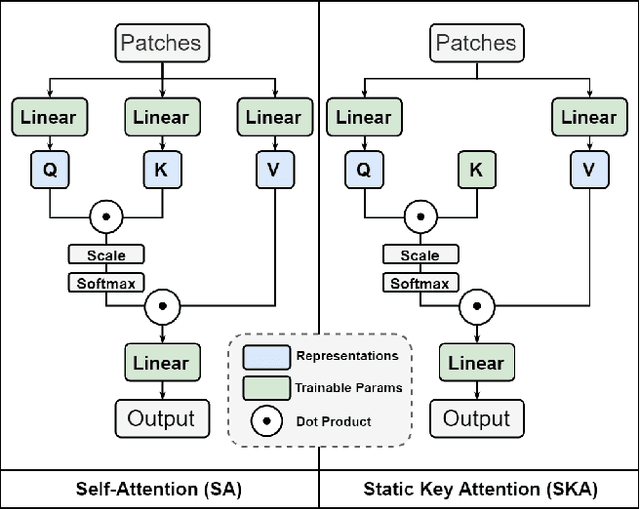
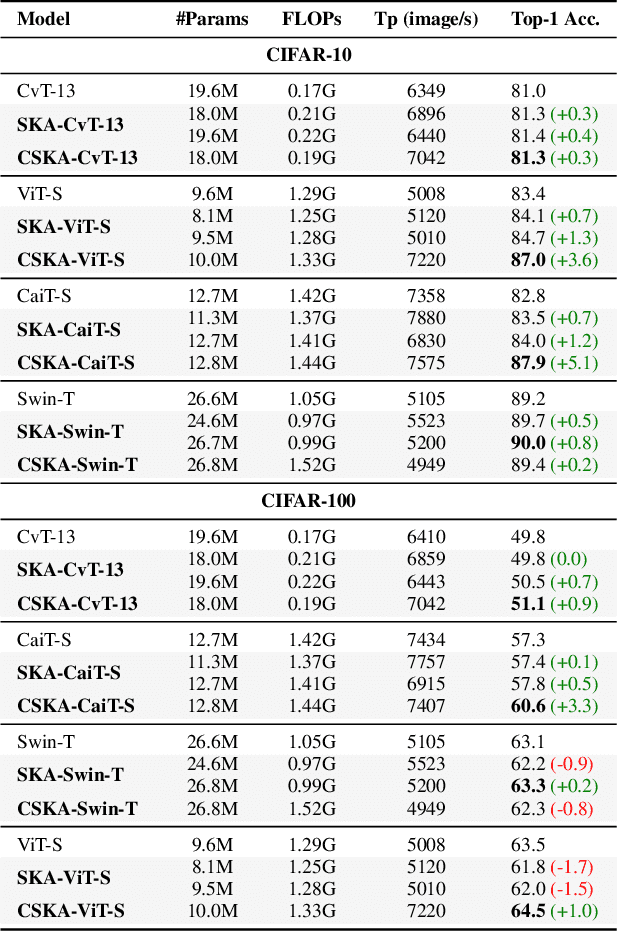
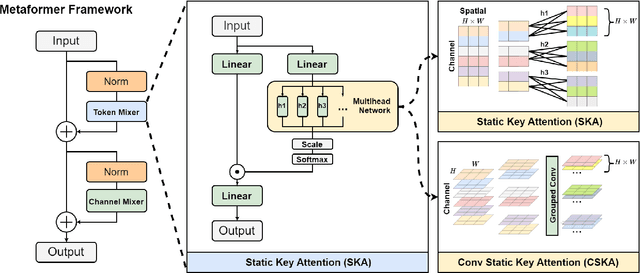
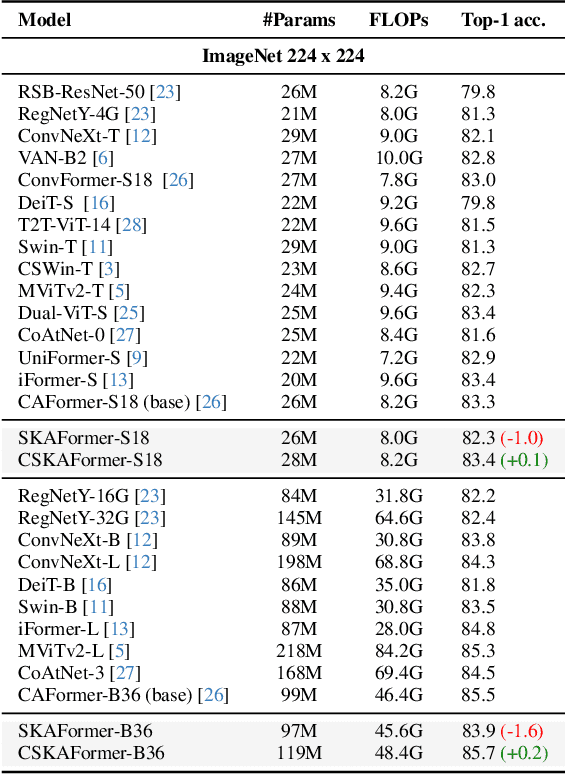
The success of vision transformers is widely attributed to the expressive power of their dynamically parameterized multi-head self-attention mechanism. We examine the impact of substituting the dynamic parameterized key with a static key within the standard attention mechanism in Vision Transformers. Our findings reveal that static key attention mechanisms can match or even exceed the performance of standard self-attention. Integrating static key attention modules into a Metaformer backbone, we find that it serves as a better intermediate stage in hierarchical hybrid architectures, balancing the strengths of depth-wise convolution and self-attention. Experiments on several vision tasks underscore the effectiveness of the static key mechanism, indicating that the typical two-step dynamic parameterization in attention can be streamlined to a single step without impacting performance under certain circumstances.
Gaussian Object Carver: Object-Compositional Gaussian Splatting with surfaces completion
Dec 03, 2024


3D scene reconstruction is a foundational problem in computer vision. Despite recent advancements in Neural Implicit Representations (NIR), existing methods often lack editability and compositional flexibility, limiting their use in scenarios requiring high interactivity and object-level manipulation. In this paper, we introduce the Gaussian Object Carver (GOC), a novel, efficient, and scalable framework for object-compositional 3D scene reconstruction. GOC leverages 3D Gaussian Splatting (GS), enriched with monocular geometry priors and multi-view geometry regularization, to achieve high-quality and flexible reconstruction. Furthermore, we propose a zero-shot Object Surface Completion (OSC) model, which uses 3D priors from 3d object data to reconstruct unobserved surfaces, ensuring object completeness even in occluded areas. Experimental results demonstrate that GOC improves reconstruction efficiency and geometric fidelity. It holds promise for advancing the practical application of digital twins in embodied AI, AR/VR, and interactive simulation environments.