 Add to Chrome
 Add to Firefox
 Add to Edge
D$^3$-MoE:Dual Disentangled Diffusion Mixture-of-Experts for Style-Controllable End-to-End Autonomous Driving
Jun 03, 2026
Traditional end-to-end autonomous driving frameworks frequently suffer from the "style-averaging" dilemma when trained on high-variance human demonstrations, yielding homogenized, style-uncontrollable, and even kinematically unsafe policies. To overcome this limitation, we present D$^3$-MoE (Dual Disentangled Diffusion Mixture-of-Experts), which disentangles trajectory modeling along two complementary axes. On the behavioral axis, generation is decoupled from selection: a style-conditioned diffusion process synthesizes multi-style candidate trajectories in parallel within a single scene, allowing a downstream module to select the optimal trajectory based on user preference or an evaluation score. On the physical axis, decoupled longitudinal and lateral routers activate their respective experts during inference time, trained without manual labels using self-supervised targets from orthogonal ground-truth kinematics. These activated experts, architected as Diffusion Transformers (DiT) and equipped with style-conditioned AdaLN and asymmetric lateral-fusion cross-attention, independently predict their corresponding physical state before being reassembled into a unified, kinematically coherent trajectory. Extensive evaluations on the challenging NAVSIM benchmark demonstrate that D$^3$-MoE achieves state-of-the-art planning performance, reaching 88.2 PDMS and 84.3 EPDMS by default. Moreover, our Best-of-Three ensemble strategy effectively broadens the multi-modal solution space, raising performance to 91.3 PDMS and 87.5 EPDMS. Both quantitative and qualitative analyses jointly confirm the framework's advantages in planning quality and style controllability.

IstGPT: LLM-based Anomaly Detection for Spatial-Temporal Graph in Industrial Systems
Jun 01, 2026Industrial Internet systems face increasing threats from sophisticated industrial control system (ICS) attacks, resulting in critical safety incidents. However, existing tools exhibit limited effectiveness in real-time anomaly detection due to the complex dependencies among sensors and actuators. To tackle this, we present IstGPT, the first industrial anomaly detection tool based on LLMs and graph learning to provide real-time protection against a wide range of ICS attacks. IstGPT achieves fine-grained and precise modeling on spatial-temporal dependencies in industrial cyber-physical systems. It first leverages industrial multi-modal knowledge, including operational data, technical documents, and system diagrams, to extract sensor-actuator dependency graphs via multi-stage prompt engineering. Then, LLM-Optimation iteratively refines the graph based on node accuracy, edge consistency, and logical coherence. Finally, IstGPT integrated improved graph neural networks with an encoder-decoder architecture to detect anomalies via reconstruction errors. We evaluate IstGPT against 12 state-of-the-art baselines on 9 datasets, including 2 public, 6 simulated, and a real-world robotic arm dataset. IstGPT achieves the best F1-scores and eTaF1 (a newer time-aware metric) across nine datasets. We further discuss the feasibility of deploying IstGPT in real-world industrial scenarios.
Rethinking LoRA for Privacy-Preserving Federated Learning in Large Models
Feb 23, 2026Fine-tuning large vision models (LVMs) and large language models (LLMs) under differentially private federated learning (DPFL) is hindered by a fundamental privacy-utility trade-off. Low-Rank Adaptation (LoRA), a promising parameter-efficient fine-tuning (PEFT) method, reduces computational and communication costs by introducing two trainable low-rank matrices while freezing pre-trained weights. However, directly applying LoRA in DPFL settings leads to performance degradation, especially in LVMs. Our analysis reveals three previously underexplored challenges: (1) gradient coupling caused by the simultaneous update of two asymmetric low-rank matrices, (2) compounded noise amplification under differential privacy, and (3) sharpness of the global aggregated model in the parameter space. To address these issues, we propose LA-LoRA (\textbf{L}ocal \textbf{A}lternating \textbf{LoRA}), a novel approach that decouples gradient interactions and aligns update directions across clients to enhance robustness under stringent privacy constraints. Theoretically, LA-LoRA strengthens convergence guarantees in noisy federated environments. Extensive experiments demonstrate that LA-LoRA achieves state-of-the-art (SOTA) performance on Swin Transformer and RoBERTa models, showcasing robustness to DP noise and broad applicability across both LVMs and LLMs. For example, when fine-tuning the Swin-B model on the Tiny-ImageNet dataset under a strict privacy budget ($ε= 1$), LA-LoRA outperforms the best baseline, RoLoRA, by 16.83\% in test accuracy. Code is provided in \repolink.
DP-FedAdamW: An Efficient Optimizer for Differentially Private Federated Large Models
Feb 23, 2026Balancing convergence efficiency and robustness under Differential Privacy (DP) is a central challenge in Federated Learning (FL). While AdamW accelerates training and fine-tuning in large-scale models, we find that directly applying it to Differentially Private FL (DPFL) suffers from three major issues: (i) data heterogeneity and privacy noise jointly amplify the variance of second-moment estimator, (ii) DP perturbations bias the second-moment estimator, and (iii) DP amplify AdamW sensitivity to local overfitting, worsening client drift. We propose DP-FedAdamW, the first AdamW-based optimizer for DPFL. It restores AdamW under DP by stabilizing second-moment variance, removing DP-induced bias, and aligning local updates to the global descent to curb client drift. Theoretically, we establish an unbiased second-moment estimator and prove a linearly accelerated convergence rate without any heterogeneity assumption, while providing tighter $(\varepsilon,δ)$-DP guarantees. Our empirical results demonstrate the effectiveness of DP-FedAdamW across language and vision Transformers and ResNet-18. On Tiny-ImageNet (Swin-Base, $\varepsilon=1$), DP-FedAdamW outperforms the state-of-the-art (SOTA) by 5.83\%. The code is available in Appendix.
ARTEMIS: Autoregressive End-to-End Trajectory Planning with Mixture of Experts for Autonomous Driving
Apr 28, 2025This paper presents ARTEMIS, an end-to-end autonomous driving framework that combines autoregressive trajectory planning with Mixture-of-Experts (MoE). Traditional modular methods suffer from error propagation, while existing end-to-end models typically employ static one-shot inference paradigms that inadequately capture the dynamic changes of the environment. ARTEMIS takes a different method by generating trajectory waypoints sequentially, preserves critical temporal dependencies while dynamically routing scene-specific queries to specialized expert networks. It effectively relieves trajectory quality degradation issues encountered when guidance information is ambiguous, and overcomes the inherent representational limitations of singular network architectures when processing diverse driving scenarios. Additionally, we use a lightweight batch reallocation strategy that significantly improves the training speed of the Mixture-of-Experts model. Through experiments on the NAVSIM dataset, ARTEMIS exhibits superior competitive performance, achieving 87.0 PDMS and 83.1 EPDMS with ResNet-34 backbone, demonstrates state-of-the-art performance on multiple metrics.
Muscle Activation Estimation by Optimizing the Musculoskeletal Model for Personalized Strength and Conditioning Training
Feb 20, 2025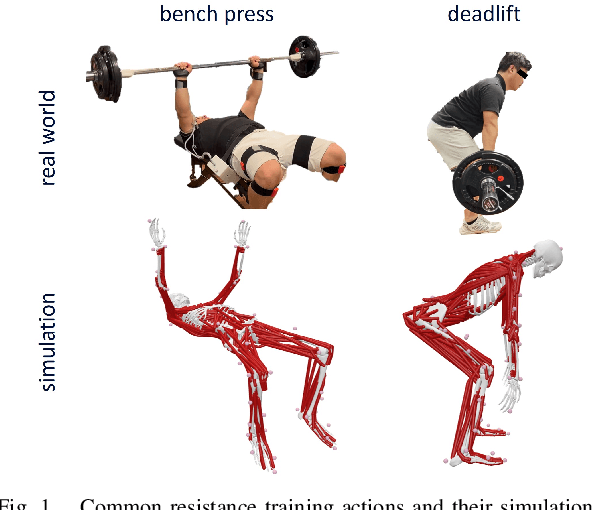
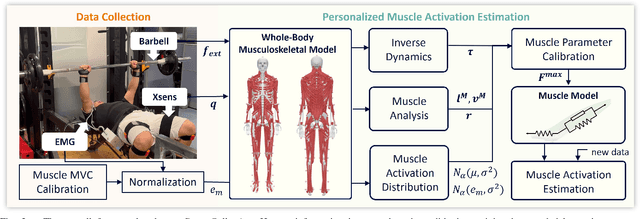
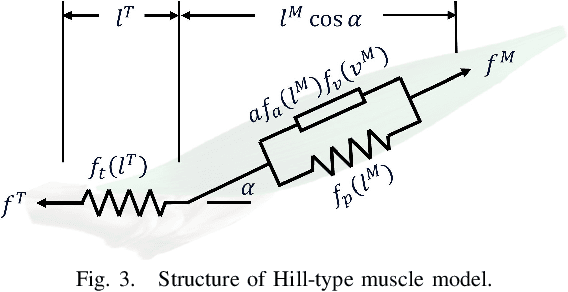
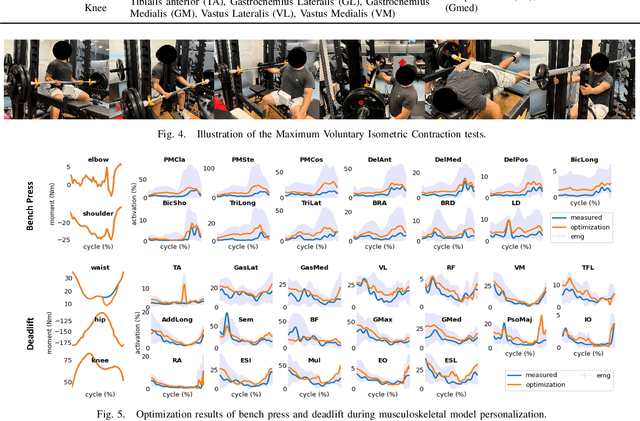
Musculoskeletal models are pivotal in the domains of rehabilitation and resistance training to analyze muscle conditions. However, individual variability in musculoskeletal parameters and the immeasurability of some internal biomechanical variables pose significant obstacles to accurate personalized modelling. Furthermore, muscle activation estimation can be challenging due to the inherent redundancy of the musculoskeletal system, where multiple muscles drive a single joint. This study develops a whole-body musculoskeletal model for strength and conditioning training and calibrates relevant muscle parameters with an electromyography-based optimization method. By utilizing the personalized musculoskeletal model, muscle activation can be subsequently estimated to analyze the performance of exercises. Bench press and deadlift are chosen for experimental verification to affirm the efficacy of this approach.