 Add to Chrome
 Add to Firefox
 Add to Edge
Unified Modeling Enhanced Multimodal Learning for Precision Neuro-Oncology
Jun 11, 2024
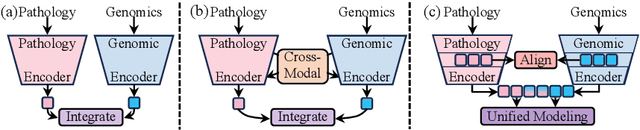
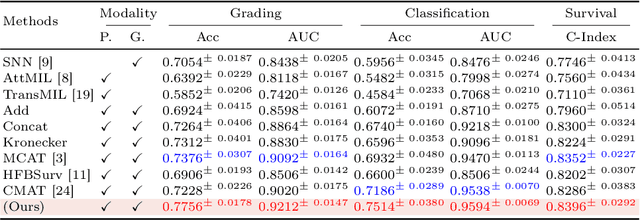
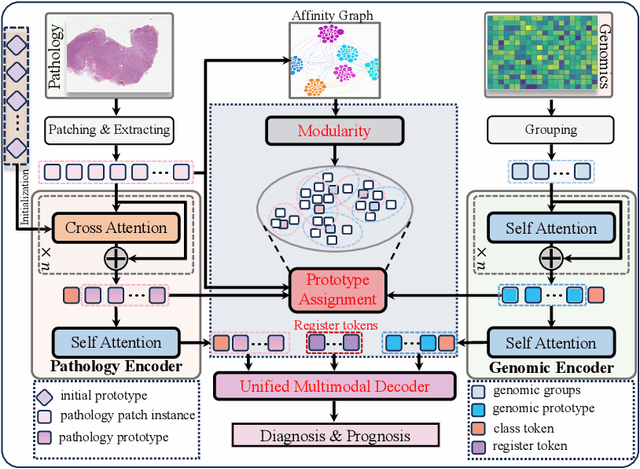
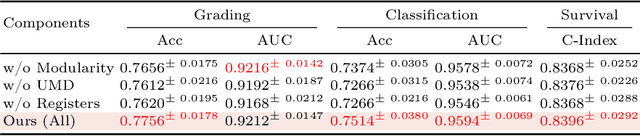
Multimodal learning, integrating histology images and genomics, promises to enhance precision oncology with comprehensive views at microscopic and molecular levels. However, existing methods may not sufficiently model the shared or complementary information for more effective integration. In this study, we introduce a Unified Modeling Enhanced Multimodal Learning (UMEML) framework that employs a hierarchical attention structure to effectively leverage shared and complementary features of both modalities of histology and genomics. Specifically, to mitigate unimodal bias from modality imbalance, we utilize a query-based cross-attention mechanism for prototype clustering in the pathology encoder. Our prototype assignment and modularity strategy are designed to align shared features and minimizes modality gaps. An additional registration mechanism with learnable tokens is introduced to enhance cross-modal feature integration and robustness in multimodal unified modeling. Our experiments demonstrate that our method surpasses previous state-of-the-art approaches in glioma diagnosis and prognosis tasks, underscoring its superiority in precision neuro-Oncology.

An Investigation of Noise Robustness for Flow-Matching-Based Zero-Shot TTS
Jun 09, 2024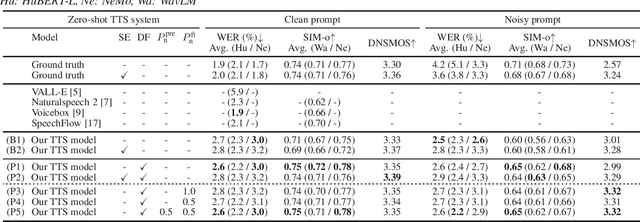
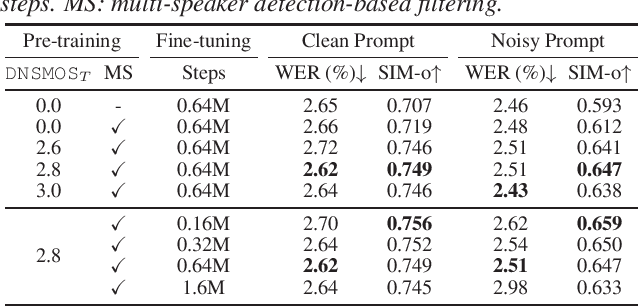
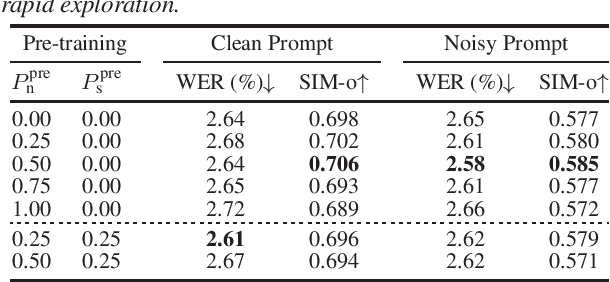
Recently, zero-shot text-to-speech (TTS) systems, capable of synthesizing any speaker's voice from a short audio prompt, have made rapid advancements. However, the quality of the generated speech significantly deteriorates when the audio prompt contains noise, and limited research has been conducted to address this issue. In this paper, we explored various strategies to enhance the quality of audio generated from noisy audio prompts within the context of flow-matching-based zero-shot TTS. Our investigation includes comprehensive training strategies: unsupervised pre-training with masked speech denoising, multi-speaker detection and DNSMOS-based data filtering on the pre-training data, and fine-tuning with random noise mixing. The results of our experiments demonstrate significant improvements in intelligibility, speaker similarity, and overall audio quality compared to the approach of applying speech enhancement to the audio prompt.
Total-Duration-Aware Duration Modeling for Text-to-Speech Systems
Jun 06, 2024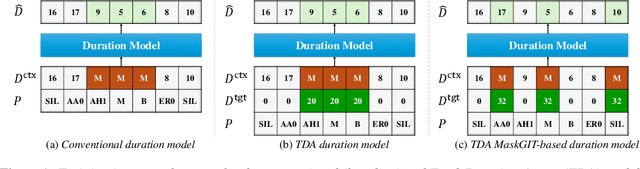

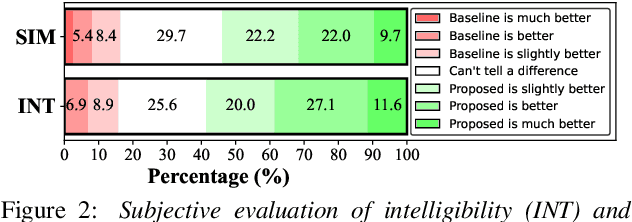
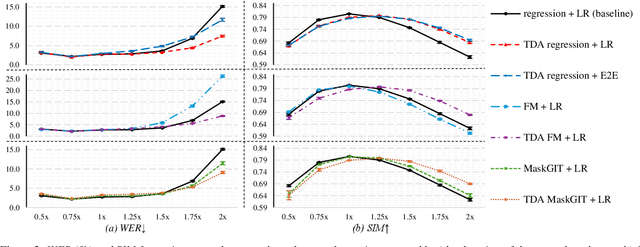
Accurate control of the total duration of generated speech by adjusting the speech rate is crucial for various text-to-speech (TTS) applications. However, the impact of adjusting the speech rate on speech quality, such as intelligibility and speaker characteristics, has been underexplored. In this work, we propose a novel total-duration-aware (TDA) duration model for TTS, where phoneme durations are predicted not only from the text input but also from an additional input of the total target duration. We also propose a MaskGIT-based duration model that enhances the diversity and quality of the predicted phoneme durations. Our results demonstrate that the proposed TDA duration models achieve better intelligibility and speaker similarity for various speech rate configurations compared to the baseline models. We also show that the proposed MaskGIT-based model can generate phoneme durations with higher quality and diversity compared to its regression or flow-matching counterparts.
Domain Game: Disentangle Anatomical Feature for Single Domain Generalized Segmentation
Jun 04, 2024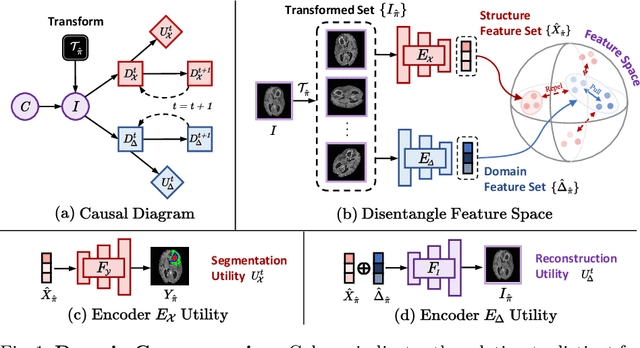
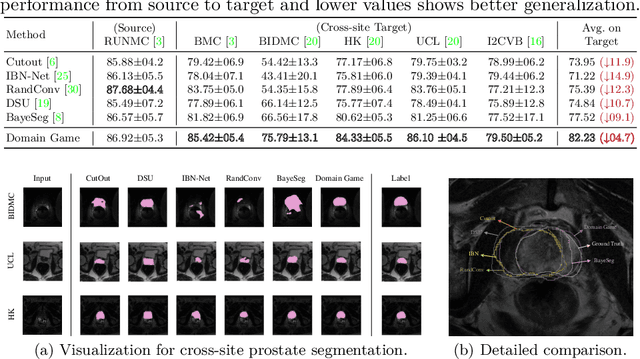
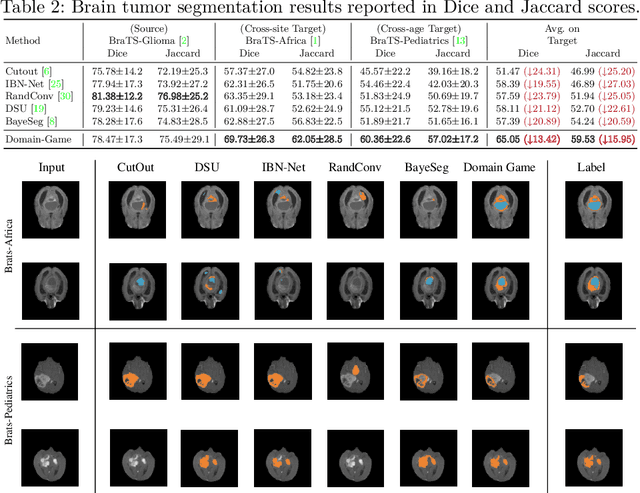

Single domain generalization aims to address the challenge of out-of-distribution generalization problem with only one source domain available. Feature distanglement is a classic solution to this purpose, where the extracted task-related feature is presumed to be resilient to domain shift. However, the absence of references from other domains in a single-domain scenario poses significant uncertainty in feature disentanglement (ill-posedness). In this paper, we propose a new framework, named \textit{Domain Game}, to perform better feature distangling for medical image segmentation, based on the observation that diagnostic relevant features are more sensitive to geometric transformations, whilist domain-specific features probably will remain invariant to such operations. In domain game, a set of randomly transformed images derived from a singular source image is strategically encoded into two separate feature sets to represent diagnostic features and domain-specific features, respectively, and we apply forces to pull or repel them in the feature space, accordingly. Results from cross-site test domain evaluation showcase approximately an ~11.8% performance boost in prostate segmentation and around ~10.5% in brain tumor segmentation compared to the second-best method.
TransVIP: Speech to Speech Translation System with Voice and Isochrony Preservation
May 28, 2024There is a rising interest and trend in research towards directly translating speech from one language to another, known as end-to-end speech-to-speech translation. However, most end-to-end models struggle to outperform cascade models, i.e., a pipeline framework by concatenating speech recognition, machine translation and text-to-speech models. The primary challenges stem from the inherent complexities involved in direct translation tasks and the scarcity of data. In this study, we introduce a novel model framework TransVIP that leverages diverse datasets in a cascade fashion yet facilitates end-to-end inference through joint probability. Furthermore, we propose two separated encoders to preserve the speaker's voice characteristics and isochrony from the source speech during the translation process, making it highly suitable for scenarios such as video dubbing. Our experiments on the French-English language pair demonstrate that our model outperforms the current state-of-the-art speech-to-speech translation model.
Socialized Learning: A Survey of the Paradigm Shift for Edge Intelligence in Networked Systems
Apr 20, 2024Amidst the robust impetus from artificial intelligence (AI) and big data, edge intelligence (EI) has emerged as a nascent computing paradigm, synthesizing AI with edge computing (EC) to become an exemplary solution for unleashing the full potential of AI services. Nonetheless, challenges in communication costs, resource allocation, privacy, and security continue to constrain its proficiency in supporting services with diverse requirements. In response to these issues, this paper introduces socialized learning (SL) as a promising solution, further propelling the advancement of EI. SL is a learning paradigm predicated on social principles and behaviors, aimed at amplifying the collaborative capacity and collective intelligence of agents within the EI system. SL not only enhances the system's adaptability but also optimizes communication, and networking processes, essential for distributed intelligence across diverse devices and platforms. Therefore, a combination of SL and EI may greatly facilitate the development of collaborative intelligence in the future network. This paper presents the findings of a literature review on the integration of EI and SL, summarizing the latest achievements in existing research on EI and SL. Subsequently, we delve comprehensively into the limitations of EI and how it could benefit from SL. Special emphasis is placed on the communication challenges and networking strategies and other aspects within these systems, underlining the role of optimized network solutions in improving system efficacy. Based on these discussions, we elaborate in detail on three integrated components: socialized architecture, socialized training, and socialized inference, analyzing their strengths and weaknesses. Finally, we identify some possible future applications of combining SL and EI, discuss open problems and suggest some future research.
Cross-modal Diffusion Modelling for Super-resolved Spatial Transcriptomics
Apr 19, 2024The recent advancement of spatial transcriptomics (ST) allows to characterize spatial gene expression within tissue for discovery research. However, current ST platforms suffer from low resolution, hindering in-depth understanding of spatial gene expression. Super-resolution approaches promise to enhance ST maps by integrating histology images with gene expressions of profiled tissue spots. However, current super-resolution methods are limited by restoration uncertainty and mode collapse. Although diffusion models have shown promise in capturing complex interactions between multi-modal conditions, it remains a challenge to integrate histology images and gene expression for super-resolved ST maps. This paper proposes a cross-modal conditional diffusion model for super-resolving ST maps with the guidance of histology images. Specifically, we design a multi-modal disentangling network with cross-modal adaptive modulation to utilize complementary information from histology images and spatial gene expression. Moreover, we propose a dynamic cross-attention modelling strategy to extract hierarchical cell-to-tissue information from histology images. Lastly, we propose a co-expression-based gene-correlation graph network to model the co-expression relationship of multiple genes. Experiments show that our method outperforms other state-of-the-art methods in ST super-resolution on three public datasets.
CoVoMix: Advancing Zero-Shot Speech Generation for Human-like Multi-talker Conversations
Apr 10, 2024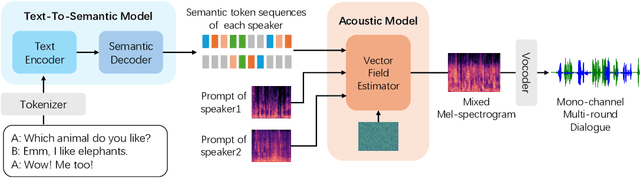
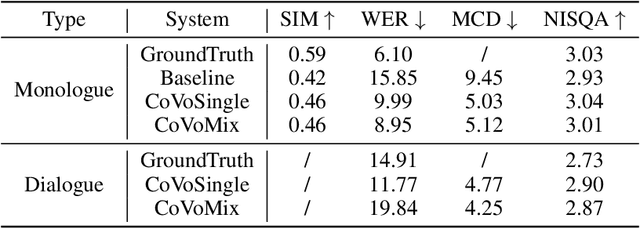
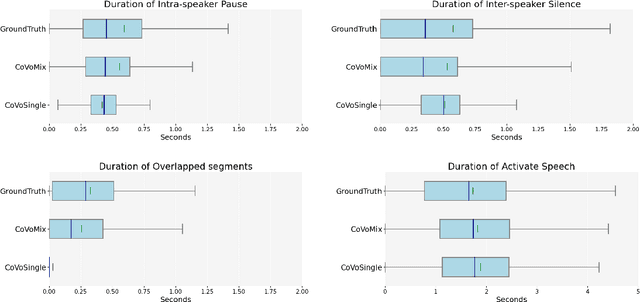
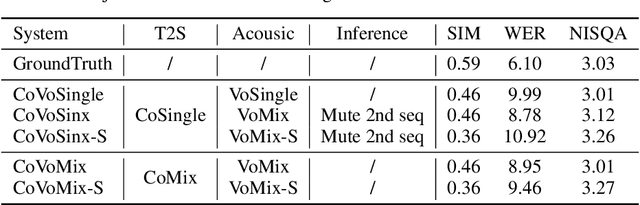
Recent advancements in zero-shot text-to-speech (TTS) modeling have led to significant strides in generating high-fidelity and diverse speech. However, dialogue generation, along with achieving human-like naturalness in speech, continues to be a challenge in the field. In this paper, we introduce CoVoMix: Conversational Voice Mixture Generation, a novel model for zero-shot, human-like, multi-speaker, multi-round dialogue speech generation. CoVoMix is capable of first converting dialogue text into multiple streams of discrete tokens, with each token stream representing semantic information for individual talkers. These token streams are then fed into a flow-matching based acoustic model to generate mixed mel-spectrograms. Finally, the speech waveforms are produced using a HiFi-GAN model. Furthermore, we devise a comprehensive set of metrics for measuring the effectiveness of dialogue modeling and generation. Our experimental results show that CoVoMix can generate dialogues that are not only human-like in their naturalness and coherence but also involve multiple talkers engaging in multiple rounds of conversation. These dialogues, generated within a single channel, are characterized by seamless speech transitions, including overlapping speech, and appropriate paralinguistic behaviors such as laughter. Audio samples are available at https://aka.ms/covomix.
Eliminating Cross-modal Conflicts in BEV Space for LiDAR-Camera 3D Object Detection
Mar 12, 2024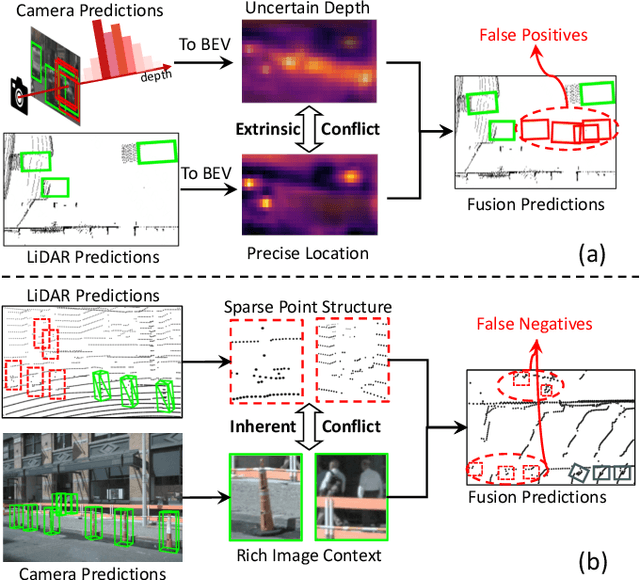
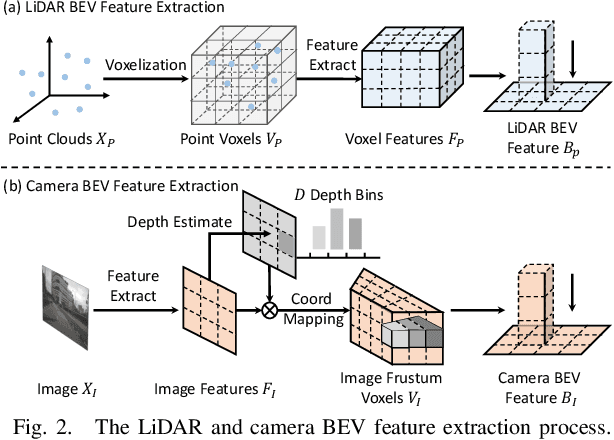


Recent 3D object detectors typically utilize multi-sensor data and unify multi-modal features in the shared bird's-eye view (BEV) representation space. However, our empirical findings indicate that previous methods have limitations in generating fusion BEV features free from cross-modal conflicts. These conflicts encompass extrinsic conflicts caused by BEV feature construction and inherent conflicts stemming from heterogeneous sensor signals. Therefore, we propose a novel Eliminating Conflicts Fusion (ECFusion) method to explicitly eliminate the extrinsic/inherent conflicts in BEV space and produce improved multi-modal BEV features. Specifically, we devise a Semantic-guided Flow-based Alignment (SFA) module to resolve extrinsic conflicts via unifying spatial distribution in BEV space before fusion. Moreover, we design a Dissolved Query Recovering (DQR) mechanism to remedy inherent conflicts by preserving objectness clues that are lost in the fusion BEV feature. In general, our method maximizes the effective information utilization of each modality and leverages inter-modal complementarity. Our method achieves state-of-the-art performance in the highly competitive nuScenes 3D object detection dataset. The code is released at https://github.com/fjhzhixi/ECFusion.
Making Flow-Matching-Based Zero-Shot Text-to-Speech Laugh as You Like
Feb 12, 2024Laughter is one of the most expressive and natural aspects of human speech, conveying emotions, social cues, and humor. However, most text-to-speech (TTS) systems lack the ability to produce realistic and appropriate laughter sounds, limiting their applications and user experience. While there have been prior works to generate natural laughter, they fell short in terms of controlling the timing and variety of the laughter to be generated. In this work, we propose ELaTE, a zero-shot TTS that can generate natural laughing speech of any speaker based on a short audio prompt with precise control of laughter timing and expression. Specifically, ELaTE works on the audio prompt to mimic the voice characteristic, the text prompt to indicate the contents of the generated speech, and the input to control the laughter expression, which can be either the start and end times of laughter, or the additional audio prompt that contains laughter to be mimicked. We develop our model based on the foundation of conditional flow-matching-based zero-shot TTS, and fine-tune it with frame-level representation from a laughter detector as additional conditioning. With a simple scheme to mix small-scale laughter-conditioned data with large-scale pre-training data, we demonstrate that a pre-trained zero-shot TTS model can be readily fine-tuned to generate natural laughter with precise controllability, without losing any quality of the pre-trained zero-shot TTS model. Through the evaluations, we show that ELaTE can generate laughing speech with significantly higher quality and controllability compared to conventional models. See https://aka.ms/elate/ for demo samples.