 Add to Chrome
 Add to Firefox
 Add to Edge
Who Broke the System? Failure Localization in LLM-Based Multi-Agent Systems
Jul 08, 2026
Large language model (LLM) based multi-agent systems enable complex problem solving through coordinated reasoning and action, but their distributed structure also introduces new challenges in diagnosing system-level failures. When an execution fails, identifying which agent is responsible and at what point the trajectory first becomes irreversibly misdirected is difficult due to long-horizon interactions and tightly coupled agent behaviors. In this paper, we study the problem of failure localization in LLM-based multi-agent systems and present AgentLocate, a framework that attributes failures to both a specific agent and the earliest decisive step. AgentLocate combines an LLM-based judging mechanism with multi-perspective verification by independent evaluators, whose assessments are aggregated using a confidence-aware strategy. The resulting feedback is further used to adapt the judge through lightweight fine-tuning, improving attribution quality. We evaluate AgentLocate on two complementary benchmarks covering diverse tasks, agent configurations, and trajectory lengths. Experimental results show that AgentLocate consistently outperforms existing failure localization methods in identifying both responsible agents and failure steps, while remaining efficient in terms of token usage and running time.

Beyond Scalar Scores: Exploring LLM-based Metrics for Clinical Significance Evaluation in Radiology Reports
Jun 17, 2026Reliable evaluation of generated radiology reports requires strict clinical accuracy, as omitted critical findings or mischaracterized radiographic observations can directly affect patient care. Existing metrics obscure this requirement by reducing report quality to a medically ungrounded scalar. Although Large Language Models (LLMs) possess rich medical knowledge, they likewise struggle to draw a reliable boundary between clinically significant errors and harmless variation. We study this boundary using ReEvalMed benchmark as testbed and evaluate metric-level clinical significance from detecting true clinical errors ("Discrimination") and tolerating insignificant variations ("Robustness"). Across 8 LLM evaluators under one-pass and two-pass settings, we identify a widespread discrimination bias: models effectively detect errors but also over-penalize harmless rephrasings. To mitigate this, we synthesize 4k report pairs and train lightweight interpretable metrics on Qwen3-8B and MedGemma-4B. Our trained metric sharpens the clinical significance boundary, surpassing 32B-scale medical LLMs and remaining competitive with proprietary models. Crucially, the more costly two-pass setting fails to consistently improve overall performance and mainly trades discrimination for robustness. These findings suggest one-pass trained metrics as the practical choice for cost-sensitive deployment, with two-pass inference reserved for settings where D-R balance is critical. We will release the dataset and metric.
LLM can Read Spectrogram: Encoder-free Speech-Language Modeling
Jun 08, 2026Recent speech-aware large language models (Speech-LLMs) rely on a pre-trained speech encoder to convert audio into semantic-rich representations consumable by LLM. In this work, instead, we explore: can an LLM learn to read Mel spectrogram directly without a dedicated speech encoder? We propose Mel-LLM, an encoder-free Speech-LLM that feeds lightly pre-processed Mel spectrogram patches directly into the LLM through a linear projection, allowing the LLM to learn speech-text alignment purely through its own parameters. We conduct extensive experiments on both automatic speech recognition (ASR) and text-to-speech (TTS) tasks. For ASR, we evaluate on the OpenASR leaderboard public sets and production-level scaling experiments, demonstrating that the encoder-free solution achieves competitive performance with only limited degradation compared to encoder-initialized counterparts. We find that when data is limited, initialization from a multimodal checkpoint (Phi-4-MM) is crucial for maintaining performance. We also present ablation studies revealing which LLM layers are less relevant to speech encoding. For TTS, we show preliminary results with a next-token VAE approach. While TTS performance is not yet optimal, these results establish the feasibility of a fully unified encoder-free architecture for autoregressive speech-text modeling.
Patcher: Post-Hoc Patching of Backdoored Large Language Models
Jun 02, 2026Large language models remain vulnerable to jailbreak backdoor attacks, where adversaries poison safety alignment data to embed hidden triggers that bypass safety mechanisms. Existing defenses often require comprehensive attack information or multiple triggered examples, making them impractical when defenders only observe a single reported failure case without knowing whether it stems from a backdoor attack or a natural alignment bug. This paper presents Patcher, a post-hoc defense framework that repairs backdoored language models using only a single reported failure case and the model parameters. Patcher operates in two stages. First, it localizes backdoor triggers by computing response-conditioned gradient-based saliency scores and applying adaptive clustering to separate triggers from benign context. Second, it patches the model through a constrained fine-tuning objective that breaks the trigger-response association while preserving benign-task utility and robustness to non-triggered jailbreak attacks through KL-divergence constraints. We conduct extensive evaluations across multiple backdoor attack strategies and demonstrate that Patcher successfully localizes triggers and neutralizes backdoors while maintaining model utility. We further show robustness against adaptive attacks designed to evade our defense. This work represents a significant step toward practical defenses against training-time attacks in deployed language models.
SurgGoal: Rethinking Surgical Planning Evaluation via Goal-Satisfiability
Jan 15, 2026Surgical planning integrates visual perception, long-horizon reasoning, and procedural knowledge, yet it remains unclear whether current evaluation protocols reliably assess vision-language models (VLMs) in safety-critical settings. Motivated by a goal-oriented view of surgical planning, we define planning correctness via phase-goal satisfiability, where plan validity is determined by expert-defined surgical rules. Based on this definition, we introduce a multicentric meta-evaluation benchmark with valid procedural variations and invalid plans containing order and content errors. Using this benchmark, we show that sequence similarity metrics systematically misjudge planning quality, penalizing valid plans while failing to identify invalid ones. We therefore adopt a rule-based goal-satisfiability metric as a high-precision meta-evaluation reference to assess Video-LLMs under progressively constrained settings, revealing failures due to perception errors and under-constrained reasoning. Structural knowledge consistently improves performance, whereas semantic guidance alone is unreliable and benefits larger models only when combined with structural constraints.
Byzantine-Resilient Federated Learning via Distributed Optimization
Mar 13, 2025Byzantine attacks present a critical challenge to Federated Learning (FL), where malicious participants can disrupt the training process, degrade model accuracy, and compromise system reliability. Traditional FL frameworks typically rely on aggregation-based protocols for model updates, leaving them vulnerable to sophisticated adversarial strategies. In this paper, we demonstrate that distributed optimization offers a principled and robust alternative to aggregation-centric methods. Specifically, we show that the Primal-Dual Method of Multipliers (PDMM) inherently mitigates Byzantine impacts by leveraging its fault-tolerant consensus mechanism. Through extensive experiments on three datasets (MNIST, FashionMNIST, and Olivetti), under various attack scenarios including bit-flipping and Gaussian noise injection, we validate the superior resilience of distributed optimization protocols. Compared to traditional aggregation-centric approaches, PDMM achieves higher model utility, faster convergence, and improved stability. Our results highlight the effectiveness of distributed optimization in defending against Byzantine threats, paving the way for more secure and resilient federated learning systems.
From Centralized to Decentralized Federated Learning: Theoretical Insights, Privacy Preservation, and Robustness Challenges
Mar 10, 2025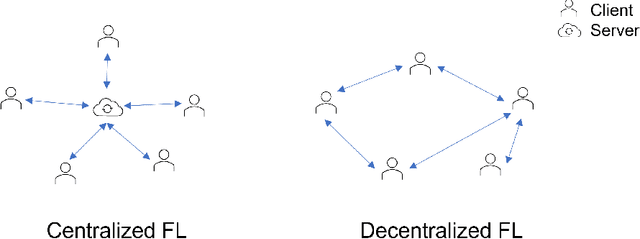


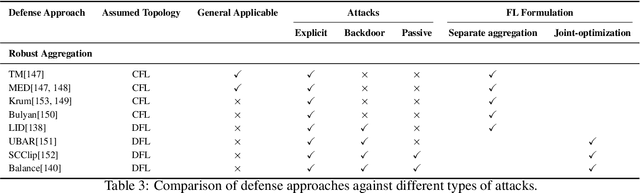
Federated Learning (FL) enables collaborative learning without directly sharing individual's raw data. FL can be implemented in either a centralized (server-based) or decentralized (peer-to-peer) manner. In this survey, we present a novel perspective: the fundamental difference between centralized FL (CFL) and decentralized FL (DFL) is not merely the network topology, but the underlying training protocol: separate aggregation vs. joint optimization. We argue that this distinction in protocol leads to significant differences in model utility, privacy preservation, and robustness to attacks. We systematically review and categorize existing works in both CFL and DFL according to the type of protocol they employ. This taxonomy provides deeper insights into prior research and clarifies how various approaches relate or differ. Through our analysis, we identify key gaps in the literature. In particular, we observe a surprising lack of exploration of DFL approaches based on distributed optimization methods, despite their potential advantages. We highlight this under-explored direction and call for more research on leveraging distributed optimization for federated learning. Overall, this work offers a comprehensive overview from centralized to decentralized FL, sheds new light on the core distinctions between approaches, and outlines open challenges and future directions for the field.
An Investigation of Noise Robustness for Flow-Matching-Based Zero-Shot TTS
Jun 09, 2024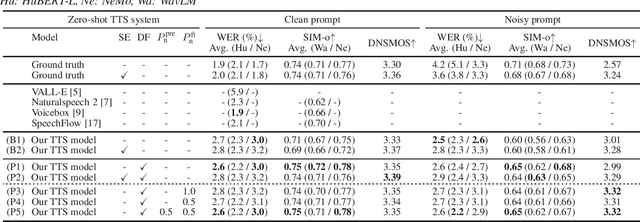
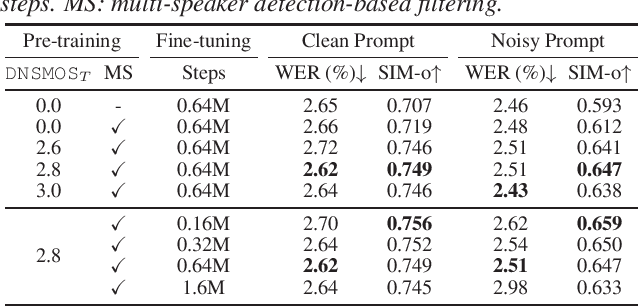
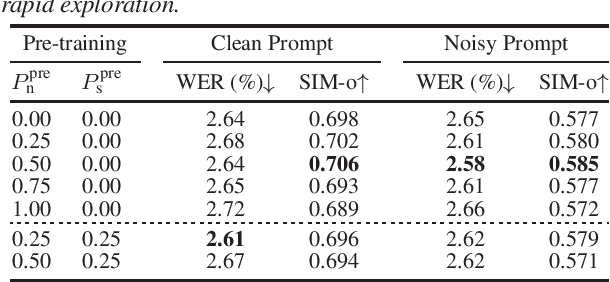
Recently, zero-shot text-to-speech (TTS) systems, capable of synthesizing any speaker's voice from a short audio prompt, have made rapid advancements. However, the quality of the generated speech significantly deteriorates when the audio prompt contains noise, and limited research has been conducted to address this issue. In this paper, we explored various strategies to enhance the quality of audio generated from noisy audio prompts within the context of flow-matching-based zero-shot TTS. Our investigation includes comprehensive training strategies: unsupervised pre-training with masked speech denoising, multi-speaker detection and DNSMOS-based data filtering on the pre-training data, and fine-tuning with random noise mixing. The results of our experiments demonstrate significant improvements in intelligibility, speaker similarity, and overall audio quality compared to the approach of applying speech enhancement to the audio prompt.
Making Flow-Matching-Based Zero-Shot Text-to-Speech Laugh as You Like
Feb 12, 2024Laughter is one of the most expressive and natural aspects of human speech, conveying emotions, social cues, and humor. However, most text-to-speech (TTS) systems lack the ability to produce realistic and appropriate laughter sounds, limiting their applications and user experience. While there have been prior works to generate natural laughter, they fell short in terms of controlling the timing and variety of the laughter to be generated. In this work, we propose ELaTE, a zero-shot TTS that can generate natural laughing speech of any speaker based on a short audio prompt with precise control of laughter timing and expression. Specifically, ELaTE works on the audio prompt to mimic the voice characteristic, the text prompt to indicate the contents of the generated speech, and the input to control the laughter expression, which can be either the start and end times of laughter, or the additional audio prompt that contains laughter to be mimicked. We develop our model based on the foundation of conditional flow-matching-based zero-shot TTS, and fine-tune it with frame-level representation from a laughter detector as additional conditioning. With a simple scheme to mix small-scale laughter-conditioned data with large-scale pre-training data, we demonstrate that a pre-trained zero-shot TTS model can be readily fine-tuned to generate natural laughter with precise controllability, without losing any quality of the pre-trained zero-shot TTS model. Through the evaluations, we show that ELaTE can generate laughing speech with significantly higher quality and controllability compared to conventional models. See https://aka.ms/elate/ for demo samples.