 Add to Chrome
 Add to Firefox
 Add to Edge
Event Stream based Sign Language Translation: A High-Definition Benchmark Dataset and A New Algorithm
Aug 20, 2024
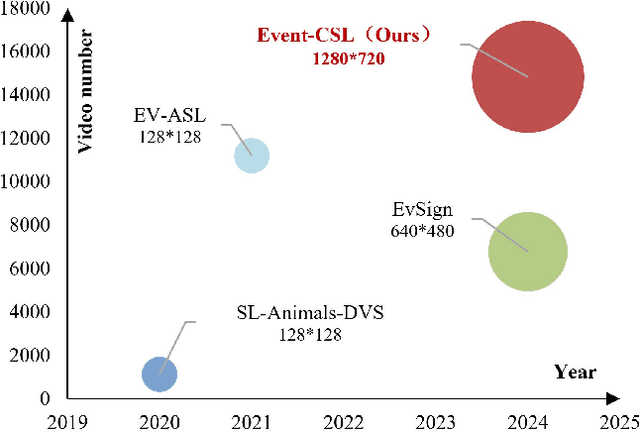
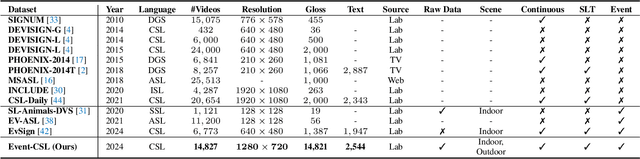
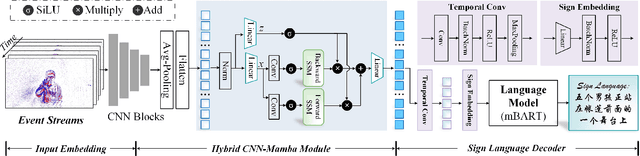
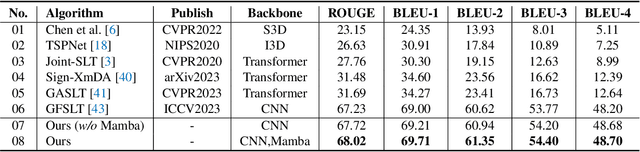
Sign Language Translation (SLT) is a core task in the field of AI-assisted disability. Unlike traditional SLT based on visible light videos, which is easily affected by factors such as lighting, rapid hand movements, and privacy breaches, this paper proposes the use of high-definition Event streams for SLT, effectively mitigating the aforementioned issues. This is primarily because Event streams have a high dynamic range and dense temporal signals, which can withstand low illumination and motion blur well. Additionally, due to their sparsity in space, they effectively protect the privacy of the target person. More specifically, we propose a new high-resolution Event stream sign language dataset, termed Event-CSL, which effectively fills the data gap in this area of research. It contains 14,827 videos, 14,821 glosses, and 2,544 Chinese words in the text vocabulary. These samples are collected in a variety of indoor and outdoor scenes, encompassing multiple angles, light intensities, and camera movements. We have benchmarked existing mainstream SLT works to enable fair comparison for future efforts. Based on this dataset and several other large-scale datasets, we propose a novel baseline method that fully leverages the Mamba model's ability to integrate temporal information of CNN features, resulting in improved sign language translation outcomes. Both the benchmark dataset and source code will be released on https://github.com/Event-AHU/OpenESL

MambaEVT: Event Stream based Visual Object Tracking using State Space Model
Aug 20, 2024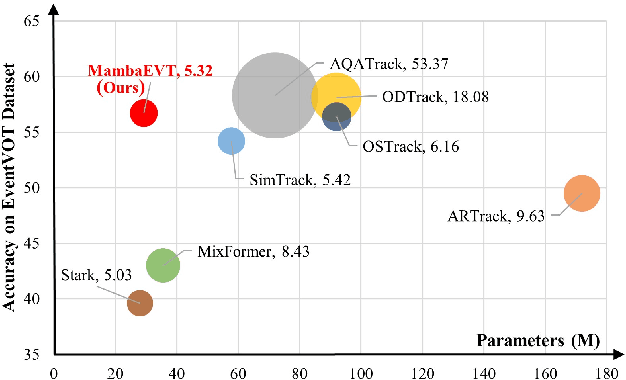

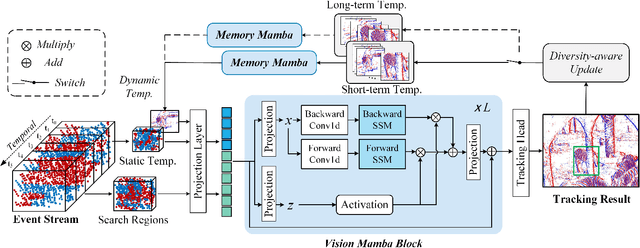
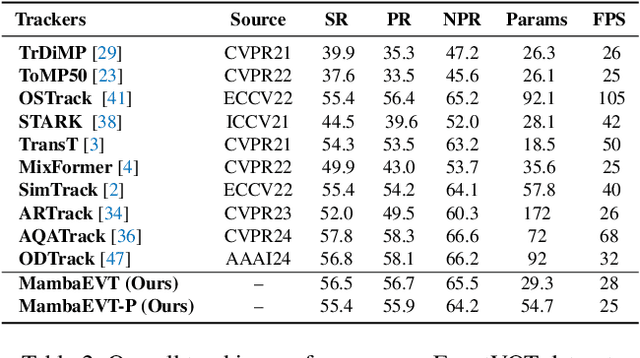
Event camera-based visual tracking has drawn more and more attention in recent years due to the unique imaging principle and advantages of low energy consumption, high dynamic range, and dense temporal resolution. Current event-based tracking algorithms are gradually hitting their performance bottlenecks, due to the utilization of vision Transformer and the static template for target object localization. In this paper, we propose a novel Mamba-based visual tracking framework that adopts the state space model with linear complexity as a backbone network. The search regions and target template are fed into the vision Mamba network for simultaneous feature extraction and interaction. The output tokens of search regions will be fed into the tracking head for target localization. More importantly, we consider introducing a dynamic template update strategy into the tracking framework using the Memory Mamba network. By considering the diversity of samples in the target template library and making appropriate adjustments to the template memory module, a more effective dynamic template can be integrated. The effective combination of dynamic and static templates allows our Mamba-based tracking algorithm to achieve a good balance between accuracy and computational cost on multiple large-scale datasets, including EventVOT, VisEvent, and FE240hz. The source code will be released on https://github.com/Event-AHU/MambaEVT
R2GenCSR: Retrieving Context Samples for Large Language Model based X-ray Medical Report Generation
Aug 19, 2024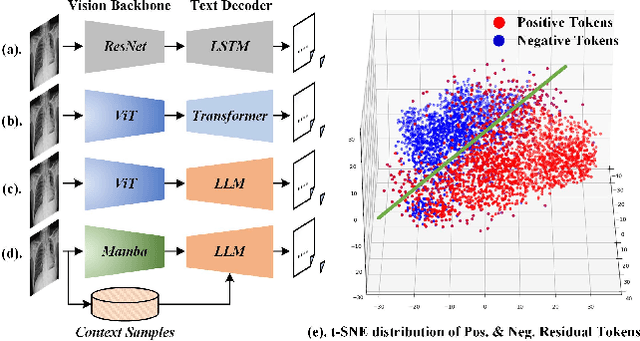
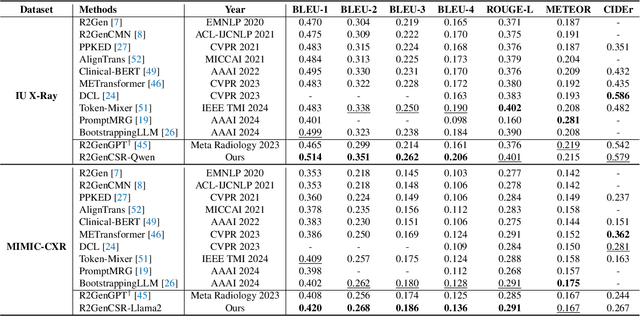
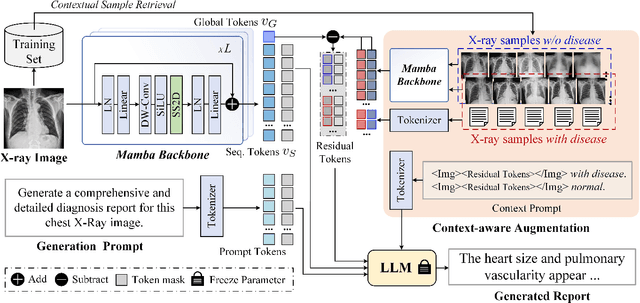
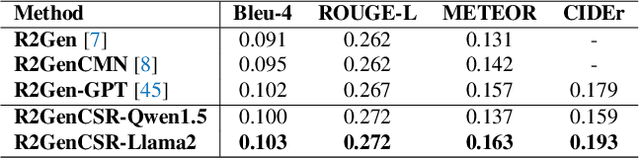
Inspired by the tremendous success of Large Language Models (LLMs), existing X-ray medical report generation methods attempt to leverage large models to achieve better performance. They usually adopt a Transformer to extract the visual features of a given X-ray image, and then, feed them into the LLM for text generation. How to extract more effective information for the LLMs to help them improve final results is an urgent problem that needs to be solved. Additionally, the use of visual Transformer models also brings high computational complexity. To address these issues, this paper proposes a novel context-guided efficient X-ray medical report generation framework. Specifically, we introduce the Mamba as the vision backbone with linear complexity, and the performance obtained is comparable to that of the strong Transformer model. More importantly, we perform context retrieval from the training set for samples within each mini-batch during the training phase, utilizing both positively and negatively related samples to enhance feature representation and discriminative learning. Subsequently, we feed the vision tokens, context information, and prompt statements to invoke the LLM for generating high-quality medical reports. Extensive experiments on three X-ray report generation datasets (i.e., IU-Xray, MIMIC-CXR, CheXpert Plus) fully validated the effectiveness of our proposed model. The source code of this work will be released on \url{https://github.com/Event-AHU/Medical_Image_Analysis}.
Event Stream based Human Action Recognition: A High-Definition Benchmark Dataset and Algorithms
Aug 19, 2024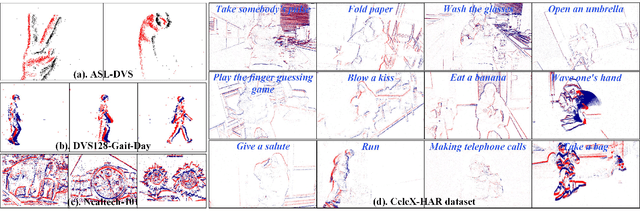


Human Action Recognition (HAR) stands as a pivotal research domain in both computer vision and artificial intelligence, with RGB cameras dominating as the preferred tool for investigation and innovation in this field. However, in real-world applications, RGB cameras encounter numerous challenges, including light conditions, fast motion, and privacy concerns. Consequently, bio-inspired event cameras have garnered increasing attention due to their advantages of low energy consumption, high dynamic range, etc. Nevertheless, most existing event-based HAR datasets are low resolution ($346 \times 260$). In this paper, we propose a large-scale, high-definition ($1280 \times 800$) human action recognition dataset based on the CeleX-V event camera, termed CeleX-HAR. It encompasses 150 commonly occurring action categories, comprising a total of 124,625 video sequences. Various factors such as multi-view, illumination, action speed, and occlusion are considered when recording these data. To build a more comprehensive benchmark dataset, we report over 20 mainstream HAR models for future works to compare. In addition, we also propose a novel Mamba vision backbone network for event stream based HAR, termed EVMamba, which equips the spatial plane multi-directional scanning and novel voxel temporal scanning mechanism. By encoding and mining the spatio-temporal information of event streams, our EVMamba has achieved favorable results across multiple datasets. Both the dataset and source code will be released on \url{https://github.com/Event-AHU/CeleX-HAR}
Pedestrian Attribute Recognition: A New Benchmark Dataset and A Large Language Model Augmented Framework
Aug 19, 2024Pedestrian Attribute Recognition (PAR) is one of the indispensable tasks in human-centered research. However, existing datasets neglect different domains (e.g., environments, times, populations, and data sources), only conducting simple random splits, and the performance of these datasets has already approached saturation. In the past five years, no large-scale dataset has been opened to the public. To address this issue, this paper proposes a new large-scale, cross-domain pedestrian attribute recognition dataset to fill the data gap, termed MSP60K. It consists of 60,122 images and 57 attribute annotations across eight scenarios. Synthetic degradation is also conducted to further narrow the gap between the dataset and real-world challenging scenarios. To establish a more rigorous benchmark, we evaluate 17 representative PAR models under both random and cross-domain split protocols on our dataset. Additionally, we propose an innovative Large Language Model (LLM) augmented PAR framework, named LLM-PAR. This framework processes pedestrian images through a Vision Transformer (ViT) backbone to extract features and introduces a multi-embedding query Transformer to learn partial-aware features for attribute classification. Significantly, we enhance this framework with LLM for ensemble learning and visual feature augmentation. Comprehensive experiments across multiple PAR benchmark datasets have thoroughly validated the efficacy of our proposed framework. The dataset and source code accompanying this paper will be made publicly available at \url{https://github.com/Event-AHU/OpenPAR}.
Can Large Language Models Improve the Adversarial Robustness of Graph Neural Networks?
Aug 16, 2024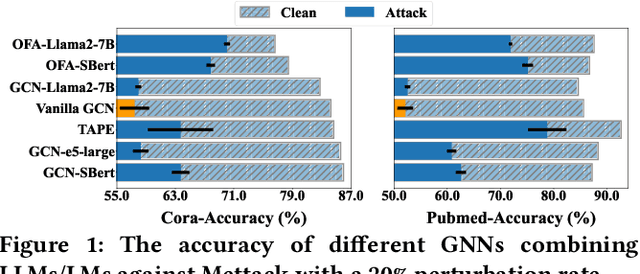
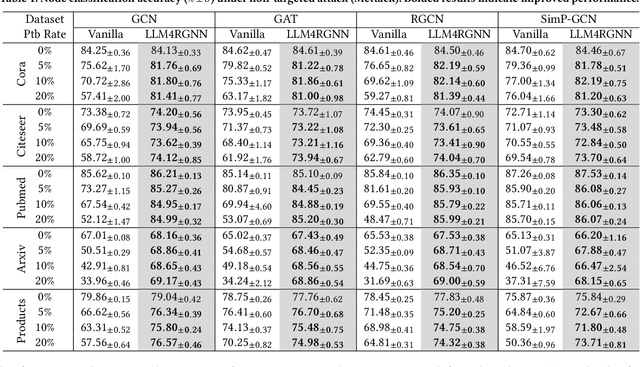
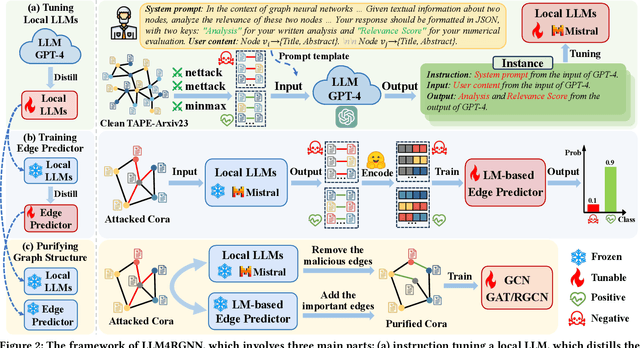
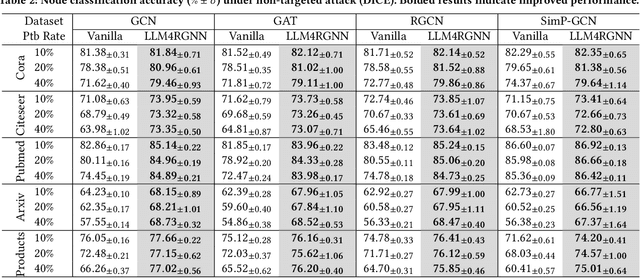
Graph neural networks (GNNs) are vulnerable to adversarial perturbations, especially for topology attacks, and many methods that improve the robustness of GNNs have received considerable attention. Recently, we have witnessed the significant success of large language models (LLMs), leading many to explore the great potential of LLMs on GNNs. However, they mainly focus on improving the performance of GNNs by utilizing LLMs to enhance the node features. Therefore, we ask: Will the robustness of GNNs also be enhanced with the powerful understanding and inference capabilities of LLMs? By presenting the empirical results, we find that despite that LLMs can improve the robustness of GNNs, there is still an average decrease of 23.1% in accuracy, implying that the GNNs remain extremely vulnerable against topology attack. Therefore, another question is how to extend the capabilities of LLMs on graph adversarial robustness. In this paper, we propose an LLM-based robust graph structure inference framework, LLM4RGNN, which distills the inference capabilities of GPT-4 into a local LLM for identifying malicious edges and an LM-based edge predictor for finding missing important edges, so as to recover a robust graph structure. Extensive experiments demonstrate that LLM4RGNN consistently improves the robustness across various GNNs. Even in some cases where the perturbation ratio increases to 40%, the accuracy of GNNs is still better than that on the clean graph.
Treat Stillness with Movement: Remote Sensing Change Detection via Coarse-grained Temporal Foregrounds Mining
Aug 15, 2024
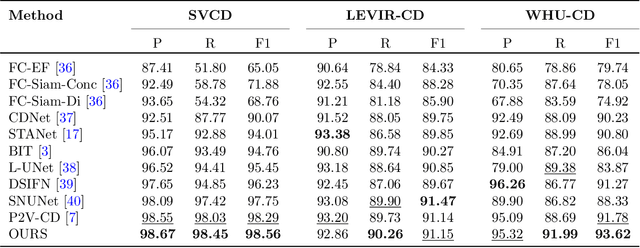
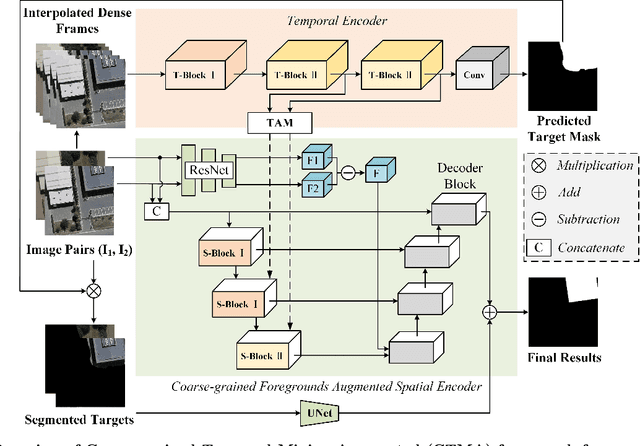
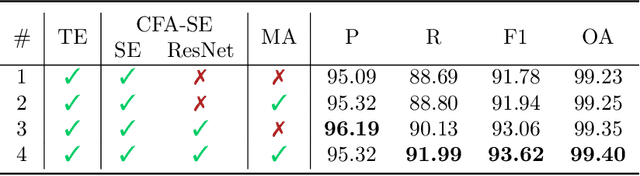
Current works focus on addressing the remote sensing change detection task using bi-temporal images. Although good performance can be achieved, however, seldom of they consider the motion cues which may also be vital. In this work, we revisit the widely adopted bi-temporal images-based framework and propose a novel Coarse-grained Temporal Mining Augmented (CTMA) framework. To be specific, given the bi-temporal images, we first transform them into a video using interpolation operations. Then, a set of temporal encoders is adopted to extract the motion features from the obtained video for coarse-grained changed region prediction. Subsequently, we design a novel Coarse-grained Foregrounds Augmented Spatial Encoder module to integrate both global and local information. We also introduce a motion augmented strategy that leverages motion cues as an additional output to aggregate with the spatial features for improved results. Meanwhile, we feed the input image pairs into the ResNet to get the different features and also the spatial blocks for fine-grained feature learning. More importantly, we propose a mask augmented strategy that utilizes coarse-grained changed regions, incorporating them into the decoder blocks to enhance the final changed prediction. Extensive experiments conducted on multiple benchmark datasets fully validated the effectiveness of our proposed framework for remote sensing image change detection. The source code of this paper will be released on https://github.com/Event-AHU/CTM_Remote_Sensing_Change_Detection
SMILES-Mamba: Chemical Mamba Foundation Models for Drug ADMET Prediction
Aug 11, 2024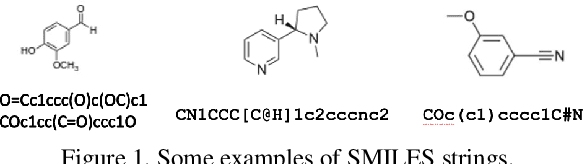
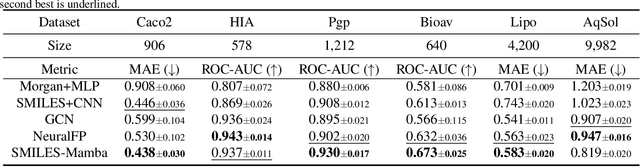
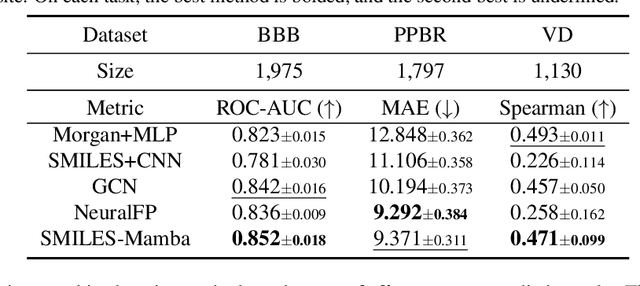
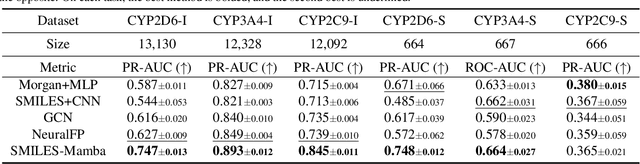
In drug discovery, predicting the absorption, distribution, metabolism, excretion, and toxicity (ADMET) properties of small-molecule drugs is critical for ensuring safety and efficacy. However, the process of accurately predicting these properties is often resource-intensive and requires extensive experimental data. To address this challenge, we propose SMILES-Mamba, a two-stage model that leverages both unlabeled and labeled data through a combination of self-supervised pretraining and fine-tuning strategies. The model first pre-trains on a large corpus of unlabeled SMILES strings to capture the underlying chemical structure and relationships, before being fine-tuned on smaller, labeled datasets specific to ADMET tasks. Our results demonstrate that SMILES-Mamba exhibits competitive performance across 22 ADMET datasets, achieving the highest score in 14 tasks, highlighting the potential of self-supervised learning in improving molecular property prediction. This approach not only enhances prediction accuracy but also reduces the dependence on large, labeled datasets, offering a promising direction for future research in drug discovery.
AI Foundation Models in Remote Sensing: A Survey
Aug 06, 2024Artificial Intelligence (AI) technologies have profoundly transformed the field of remote sensing, revolutionizing data collection, processing, and analysis. Traditionally reliant on manual interpretation and task-specific models, remote sensing has been significantly enhanced by the advent of foundation models--large-scale, pre-trained AI models capable of performing a wide array of tasks with unprecedented accuracy and efficiency. This paper provides a comprehensive survey of foundation models in the remote sensing domain, covering models released between June 2021 and June 2024. We categorize these models based on their applications in computer vision and domain-specific tasks, offering insights into their architectures, pre-training datasets, and methodologies. Through detailed performance comparisons, we highlight emerging trends and the significant advancements achieved by these foundation models. Additionally, we discuss the technical challenges, practical implications, and future research directions, addressing the need for high-quality data, computational resources, and improved model generalization. Our research also finds that pre-training methods, particularly self-supervised learning techniques like contrastive learning and masked autoencoders, significantly enhance the performance and robustness of foundation models in remote sensing tasks such as scene classification, object detection, and other applications. This survey aims to serve as a resource for researchers and practitioners by providing a panorama of advances and promising pathways for continued development and application of foundation models in remote sensing.
Improving Retrieval-Augmented Generation in Medicine with Iterative Follow-up Questions
Aug 01, 2024
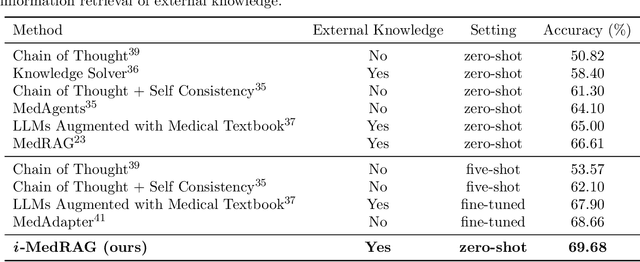

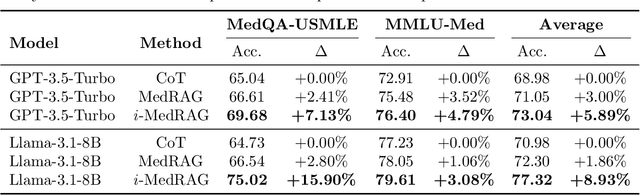
The emergent abilities of large language models (LLMs) have demonstrated great potential in solving medical questions. They can possess considerable medical knowledge, but may still hallucinate and are inflexible in the knowledge updates. While Retrieval-Augmented Generation (RAG) has been proposed to enhance the medical question-answering capabilities of LLMs with external knowledge bases, it may still fail in complex cases where multiple rounds of information-seeking are required. To address such an issue, we propose iterative RAG for medicine (i-MedRAG), where LLMs can iteratively ask follow-up queries based on previous information-seeking attempts. In each iteration of i-MedRAG, the follow-up queries will be answered by a vanilla RAG system and they will be further used to guide the query generation in the next iteration. Our experiments show the improved performance of various LLMs brought by i-MedRAG compared with vanilla RAG on complex questions from clinical vignettes in the United States Medical Licensing Examination (USMLE), as well as various knowledge tests in the Massive Multitask Language Understanding (MMLU) dataset. Notably, our zero-shot i-MedRAG outperforms all existing prompt engineering and fine-tuning methods on GPT-3.5, achieving an accuracy of 69.68\% on the MedQA dataset. In addition, we characterize the scaling properties of i-MedRAG with different iterations of follow-up queries and different numbers of queries per iteration. Our case studies show that i-MedRAG can flexibly ask follow-up queries to form reasoning chains, providing an in-depth analysis of medical questions. To the best of our knowledge, this is the first-of-its-kind study on incorporating follow-up queries into medical RAG.