 Add to Chrome
 Add to Firefox
 Add to Edge
Se-DPO: Self-Evolving Token Credit for Direct Preference Optimization
Aug 10, 2026
Direct Preference Optimization (DPO) aggregates token-level log-probability ratios via uniform summation, implicitly treating all tokens as contributing equally to the preference signal. However, the contribution of individual tokens to the preference signal varies. We introduce token credit, which modulates each token's KL regularization based on its contribution to the preference outcome. We derive that effective token credit is proportional to the magnitude of each token's implicit reward, and observe that this quantity evolves substantially during training. This implies that static token credit becomes increasingly misaligned as training progresses. In this work, we propose Se-DPO (Self-Evolving Token Credit for DPO), a live mechanism that derives token credit from the model's own evolving internal signals during DPO training. Since the reward signal varies in reliability across positions, Se-DPO calibrates token credit based on both the strength and the confidence of each token's contribution. Se-DPO requires no external models, adding only a lightweight calibration network with minimal computational overhead. Experiments show that Se-DPO improves over DPO by up to 9.8 points on AlpacaEval~2 and 12.2 points on Arena-Hard.

A-SR: Self-Evolving Agentic LLMs for Symbolic Regression via Hierarchical Coordination
Aug 06, 2026Symbolic regression aims to discover closed-form equations from data, but existing LLM-guided methods often rely on a unified proposal loop that compresses heterogeneous search failures into a scalar score and a single prompt. We propose A-SR, a self-evolving agentic framework that shifts the control unit from expression edits to role-conditioned evidence views. A-SR coordinates formula discovery through routing among coordination protocols, an online evaluator-reward role policy, and state-routed process memory. During search, evaluator feedback characterizes reliability and productivity, updates role-level utilities, and routes elite motifs, failure traces, and validity diagnostics to different agents. The framework self-evolves at two timescales: within a run, it adapts the search process without updating LLM parameters; across runs, recorded trajectories can be distilled into open-source LLMs as role-conditioned proposal priors. Averaged over the four LSR-Synth scientific domains in LLM-SRBench, A-SR improves Acc@0.01 over baselines from 25.79% to 48.30% with Llama3.1-8B, while A-SR-LoRA improves the corresponding Qwen3-4B result from 24.58% to 38.29%. On four real-world scientific discovery tasks, A-SR obtains the best in-distribution or out-of-distribution normalized mean squared error on 7 of 8 reported metrics.
AutoSupervision: Closing the Feedback Loop in Scientific Workflows with Grounded Revision Verification
Jul 30, 2026Recent advances in large language models (LLMs) have enabled AI systems to assist scientific research and peer review. However, an essential capability for reliable AI-assisted scientific workflows remains underexplored: verifying whether reviewer feedback leads to meaningful and evidence-supported manuscript improvements. We introduce AutoSupervision, which evaluates whether scientific manuscript revisions genuinely address reviewer concerns through grounded evidence. AutoSupervision leverages transparent peer-review records as a natural source of supervision, where reviewer comments specify scientific concerns, author responses describe claimed resolutions, and revised manuscripts provide evidence of changes. Given reviewer comments, author responses, and revised manuscripts, models must characterize reviewer concerns, determine whether concerns have been addressed, and identify supporting manuscript evidence. We construct AutoSupervision from 56,000 Nature Communications articles and corresponding review records. Then we conducted experiments on LLMs, the ablation study, and the case study. Our results show that while LLMs perform well in characterizing reviewer concerns, with GPT-5.5 achieving a score of 0.754, evidence-based verification remains the primary bottleneck, with the best-performing model reaching only 0.501.
Explore the Reasoning Capability of LLMs in the Chess Testbed
Nov 11, 2024


Reasoning is a central capability of human intelligence. In recent years, with the advent of large-scale datasets, pretrained large language models have emerged with new capabilities, including reasoning. However, these models still struggle with long-term, complex reasoning tasks, such as playing chess. Based on the observation that expert chess players employ a dual approach combining long-term strategic play with short-term tactical play along with language explanation, we propose improving the reasoning capability of large language models in chess by integrating annotated strategy and tactic. Specifically, we collect a dataset named MATE, which consists of 1 million chess positions with candidate moves annotated by chess experts for strategy and tactics. We finetune the LLaMA-3-8B model and compare it against state-of-the-art commercial language models in the task of selecting better chess moves. Our experiments show that our models perform better than GPT, Claude, and Gemini models. We find that language explanations can enhance the reasoning capability of large language models.
CtrSVDD: A Benchmark Dataset and Baseline Analysis for Controlled Singing Voice Deepfake Detection
Jun 04, 2024
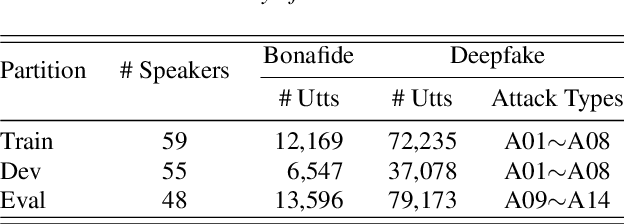


Recent singing voice synthesis and conversion advancements necessitate robust singing voice deepfake detection (SVDD) models. Current SVDD datasets face challenges due to limited controllability, diversity in deepfake methods, and licensing restrictions. Addressing these gaps, we introduce CtrSVDD, a large-scale, diverse collection of bonafide and deepfake singing vocals. These vocals are synthesized using state-of-the-art methods from publicly accessible singing voice datasets. CtrSVDD includes 47.64 hours of bonafide and 260.34 hours of deepfake singing vocals, spanning 14 deepfake methods and involving 164 singer identities. We also present a baseline system with flexible front-end features, evaluated against a structured train/dev/eval split. The experiments show the importance of feature selection and highlight a need for generalization towards deepfake methods that deviate further from training distribution. The CtrSVDD dataset and baselines are publicly accessible.
RefineGAN: Universally Generating Waveform Better than Ground Truth with Highly Accurate Pitch and Intensity Responses
Nov 02, 2021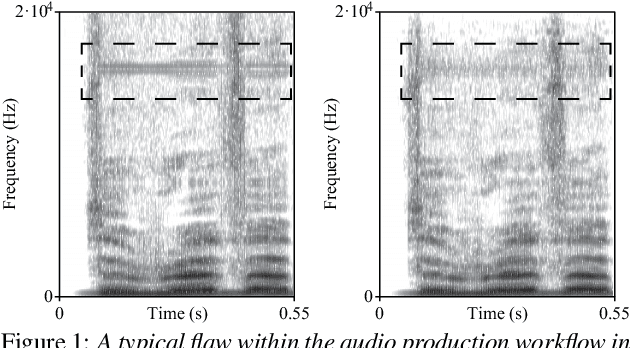
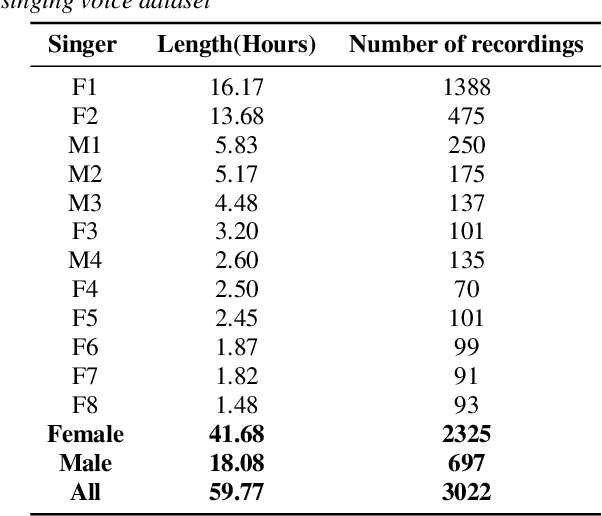
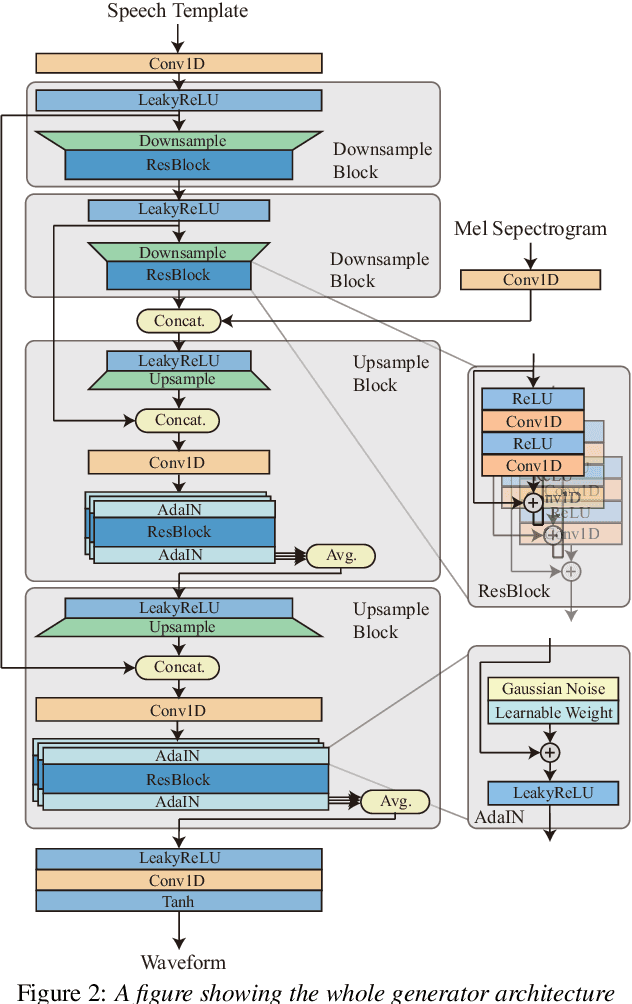
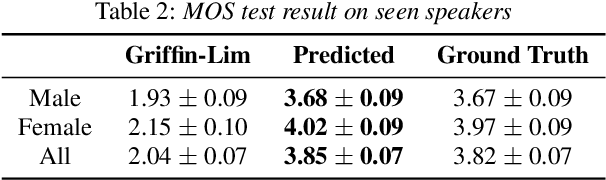
Most GAN(Generative Adversarial Network)-based approaches towards high-fidelity waveform generation heavily rely on discriminators to improve their performance. However, the over-use of this GAN method introduces much uncertainty into the generation process and often result in mismatches of pitch and intensity, which is fatal when it comes to sensitive using cases such as singing voice synthesis(SVS). To address this problem, we propose RefineGAN, a high-fidelity neural vocoder with faster-than-real-time generation capability, and focused on the robustness, pitch and intensity accuracy, and full-band audio generation. We employed a pitch-guided refine architecture with a multi-scale spectrogram-based loss function to help stabilize the training process and maintain the robustness of the neural vocoder while using the GAN-based training method. Audio generated using this method shows a better performance in subjective tests when compared with the ground-truth audio. This result shows that the fidelity is even improved during the waveform reconstruction by eliminating defects produced by the speaker and the recording procedure. Moreover, a further study shows that models trained on a specified type of data can perform on totally unseen language and unseen speaker identically well. Generated sample pairs are provided on https://timedomain-tech.github.io/refinegan/.