 Add to Chrome
 Add to Firefox
 Add to Edge
Signal Processing Foundations of Reconfigurable Antennas in the Tri-Hybrid MIMO Architecture
Apr 26, 2026
To enable larger apertures in multipleinput multipleoutput MIMO systems the trihybrid MIMO architecture offers a promising lowcost and lowpower solution by introducing reconfigurable antennas as a third layer of precoding on top of conventional digital and analog processing In this paper we develop a unified signal processing framework for trihybrid MIMO that explicitly captures the electromagnetic EM characteristics of diverse reconfigurable antenna technologies We first propose a generic inputoutput model that incorporates the reconfigurable antenna layer into an effective channel representation revealing a fundamental coupling between the channel precoder and radiated power Building on this model we formulate a general optimization problem that jointly accounts for digital analog and antennadomain precoding under hardware and power constraints We then instantiate this framework across seven representative reconfigurable antenna architectures including parasitic arrays dynamic metasurface antennas fluidpixel antennas polarizationreconfigurable antennas stacked intelligent metasurfaces pinching antenna systems and nonradiating wires To systematically compare these heterogeneous architectures we introduce a new metric the reconfigurability efficiency factor REF which quantifies the performance gains achievable through antenna reconfiguration under realistic constraints Numerical results demonstrate the tradeoffs among aperture size power consumption hardware complexity and spectral efficiency Our results establish that EMlevel reconfiguration reshapes the signal processing design space highlighting the need for new architectures and algorithms that jointly optimize across digital analog and electromagnetic domains This work reveals that electromagnetic reconfiguration couples the channel and precoder

Jointly Optimizing Debiased CTR and Uplift for Coupons Marketing: A Unified Causal Framework
Feb 13, 2026In online advertising, marketing interventions such as coupons introduce significant confounding bias into Click-Through Rate (CTR) prediction. Observed clicks reflect a mixture of users' intrinsic preferences and the uplift induced by these interventions. This causes conventional models to miscalibrate base CTRs, which distorts downstream ranking and billing decisions. Furthermore, marketing interventions often operate as multi-valued treatments with varying magnitudes, introducing additional complexity to CTR prediction. To address these issues, we propose the \textbf{Uni}fied \textbf{M}ulti-\textbf{V}alued \textbf{T}reatment Network (UniMVT). Specifically, UniMVT disentangles confounding factors from treatment-sensitive representations, enabling a full-space counterfactual inference module to jointly reconstruct the debiased base CTR and intensity-response curves. To handle the complexity of multi-valued treatments, UniMVT employs an auxiliary intensity estimation task to capture treatment propensities and devise a unit uplift objective that normalizes the intervention effect. This ensures comparable estimation across the continuous coupon-value spectrum. UniMVT simultaneously achieves debiased CTR prediction for accurate system calibration and precise uplift estimation for incentive allocation. Extensive experiments on synthetic and industrial datasets demonstrate UniMVT's superiority in both predictive accuracy and calibration. Furthermore, real-world A/B tests confirm that UniMVT significantly improves business metrics through more effective coupon distribution.
Near-Field Challenges in Ultra-Wideband ISAC: Beamforming Strategies and System Insights
Aug 26, 2025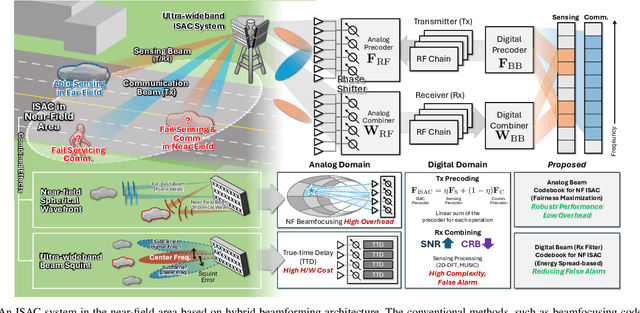
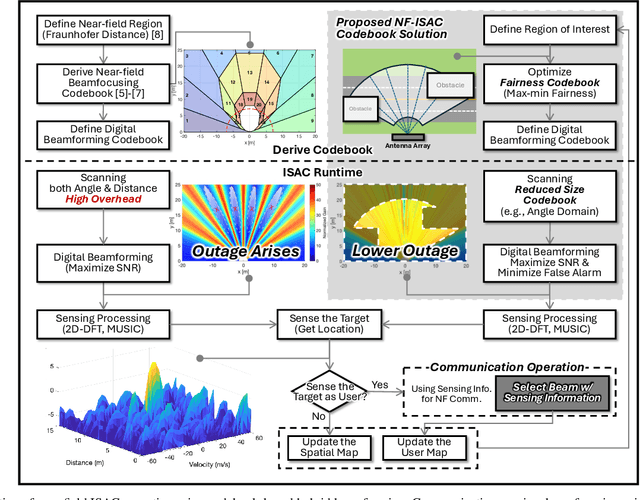
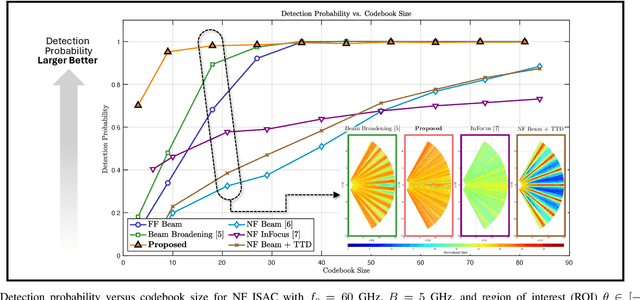
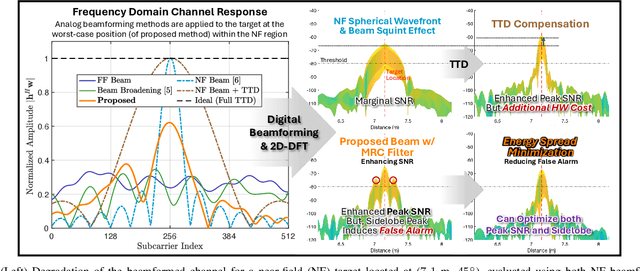
The shift toward sixth-generation (6G) wireless networks places integrated sensing and communications (ISAC) at the core of future applications such as autonomous driving, extended reality, and smart manufacturing. However, the combination of large antenna arrays and ultra-wide bandwidths brings near-field propagation effects and beam squint to the forefront, fundamentally challenging traditional far-field designs. True time delay units (TTDs) offer a potential solution, but their cost and hardware complexity limit scalability. In this article, we present practical beamforming strategies for near-field ultra-wideband ISAC systems. We explore codebook designs across analog and digital domains that mitigate beam squint, ensure reliable user coverage, and enhance sensing accuracy. We further validate these approaches through large-scale system-level simulations, including 3D map-based evaluations that reflect real-world urban environments. Our results demonstrate how carefully designed beamforming can balance communication throughput with sensing performance, achieving reliable coverage and efficient resource use even under severe near-field conditions. We conclude by highlighting open challenges in hardware, algorithms, and system integration, pointing toward research directions that will shape the deployment of 6G-ready ISAC networks.