 Add to Chrome
 Add to Firefox
 Add to Edge
S1-Omni: A Unified Multimodal Reasoning Model for Scientific Understanding, Prediction, and Generation
Jul 17, 2026
We present S1-Omni, a unified multimodal reasoning model for scientific understanding, prediction, and generation. AI for Science (AI4S) has advanced significantly through domain-specific models, tool-augmented LLMs, and scientific language models. However, model capabilities remain highly fragmented, limiting the joint modeling of heterogeneous data, scientific laws, and expert knowledge. S1-Omni addresses this gap by consolidating these capabilities into a single, coherent scientific reasoning model. The architecture of S1-Omni is built upon three core components: unified representation of scientific data, natural-world knowledge alignment, and decoding for domain-specific tasks. First, S1-Omni maps natural-language instructions and scientific objects, including CIF, SMILES, protein sequences, spectra, and scientific images, into a shared representation space. Second, it incorporates scientific laws and expert knowledge into data construction and training, enabling the model to reason from scientific evidence. Third, it performs task-specific decoding to support a broad range of applications, including property prediction, spectrum-to-molecular generation, protein site and structure prediction, and scientific image generation and editing. S1-Omni is trained on S1-Omni-Corpus, which covers 200 scientific tasks and contains millions of reasoning samples, and is evaluated on over 60 scientific benchmarks. It outperforms GPT-5.5 and Gemini-3.1-Pro on most benchmarks and matches or surpasses domain-specific models on several benchmarks. Overall, S1-Omni provides a practical path toward unified scientific modeling.

S1-Omni-Image: A Unified Model for Scientific Image Understanding, Generation, and Editing
Jun 23, 2026We present S1-Omni-Image, an open-weight unified multimodal model for scientific image understanding, generation, and editing. Unlike general-purpose image generation models, scientific image tasks require not only high-fidelity synthesis, but also robust understanding of scientific semantics, structural relations, domain knowledge, and task intent. To this end, S1-Omni-Image builds on the scientific multimodal reasoning backbone S1-VL-32B and couples its understanding capability with an image generation module under a unified think-before-generate paradigm. Given a user instruction, the model first produces a task-oriented reasoning trace, a textual answer, and a task special token; their hidden states are then injected into the generation module to condition image generation or editing. S1-Omni-Image supports scientific image understanding, generation, and editing in a unified framework. For generation, it focuses on scientific illustrations and text rendering, including logical diagrams, relational comparisons, data charts, and realistic scientific visualizations. For editing, it casts segmentation and other domain-specific vision tasks as native image editing problems, enabling multi-turn illustration editing, medical and geographic image segmentation, medical image translation, and scientific image super-resolution. We construct SciGenEdit, a 314K-sample training dataset, and release the model weights, inference code, and SciGenEdit-10K. Experiments show that S1-Omni-Image substantially improves scientific image generation and editing while preserving the scientific image understanding capability inherited from S1-VL-32B. It outperforms open-source models on GenExam and TechImage-Bench, achieves state-of-the-art results on four editing benchmarks including MSD, cigRockSEM, SynthRAD2025, and IXI, and maintains stable performance on scientific image understanding evaluations.
S1-VL: Scientific Multimodal Reasoning Model with Thinking-with-Images
Apr 23, 2026We present S1-VL, a multimodal reasoning model for scientific domains that natively supports two complementary reasoning paradigms: Scientific Reasoning, which relies on structured chain-of-thought, and Thinking-with-Images, which enables the model to actively manipulate images through Python code execution during reasoning. In the Thinking-with-Images mode, the model generates and executes image-processing code in a sandbox environment, obtains intermediate visual results, and continues reasoning in a multi-turn iterative manner. This design is particularly effective for challenging scenarios such as high-resolution scientific chart interpretation, microscopic image understanding, and geometry-assisted reasoning. To construct the training data, we collect scientific multimodal datasets spanning six disciplines: mathematics, physics, chemistry, astronomy, geography, and biology. We further develop a six-dimensional quality filtering framework for reasoning trajectories. To mitigate redundant, ineffective, and erroneous visual operations commonly found in existing datasets, we propose a multi-stage filtering pipeline together with an adaptive data routing strategy. This strategy converts samples with low visual information gain into pure Reasoning-mode data, enabling the model to learn when image operations are truly necessary. S1-VL is trained through a four-stage progressive pipeline: scientific multimodal SFT, Thinking-with-Images cold-start SFT, and two stages of reinforcement learning with SAPO. We build S1-VL-32B on top of Qwen3-VL-32B-Thinking and evaluate it on 13 benchmarks. Experimental results show that S1-VL-32B achieves state-of-the-art performance on all five Thinking-with-Images benchmarks, including HRBench-4K, HRBench-8K, MME-RealWorld-CN, MME-RealWorld-Lite, and V*, and outperforms compared systems on scientific reasoning benchmarks such as Physics and VRSBench.
YAYI 2: Multilingual Open-Source Large Language Models
Dec 22, 2023As the latest advancements in natural language processing, large language models (LLMs) have achieved human-level language understanding and generation abilities in many real-world tasks, and even have been regarded as a potential path to the artificial general intelligence. To better facilitate research on LLMs, many open-source LLMs, such as Llama 2 and Falcon, have recently been proposed and gained comparable performances to proprietary models. However, these models are primarily designed for English scenarios and exhibit poor performances in Chinese contexts. In this technical report, we propose YAYI 2, including both base and chat models, with 30 billion parameters. YAYI 2 is pre-trained from scratch on a multilingual corpus which contains 2.65 trillion tokens filtered by our pre-training data processing pipeline. The base model is aligned with human values through supervised fine-tuning with millions of instructions and reinforcement learning from human feedback. Extensive experiments on multiple benchmarks, such as MMLU and CMMLU, consistently demonstrate that the proposed YAYI 2 outperforms other similar sized open-source models.
Improving Interpretability of Word Embeddings by Generating Definition and Usage
Dec 12, 2019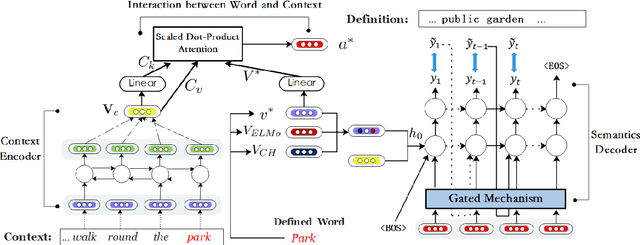
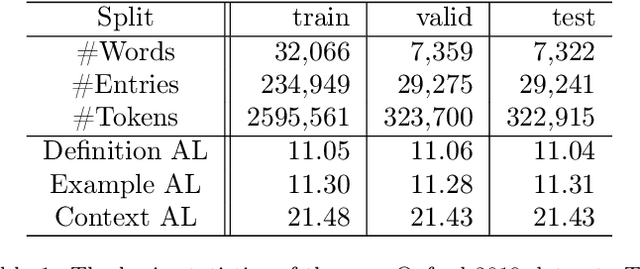
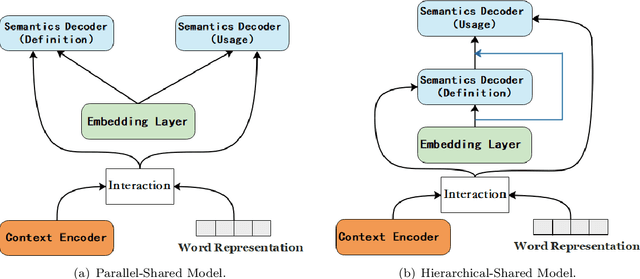
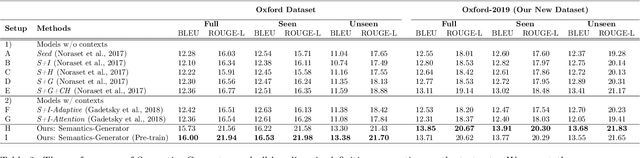
Word Embeddings, which encode semantic and syntactic features, have achieved success in many natural language processing tasks recently. However, the lexical semantics captured by these embeddings are difficult to interpret due to the dense vector representations. In order to improve the interpretability of word vectors, we explore definition modeling task and propose a novel framework (Semantics-Generator) to generate more reasonable and understandable context-dependent definitions. Moreover, we introduce usage modeling and study whether it is possible to utilize distributed representations to generate example sentences of words. These ways of semantics generation are a more direct and explicit expression of embedding's semantics. Two multi-task learning methods are used to combine usage modeling and definition modeling. To verify our approach, we construct Oxford-2019 dataset, where each entry contains word, context, example sentence and corresponding definition. Experimental results show that Semantics-Generator achieves the state-of-the-art result in definition modeling and the multi-task learning methods are helpful for two tasks to improve the performance.