 Add to Chrome
 Add to Firefox
 Add to Edge
Context-Aware Deep Learning for Defect Classification in Atomic-Resolution STEM
Jun 08, 2026
Artificial intelligence is rapidly advancing materials characterization, yet most applications in electron microscopy rely solely on image contrast, overlooking the chemical and experimental context that shapes image formation. This limitation makes defect classification inherently ambiguous, as similar contrasts can arise from different materials or imaging conditions. Here we develop a context-aware learning framework that integrates image-derived contrast with metadata describing composition, beam energy, and detector geometry. Using a systematically constructed dataset of ~55 million simulated patches spanning 576 cases across 96 doped monolayer transition-metal dichalcogenides, we show that conditioning on contextual variables transforms defect classification from an ill-posed image-only task into a well-posed, physically grounded problem. The framework achieves over 98% accuracy on simulations and near-human agreement on experimental data, with a 94% reduction in posterior entropy. By emphasizing contextual grounding over architectural complexity, this approach links experimental image contrast to the underlying chemical and imaging conditions, supporting physically grounded defect assignments and a general pathway toward multimodal AI models for autonomous materials characterization.

An Integrated Constrained Gradient Descent (iCGD) Protocol to Correct Scan-Positional Errors for Electron Ptychography with High Accuracy and Precision
Nov 06, 2022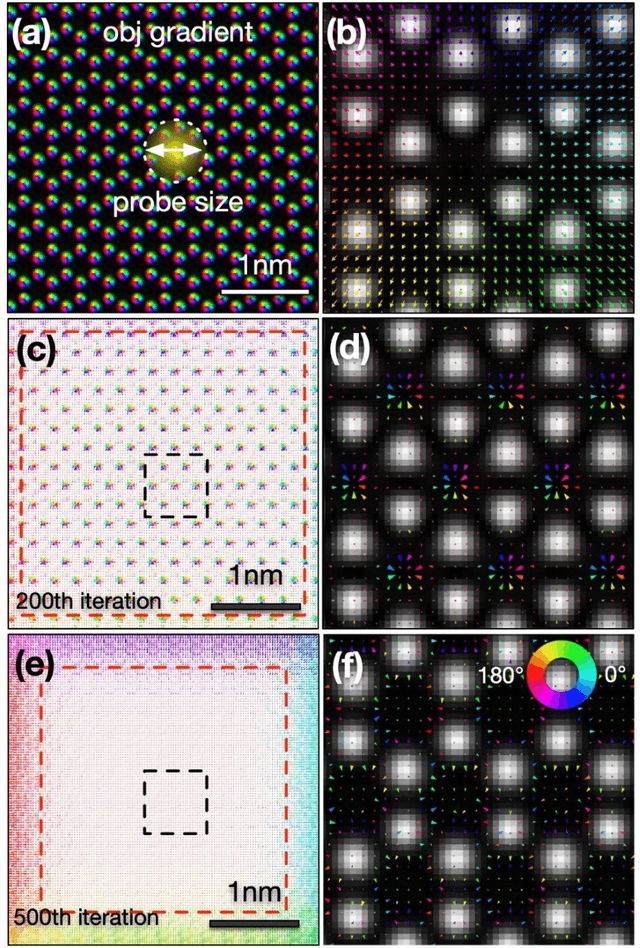
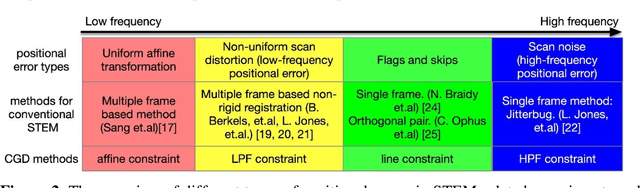
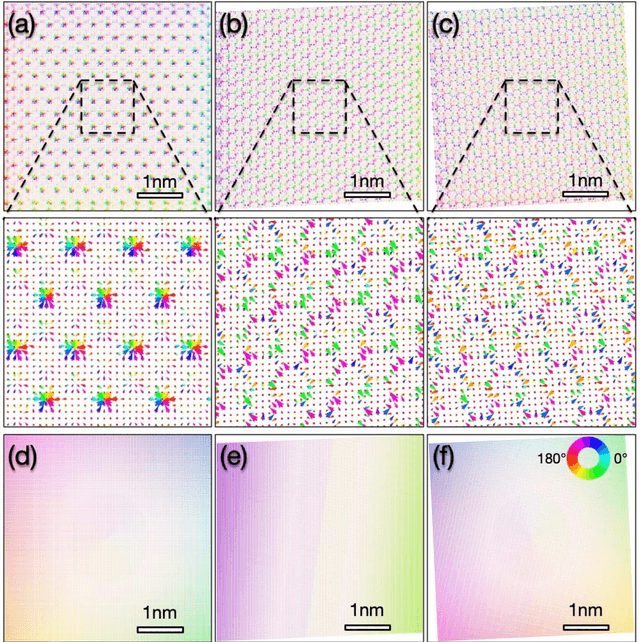
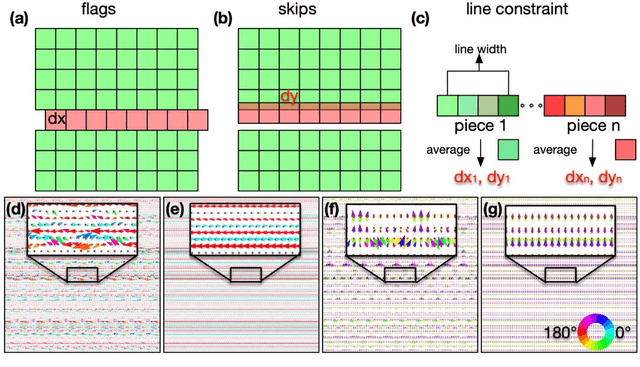
Correcting scan-positional errors is critical in achieving electron ptychography with both high resolution and high precision. This is a demanding and challenging task due to the sheer number of parameters that need to be optimized. For atomic-resolution ptychographic reconstructions, we found classical refining methods for scan positions not satisfactory due to the inherent entanglement between the object and scan positions, which can produce systematic errors in the results. Here, we propose a new protocol consisting of a series of constrained gradient descent (CGD) methods to achieve better recovery of scan positions. The central idea of these CGD methods is to utilize a priori knowledge about the nature of STEM experiments and add necessary constraints to isolate different types of scan positional errors during the iterative reconstruction process. Each constraint will be introduced with the help of simulated 4D-STEM datasets with known positional errors. Then the integrated constrained gradient decent (iCGD) protocol will be demonstrated using an experimental 4D-STEM dataset of the 1H-MoS2 monolayer. We will show that the iCGD protocol can effectively address the errors of scan positions across the spectrum and help to achieve electron ptychography with high accuracy and precision.