 Add to Chrome
 Add to Firefox
 Add to Edge
ST-WAM: Semantic-Temporal World Action Model for Robust Manipulation under Visual Distribution Shifts
Jul 31, 2026
World Action Models (WAMs) have emerged as a promising paradigm by jointly modeling robot actions and future visual dynamics. However, their reliance on pixel-generative future supervision can entangle action-relevant state transitions with task-irrelevant visual content, limiting robustness under visual distribution shifts. We identify Training-Distribution Hallucination, a recurring phenomenon in which futures conditioned on visually shifted observations hallucinate training-domain content rather than remain faithful to the current scene. A controlled frame-triplet diagnosis further shows that DINOv3 features remain more stable across visual shifts while better preserving task-state distinctions than Wan-VAE latents. Rather than correcting the predicted futures, we propose Semantic-Temporal WAM (ST-WAM) to improve action robustness by using DINOv3 as a shared semantic representation for future prediction and history retrieval while retaining fine-grained VAE dynamics. Its Dual-Space Future Experts (DSFE) jointly predict future VAE latents and DINO features, while Current-Anchored Intent Retrieval (CAIR) retrieves task-relevant evidence from recent DINO history under the current visual-language context. ST-WAM is trained end-to-end without additional embodied pretraining or task-specific annotations, and requires no explicit future generation at inference. It achieves 98.7% on LIBERO and 92.8% on RoboTwin 2.0; more importantly, compared with Fast-WAM, it improves zero-shot LIBERO-Plus performance by 21.3 percentage points and more than doubles real-world success under visual shifts from 25.8% to 61.5%. These results demonstrate that semantic-temporal modeling effectively complements pixel-generative dynamics for robust manipulation.

ADM-DP: Adaptive Dynamic Modality Diffusion Policy through Vision-Tactile-Graph Fusion for Multi-Agent Manipulation
Feb 25, 2026Multi-agent robotic manipulation remains challenging due to the combined demands of coordination, grasp stability, and collision avoidance in shared workspaces. To address these challenges, we propose the Adaptive Dynamic Modality Diffusion Policy (ADM-DP), a framework that integrates vision, tactile, and graph-based (multi-agent pose) modalities for coordinated control. ADM-DP introduces four key innovations. First, an enhanced visual encoder merges RGB and point-cloud features via Feature-wise Linear Modulation (FiLM) modulation to enrich perception. Second, a tactile-guided grasping strategy uses Force-Sensitive Resistor (FSR) feedback to detect insufficient contact and trigger corrective grasp refinement, improving grasp stability. Third, a graph-based collision encoder leverages shared tool center point (TCP) positions of multiple agents as structured kinematic context to maintain spatial awareness and reduce inter-agent interference. Fourth, an Adaptive Modality Attention Mechanism (AMAM) dynamically re-weights modalities according to task context, enabling flexible fusion. For scalability and modularity, a decoupled training paradigm is employed in which agents learn independent policies while sharing spatial information. This maintains low interdependence between agents while retaining collective awareness. Across seven multi-agent tasks, ADM-DP achieves 12-25% performance gains over state-of-the-art baselines. Ablation studies show the greatest improvements in tasks requiring multiple sensory modalities, validating our adaptive fusion strategy and demonstrating its robustness for diverse manipulation scenarios.
Estimating Continuum Robot Shape under External Loading using Spatiotemporal Neural Networks
Oct 25, 2025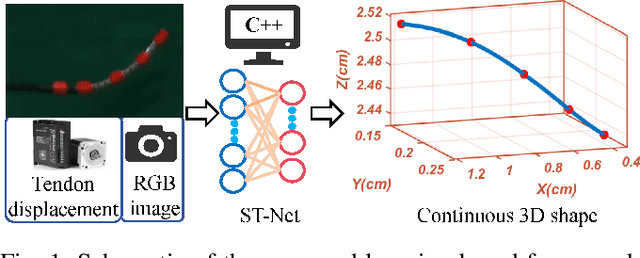
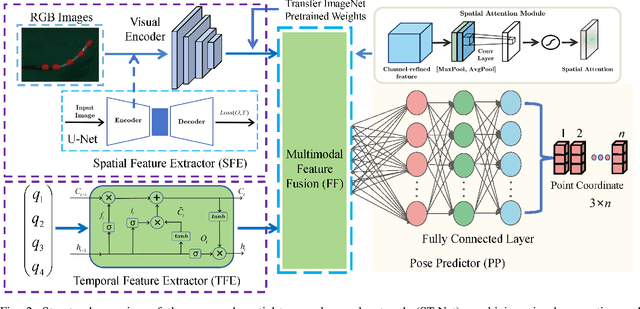
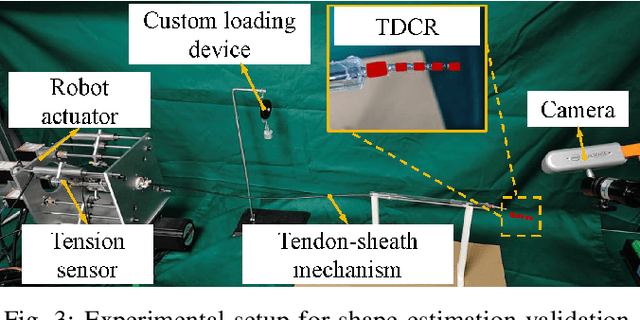
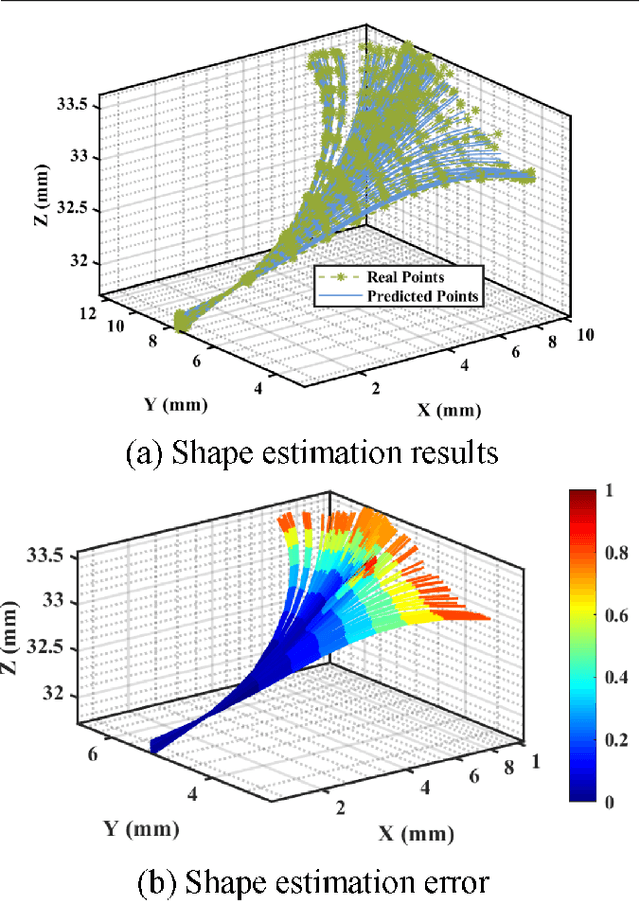
This paper presents a learning-based approach for accurately estimating the 3D shape of flexible continuum robots subjected to external loads. The proposed method introduces a spatiotemporal neural network architecture that fuses multi-modal inputs, including current and historical tendon displacement data and RGB images, to generate point clouds representing the robot's deformed configuration. The network integrates a recurrent neural module for temporal feature extraction, an encoding module for spatial feature extraction, and a multi-modal fusion module to combine spatial features extracted from visual data with temporal dependencies from historical actuator inputs. Continuous 3D shape reconstruction is achieved by fitting B\'ezier curves to the predicted point clouds. Experimental validation demonstrates that our approach achieves high precision, with mean shape estimation errors of 0.08 mm (unloaded) and 0.22 mm (loaded), outperforming state-of-the-art methods in shape sensing for TDCRs. The results validate the efficacy of deep learning-based spatiotemporal data fusion for precise shape estimation under loading conditions.