 Add to Chrome
 Add to Firefox
 Add to Edge
Soft Eversion Robots for Colonoscopy: Challenges, Open Problems, and Emerging Solutions
Jul 11, 2026
Conventional colonoscopy remains limited by patient discomfort and procedural risks, motivating research into compliant robotic alternatives. Eversion robots, which advance via pressure-driven tip growth, eliminate sliding friction against the colon wall and offer a less intrusive approach to traversal. However, no existing design simultaneously satisfies all clinical requirements. This paper benchmarks four recent eversion robot architectures against the key anatomical and clinical constraints of colonoscopy, including colon length, minimum luminal diameter, bending angle, and working-channel needs. We identify the central trade-offs each design reveals, particularly the difficulty of integrating steering and payload delivery without sacrificing the soft, low-friction behaviour that makes eversion robots attractive. We then provide design guidance across material selection, steering strategy, and payload delivery, and highlight open problems for clinical translation.

TacVerse: A Multi-Sensor Dataset and Benchmark for Cross-Sensor Vision-Based Tactile Perception
Jun 24, 2026Vision-based tactile sensors (VBTSs) enable robots to infer contact geometry and force-related cues by imaging deformation through an internal camera, yet generalisation across sensor designs remains poorly understood. We present TacVerse, a multi-sensor dataset and benchmark for cross-sensor vision-based tactile perception. The dataset contains 106,800 tactile images from seven VBTSs and supports three downstream tasks: shape classification, grating classification, and force regression. Experiments are conducted under three settings: within-sensor training, zero-shot cross-sensor transfer, and few-shot adaptation. Strong within-sensor performance across all tasks indicates that the collected tactile observations are informative for the target objectives. Direct cross-sensor transfer, however, leads to substantial degradation. Shape classification is comparatively robust, whereas grating classification and force regression are more sensitive to sensor shift. Few-shot adaptation for force regression consistently improves performance on unseen target sensors but does not fully close the gap to within-sensor upper bounds. A representation study further shows that MAE (Masked Autoencoder) pretraining provides the most consistent gains across tasks and sensors. TacVerse provides a controlled testbed for studying sensor shift, data-efficient adaptation, and self-supervised learning in tactile perception.
Design and Benchmarking of A Multi-Modality Sensor for Robotic Manipulation with GAN-Based Cross-Modality Interpretation
Jan 04, 2025


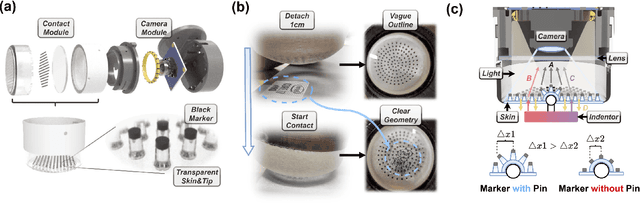
In this paper, we present the design and benchmark of an innovative sensor, ViTacTip, which fulfills the demand for advanced multi-modal sensing in a compact design. A notable feature of ViTacTip is its transparent skin, which incorporates a `see-through-skin' mechanism. This mechanism aims at capturing detailed object features upon contact, significantly improving both vision-based and proximity perception capabilities. In parallel, the biomimetic tips embedded in the sensor's skin are designed to amplify contact details, thus substantially augmenting tactile and derived force perception abilities. To demonstrate the multi-modal capabilities of ViTacTip, we developed a multi-task learning model that enables simultaneous recognition of hardness, material, and textures. To assess the functionality and validate the versatility of ViTacTip, we conducted extensive benchmarking experiments, including object recognition, contact point detection, pose regression, and grating identification. To facilitate seamless switching between various sensing modalities, we employed a Generative Adversarial Network (GAN)-based approach. This method enhances the applicability of the ViTacTip sensor across diverse environments by enabling cross-modality interpretation.
TacFR-Gripper: A Reconfigurable Fin Ray-Based Compliant Robotic Gripper with Tactile Skin for In-Hand Manipulation
Nov 17, 2023This paper introduces the TacFR-Gripper, a reconfigurable Fin Ray-based soft and compliant robotic gripper equipped with tactile skin, which can be used for dexterous in-hand manipulation tasks. This gripper can adaptively grasp objects of diverse shapes and stiffness levels. An array of Force Sensitive Resistor (FSR) sensors is embedded within the robotic finger to serve as the tactile skin, enabling the robot to perceive contact information during manipulation. We provide theoretical analysis for gripper design, including kinematic analysis, workspace analysis, and finite element analysis to identify the relationship between the gripper's load and its deformation. Moreover, we implemented a Graph Neural Network (GNN)-based tactile perception approach to enable reliable grasping without accidental slip or excessive force. Three physical experiments were conducted to quantify the performance of the TacFR-Gripper. These experiments aimed to i) assess the grasp success rate across various everyday objects through different configurations, ii) verify the effectiveness of tactile skin with the GNN algorithm in grasping, iii) evaluate the gripper's in-hand manipulation capabilities for object pose control. The experimental results indicate that the TacFR-Gripper can grasp a wide range of complex-shaped objects with a high success rate and deliver dexterous in-hand manipulation. Additionally, the integration of tactile skin with the GNN algorithm enhances grasp stability by incorporating tactile feedback during manipulations. For more details of this project, please view our website: https://sites.google.com/view/tacfr-gripper/homepage.