 Add to Chrome
 Add to Firefox
 Add to Edge
ActProbe: Action-Space Probe for Early Failure Detection of Generative Robot Policies
Jun 07, 2026
Generative robot policies fail unpredictably at deployment: they hesitate at critical moments, drift off-task, or commit to unrecoverable actions. Existing online failure detectors either require white-box access to policy internals or add runtime overhead through resampling and observation-side signals. Our empirical analysis shows that emitted action chunks themselves already carry strong predictive signal for impending failures in generative robot policies. Motivated by this observation, we introduce ActProbe, a lightweight, pure action-space detector that uses two compact signals available from a single forward pass: Temporal Consistency Error (TCE) between consecutive action chunks and Action Chunk Magnitude (ACM) of the current chunk. ActProbe maps these signals to per-step failure probabilities with a task-conditioned LSTM-MLP architecture. Across a diverse suite of generative robot policies and benchmarks, ActProbe raises alerts before failures become visually recognizable, improving the accuracy (F1)-timeliness Pareto frontier of failure detection by an average hypervolume gain of +12.7% over both internal- and external-feature baselines, with a +9.0% early-detection ROC-AUC lead on unseen tasks. ActProbe further transfers to deployment, predicting failures on unseen real-robot pick tasks and accelerating RL fine-tuning (PPO) with 2.9x fewer environment interactions.

GRIP-VLM: Group-Relative Importance Pruning for Efficient Vision-Language Models
May 13, 2026In Vision-Language Models (VLMs), processing a massive number of visual tokens incurs prohibitive computational overhead. While recent training-aware pruning methods attempt to selectively discard redundant tokens, they largely rely on continuous-gradient relaxations. However, visual token pruning is inherently a discrete, non-convex combinatorial problem; consequently, these continuous approximations frequently trap the optimization in sub-optimal local minima, especially under aggressive compression budgets. To overcome this fundamental bottleneck, we propose GRIP-VLM, a Group-Relative Importance Pruning framework driven by Reinforcement Learning. Rather than relying on smooth-gradient assumptions, GRIP-VLM formulates pruning as a Markov Decision Process, employing a Group Relative Policy Optimization (GRPO) paradigm anchored by supervised warm-up to directly explore the discrete selection space. Integrated with a budget-aware scorer, our lightweight agent dynamically evaluates per-token importance and adapts to arbitrary compression ratios without retraining. Extensive experiments across diverse multimodal benchmarks demonstrate that GRIP-VLM consistently outperforms heuristic and supervised-learning baselines, achieving a superior Pareto frontier and delivering up to a 15\% inference speedup at equal accuracy.
EmbodiSkill: Skill-Aware Reflection for Self-Evolving Embodied Agents
May 11, 2026Embodied agents can benefit from skills that guide object search, action execution, and state changes across diverse environments. Since embodied environments vary across layouts, object states, and other execution factors, these skills must self-evolve from trajectories generated during task execution. However, existing skill self-evolution methods are mainly developed in digital environments and often convert trajectories into coarse skill updates. Directly applying this paradigm to embodied settings is problematic, because a failed task execution may reflect not only incorrect skill content, but also an execution lapse in which the agent fails to follow valid guidance. We propose EmbodiSkill, a training-free framework for embodied skill self-evolution through skill-aware reflection and targeted revision. EmbodiSkill interprets each trajectory with respect to the current skill, uses skill-changing evidence to update the skill body, and uses execution-lapse evidence to preserve and emphasize valid guidance. Experiments on ALFWorld and EmbodiedBench show that EmbodiSkill consistently improves embodied task success. On ALFWorld, EmbodiSkill enables a frozen Qwen3.5-27B executor to reach 93.28% task success, outperforming GPT-5.2 used as a direct agent without skills by 31.58%. These results show that skill-aware self-evolution helps embodied agents accumulate reusable procedural knowledge from their own trajectories.
Em-Garde: A Propose-Match Framework for Proactive Streaming Video Understanding
Mar 19, 2026Recent advances in Streaming Video Understanding has enabled a new interaction paradigm where models respond proactively to user queries. Current proactive VideoLLMs rely on per-frame triggering decision making, which suffers from an efficiency-accuracy dilemma. We propose Em-Garde, a novel framework that decouples semantic understanding from streaming perception. At query time, the Instruction-Guided Proposal Parser transforms user queries into structured, perceptually grounded visual proposals; during streaming, a Lightweight Proposal Matching Module performs efficient embedding-based matching to trigger responses. Experiments on StreamingBench and OVO-Bench demonstrate consistent improvements over prior models in proactive response accuracy and efficiency, validating an effective solution for proactive video understanding under strict computational constraints.
OxyGen: Unified KV Cache Management for Vision-Language-Action Models under Multi-Task Parallelism
Mar 15, 2026Embodied AI agents increasingly require parallel execution of multiple tasks, such as manipulation, conversation, and memory construction, from shared observations under distinct time constraints. Recent Mixture-of-Transformers (MoT) Vision-Language-Action Models (VLAs) architecturally support such heterogeneous outputs, yet existing inference systems fail to achieve efficient multi-task parallelism for on-device deployment due to redundant computation and resource contention. We identify isolated KV cache management as the root cause. To address this, we propose unified KV cache management, an inference paradigm that treats KV cache as a first-class shared resource across tasks and over time. This abstraction enables two key optimizations: cross-task KV sharing eliminates redundant prefill of shared observations, while cross-frame continuous batching decouples variable-length language decoding from fixed-rate action generation across control cycles. We implement this paradigm for $π_{0.5}$, the most popular MoT VLA, and evaluate under representative robotic configurations. OxyGen achieves up to 3.7$\times$ speedup over isolated execution, delivering over 200 tokens/s language throughput and 70 Hz action frequency simultaneously without action quality degradation.
Enabling MoE on the Edge via Importance-Driven Expert Scheduling
Aug 26, 2025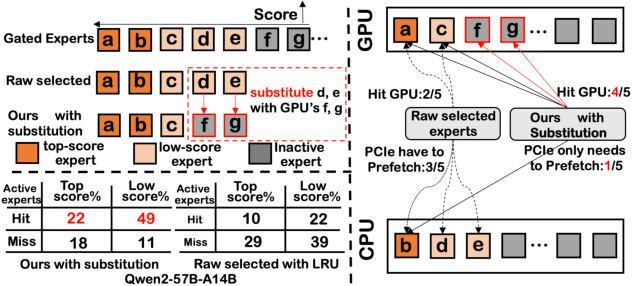

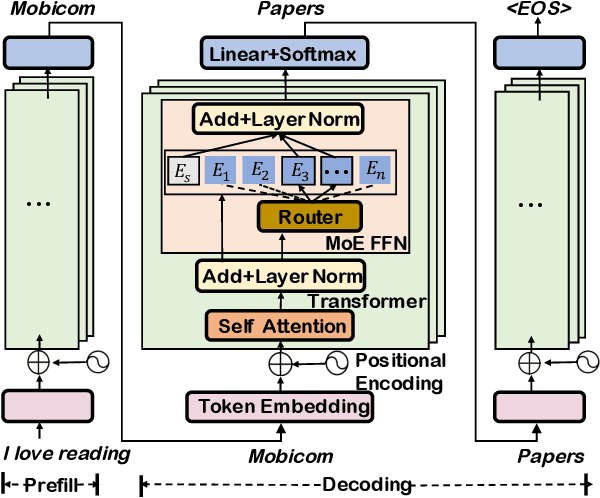
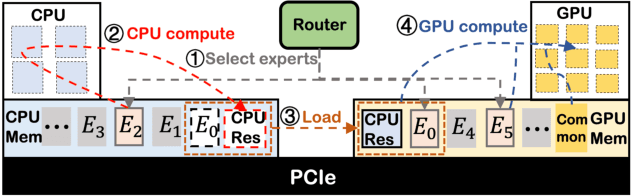
The Mixture of Experts (MoE) architecture has emerged as a key technique for scaling Large Language Models by activating only a subset of experts per query. Deploying MoE on consumer-grade edge hardware, however, is constrained by limited device memory, making dynamic expert offloading essential. Unlike prior work that treats offloading purely as a scheduling problem, we leverage expert importance to guide decisions, substituting low-importance activated experts with functionally similar ones already cached in GPU memory, thereby preserving accuracy. As a result, this design reduces memory usage and data transfer, while largely eliminating PCIe overhead. In addition, we introduce a scheduling policy that maximizes the reuse ratio of GPU-cached experts, further boosting efficiency. Extensive evaluations show that our approach delivers 48% lower decoding latency with over 60% expert cache hit rate, while maintaining nearly lossless accuracy.
Dynamic Modeling and Dimensional Optimization of Legged Mechanisms for Construction Robot
Jul 23, 2025With the rapid development of the construction industry, issues such as harsh working environments, high-intensity and high-risk tasks, and labor shortages have become increasingly prominent. This drives higher demands for construction robots in terms of low energy consumption, high mobility, and high load capacity. This paper focuses on the design and optimization of leg structures for construction robots, aiming to improve their dynamic performance, reduce energy consumption, and enhance load-bearing capabilities. Firstly, based on the leg configuration of ants in nature, we design a structure for the robot's leg. Secondly, we propose a novel structural optimization method. Using the Lagrangian approach, a dynamic model of the leg was established. Combining the dynamic model with the leg's motion trajectory, we formulated multiple dynamic evaluation metrics and conducted a comprehensive optimization study on the geometric parameters of each leg segment. The results show that the optimized leg structure reduces peak joint torques and energy consumption by over 20%. Finally, dynamic simulation experiments were conducted using ADAMS. The results demonstrate a significant reduction in the driving power of each joint after optimization, validating the effectiveness and rationality of the proposed strategy. This study provides a theoretical foundation and technical support for the design of heavy-load, high-performance construction robots.
Multi-Objective Trajectory Planning for a Robotic Arm in Curtain Wall Installation
Jul 23, 2025In the context of labor shortages and rising costs, construction robots are regarded as the key to revolutionizing traditional construction methods and improving efficiency and quality in the construction industry. In order to ensure that construction robots can perform tasks efficiently and accurately in complex construction environments, traditional single-objective trajectory optimization methods are difficult to meet the complex requirements of the changing construction environment. Therefore, we propose a multi-objective trajectory optimization for the robotic arm used in the curtain wall installation. First, we design a robotic arm for curtain wall installation, integrating serial, parallel, and folding arm elements, while considering its physical properties and motion characteristics. In addition, this paper proposes an NSGA-III-FO algorithm (NSGA-III with Focused Operator, NSGA-III-FO) that incorporates a focus operator screening mechanism to accelerate the convergence of the algorithm towards the Pareto front, thereby effectively balancing the multi-objective constraints of construction robots. The proposed algorithm is tested against NSGA-III, MOEA/D, and MSOPS-II in ten consecutive trials on the DTLZ3 and WFG3 test functions, showing significantly better convergence efficiency than the other algorithms. Finally, we conduct two sets of experiments on the designed robotic arm platform, which confirm the efficiency and practicality of the NSGA-III-FO algorithm in solving multi-objective trajectory planning problems for curtain wall installation tasks.
Dynamic Parameter Identification of a Curtain Wall Installation Robotic Arm
Jul 23, 2025In the construction industry, traditional methods fail to meet the modern demands for efficiency and quality. The curtain wall installation is a critical component of construction projects. We design a hydraulically driven robotic arm for curtain wall installation and a dynamic parameter identification method. We establish a Denavit-Hartenberg (D-H) model based on measured robotic arm structural parameters and integrate hydraulic cylinder dynamics to construct a composite parametric system driven by a Stribeck friction model. By designing high-signal-to-noise ratio displacement excitation signals for hydraulic cylinders and combining Fourier series to construct optimal excitation trajectories that satisfy joint constraints, this method effectively excites the characteristics of each parameter in the minimal parameter set of the dynamic model of the robotic arm. On this basis, a hierarchical progressive parameter identification strategy is proposed: least squares estimation is employed to separately identify and jointly calibrate the dynamic parameters of both the hydraulic cylinder and the robotic arm, yielding Stribeck model curves for each joint. Experimental validation on a robotic arm platform demonstrates residual standard deviations below 0.4 Nm between theoretical and measured joint torques, confirming high-precision dynamic parameter identification for the hydraulic-driven curtain wall installation robotic arm. This significantly contributes to enhancing the intelligence level of curtain wall installation operations.
GS-Matching: Reconsidering Feature Matching task in Point Cloud Registration
Dec 06, 2024Traditional point cloud registration (PCR) methods for feature matching often employ the nearest neighbor policy. This leads to many-to-one matches and numerous potential inliers without any corresponding point. Recently, some approaches have framed the feature matching task as an assignment problem to achieve optimal one-to-one matches. We argue that the transition to the Assignment problem is not reliable for general correspondence-based PCR. In this paper, we propose a heuristics stable matching policy called GS-matching, inspired by the Gale-Shapley algorithm. Compared to the other matching policies, our method can perform efficiently and find more non-repetitive inliers under low overlapping conditions. Furthermore, we employ the probability theory to analyze the feature matching task, providing new insights into this research problem. Extensive experiments validate the effectiveness of our matching policy, achieving better registration recall on multiple datasets.