 Add to Chrome
 Add to Firefox
 Add to Edge
A Pure Transformer Pretraining Framework on Text-attributed Graphs
Jun 19, 2024
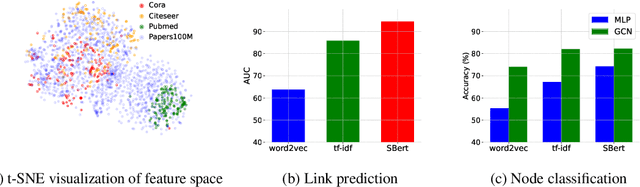
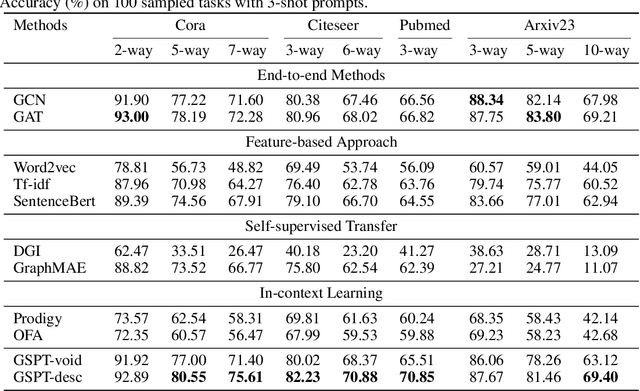
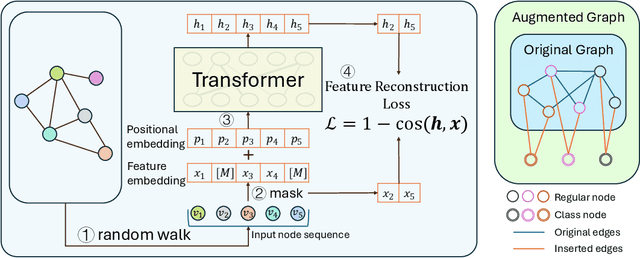
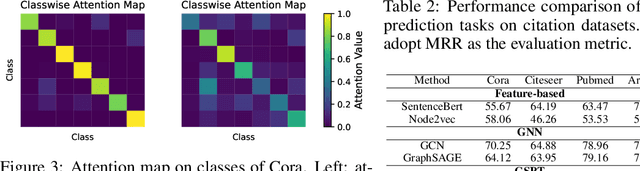
Pretraining plays a pivotal role in acquiring generalized knowledge from large-scale data, achieving remarkable successes as evidenced by large models in CV and NLP. However, progress in the graph domain remains limited due to fundamental challenges such as feature heterogeneity and structural heterogeneity. Recently, increasing efforts have been made to enhance node feature quality with Large Language Models (LLMs) on text-attributed graphs (TAGs), demonstrating superiority to traditional bag-of-words or word2vec techniques. These high-quality node features reduce the previously critical role of graph structure, resulting in a modest performance gap between Graph Neural Networks (GNNs) and structure-agnostic Multi-Layer Perceptrons (MLPs). Motivated by this, we introduce a feature-centric pretraining perspective by treating graph structure as a prior and leveraging the rich, unified feature space to learn refined interaction patterns that generalizes across graphs. Our framework, Graph Sequence Pretraining with Transformer (GSPT), samples node contexts through random walks and employs masked feature reconstruction to capture pairwise proximity in the LLM-unified feature space using a standard Transformer. By utilizing unified text representations rather than varying structures, our framework achieves significantly better transferability among graphs within the same domain. GSPT can be easily adapted to both node classification and link prediction, demonstrating promising empirical success on various datasets.

Text-space Graph Foundation Models: Comprehensive Benchmarks and New Insights
Jun 15, 2024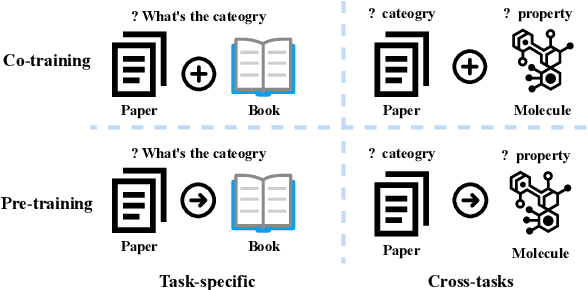


Given the ubiquity of graph data and its applications in diverse domains, building a Graph Foundation Model (GFM) that can work well across different graphs and tasks with a unified backbone has recently garnered significant interests. A major obstacle to achieving this goal stems from the fact that graphs from different domains often exhibit diverse node features. Inspired by multi-modal models that align different modalities with natural language, the text has recently been adopted to provide a unified feature space for diverse graphs. Despite the great potential of these text-space GFMs, current research in this field is hampered by two problems. First, the absence of a comprehensive benchmark with unified problem settings hinders a clear understanding of the comparative effectiveness and practical value of different text-space GFMs. Second, there is a lack of sufficient datasets to thoroughly explore the methods' full potential and verify their effectiveness across diverse settings. To address these issues, we conduct a comprehensive benchmark providing novel text-space datasets and comprehensive evaluation under unified problem settings. Empirical results provide new insights and inspire future research directions. Our code and data are publicly available from \url{https://github.com/CurryTang/TSGFM}.
Asymmetrical Siamese Network for Point Clouds Normal Estimation
Jun 14, 2024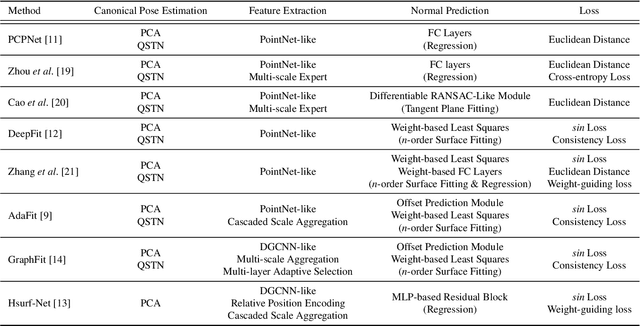
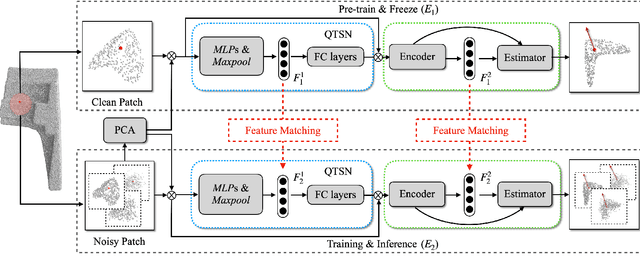
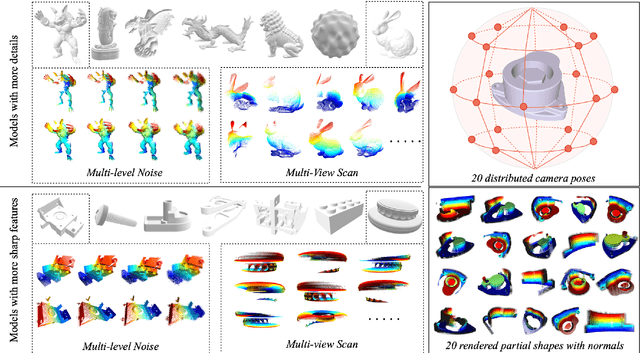
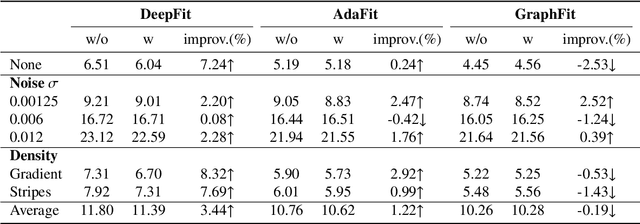
In recent years, deep learning-based point cloud normal estimation has made great progress. However, existing methods mainly rely on the PCPNet dataset, leading to overfitting. In addition, the correlation between point clouds with different noise scales remains unexplored, resulting in poor performance in cross-domain scenarios. In this paper, we explore the consistency of intrinsic features learned from clean and noisy point clouds using an Asymmetric Siamese Network architecture. By applying reasonable constraints between features extracted from different branches, we enhance the quality of normal estimation. Moreover, we introduce a novel multi-view normal estimation dataset that includes a larger variety of shapes with different noise levels. Evaluation of existing methods on this new dataset reveals their inability to adapt to different types of shapes, indicating a degree of overfitting. Extensive experiments show that the proposed dataset poses significant challenges for point cloud normal estimation and that our feature constraint mechanism effectively improves upon existing methods and reduces overfitting in current architectures.
EpiLearn: A Python Library for Machine Learning in Epidemic Modeling
Jun 10, 2024
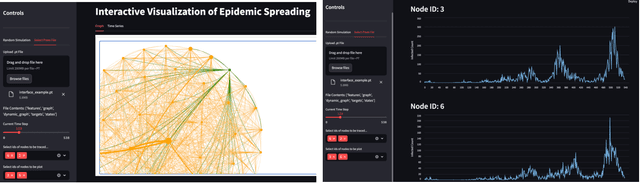
EpiLearn is a Python toolkit developed for modeling, simulating, and analyzing epidemic data. Although there exist several packages that also deal with epidemic modeling, they are often restricted to mechanistic models or traditional statistical tools. As machine learning continues to shape the world, the gap between these packages and the latest models has become larger. To bridge the gap and inspire innovative research in epidemic modeling, EpiLearn not only provides support for evaluating epidemic models based on machine learning, but also incorporates comprehensive tools for analyzing epidemic data, such as simulation, visualization, transformations, etc. For the convenience of both epidemiologists and data scientists, we provide a unified framework for training and evaluation of epidemic models on two tasks: Forecasting and Source Detection. To facilitate the development of new models, EpiLearn follows a modular design, making it flexible and easy to use. In addition, an interactive web application is also developed to visualize the real-world or simulated epidemic data. Our package is available at https://github.com/Emory-Melody/EpiLearn.
Enabling On-Device Learning via Experience Replay with Efficient Dataset Condensation
May 25, 2024Upon deployment to edge devices, it is often desirable for a model to further learn from streaming data to improve accuracy. However, extracting representative features from such data is challenging because it is typically unlabeled, non-independent and identically distributed (non-i.i.d), and is seen only once. To mitigate this issue, a common strategy is to maintain a small data buffer on the edge device to hold the most representative data for further learning. As most data is either never stored or quickly discarded, identifying the most representative data to avoid significant information loss becomes critical. In this paper, we propose an on-device framework that addresses this issue by condensing incoming data into more informative samples. Specifically, to effectively handle unlabeled incoming data, we propose a pseudo-labeling technique designed for unlabeled on-device learning environments. Additionally, we develop a dataset condensation technique that only requires little computation resources. To counteract the effects of noisy labels during the condensation process, we further utilize a contrastive learning objective to improve the purity of class data within the buffer. Our empirical results indicate substantial improvements over existing methods, particularly when buffer capacity is severely restricted. For instance, with a buffer capacity of just one sample per class, our method achieves an accuracy that outperforms the best existing baseline by 58.4% on the CIFAR-10 dataset.
A Review of Graph Neural Networks in Epidemic Modeling
Apr 11, 2024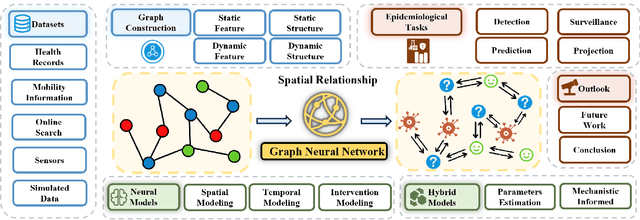
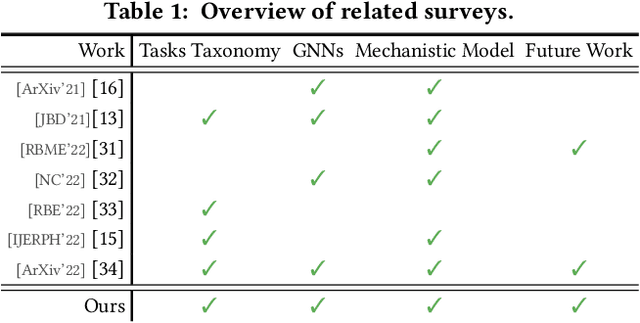
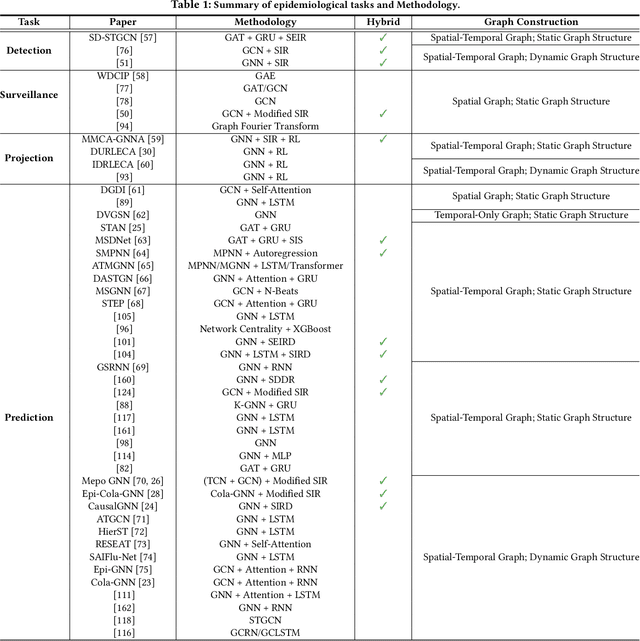
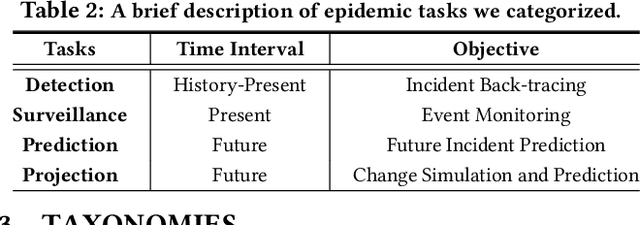
Since the onset of the COVID-19 pandemic, there has been a growing interest in studying epidemiological models. Traditional mechanistic models mathematically describe the transmission mechanisms of infectious diseases. However, they often fall short when confronted with the growing challenges of today. Consequently, Graph Neural Networks (GNNs) have emerged as a progressively popular tool in epidemic research. In this paper, we endeavor to furnish a comprehensive review of GNNs in epidemic tasks and highlight potential future directions. To accomplish this objective, we introduce hierarchical taxonomies for both epidemic tasks and methodologies, offering a trajectory of development within this domain. For epidemic tasks, we establish a taxonomy akin to those typically employed within the epidemic domain. For methodology, we categorize existing work into \textit{Neural Models} and \textit{Hybrid Models}. Following this, we perform an exhaustive and systematic examination of the methodologies, encompassing both the tasks and their technical details. Furthermore, we discuss the limitations of existing methods from diverse perspectives and systematically propose future research directions. This survey aims to bridge literature gaps and promote the progression of this promising field. We hope that it will facilitate synergies between the communities of GNNs and epidemiology, and contribute to their collective progress.
Investigating Out-of-Distribution Generalization of GNNs: An Architecture Perspective
Feb 14, 2024Graph neural networks (GNNs) have exhibited remarkable performance under the assumption that test data comes from the same distribution of training data. However, in real-world scenarios, this assumption may not always be valid. Consequently, there is a growing focus on exploring the Out-of-Distribution (OOD) problem in the context of graphs. Most existing efforts have primarily concentrated on improving graph OOD generalization from two \textbf{model-agnostic} perspectives: data-driven methods and strategy-based learning. However, there has been limited attention dedicated to investigating the impact of well-known \textbf{GNN model architectures} on graph OOD generalization, which is orthogonal to existing research. In this work, we provide the first comprehensive investigation of OOD generalization on graphs from an architecture perspective, by examining the common building blocks of modern GNNs. Through extensive experiments, we reveal that both the graph self-attention mechanism and the decoupled architecture contribute positively to graph OOD generalization. In contrast, we observe that the linear classification layer tends to compromise graph OOD generalization capability. Furthermore, we provide in-depth theoretical insights and discussions to underpin these discoveries. These insights have empowered us to develop a novel GNN backbone model, DGAT, designed to harness the robust properties of both graph self-attention mechanism and the decoupled architecture. Extensive experimental results demonstrate the effectiveness of our model under graph OOD, exhibiting substantial and consistent enhancements across various training strategies.
Enhancing ID and Text Fusion via Alternative Training in Session-based Recommendation
Feb 14, 2024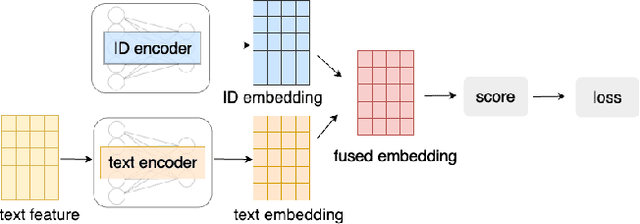

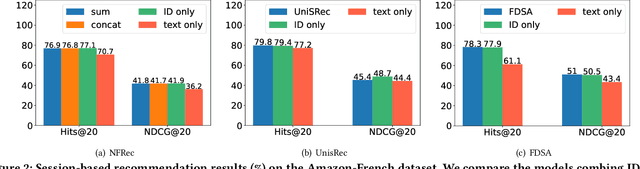
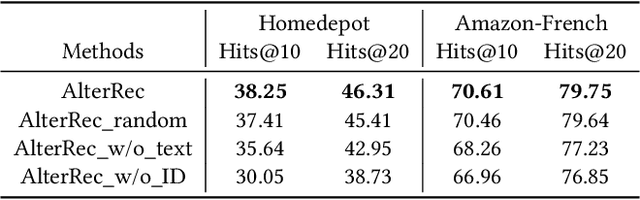
Session-based recommendation has gained increasing attention in recent years, with its aim to offer tailored suggestions based on users' historical behaviors within sessions. To advance this field, a variety of methods have been developed, with ID-based approaches typically demonstrating promising performance. However, these methods often face challenges with long-tail items and overlook other rich forms of information, notably valuable textual semantic information. To integrate text information, various methods have been introduced, mostly following a naive fusion framework. Surprisingly, we observe that fusing these two modalities does not consistently outperform the best single modality by following the naive fusion framework. Further investigation reveals an potential imbalance issue in naive fusion, where the ID dominates and text modality is undertrained. This suggests that the unexpected observation may stem from naive fusion's failure to effectively balance the two modalities, often over-relying on the stronger ID modality. This insight suggests that naive fusion might not be as effective in combining ID and text as previously expected. To address this, we propose a novel alternative training strategy AlterRec. It separates the training of ID and text, thereby avoiding the imbalance issue seen in naive fusion. Additionally, AlterRec designs a novel strategy to facilitate the interaction between the two modalities, enabling them to mutually learn from each other and integrate the text more effectively. Comprehensive experiments demonstrate the effectiveness of AlterRec in session-based recommendation. The implementation is available at https://github.com/Juanhui28/AlterRec.
A Comprehensive Survey on Graph Reduction: Sparsification, Coarsening, and Condensation
Feb 07, 2024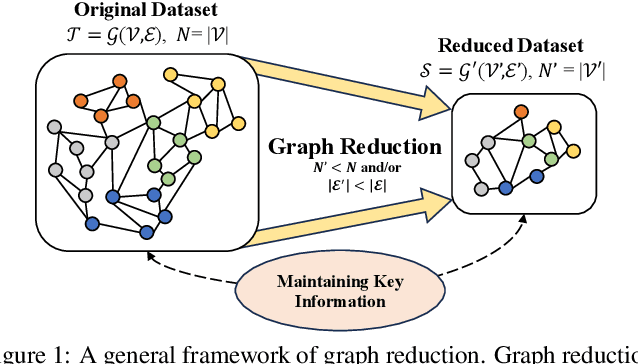
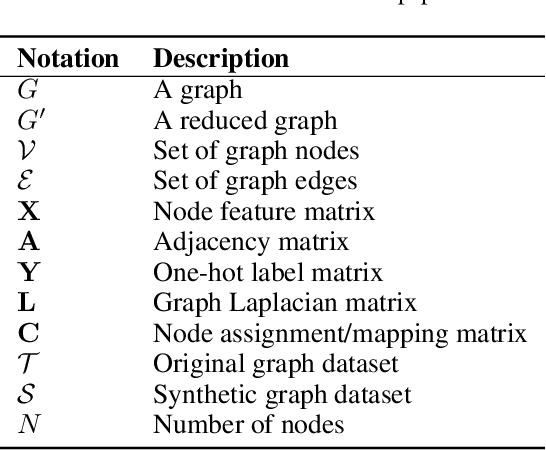
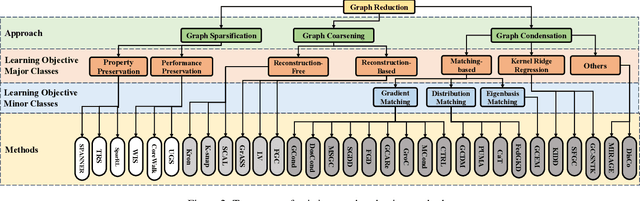

Many real-world datasets can be naturally represented as graphs, spanning a wide range of domains. However, the increasing complexity and size of graph datasets present significant challenges for analysis and computation. In response, graph reduction techniques have gained prominence for simplifying large graphs while preserving essential properties. In this survey, we aim to provide a comprehensive understanding of graph reduction methods, including graph sparsification, graph coarsening, and graph condensation. Specifically, we establish a unified definition for these methods and introduce a hierarchical taxonomy to categorize the challenges they address. Our survey then systematically reviews the technical details of these methods and emphasizes their practical applications across diverse scenarios. Furthermore, we outline critical research directions to ensure the continued effectiveness of graph reduction techniques, as well as provide a comprehensive paper list at https://github.com/ChandlerBang/awesome-graph-reduction. We hope this survey will bridge literature gaps and propel the advancement of this promising field.
Navigating Complexity: Toward Lossless Graph Condensation via Expanding Window Matching
Feb 07, 2024Graph condensation aims to reduce the size of a large-scale graph dataset by synthesizing a compact counterpart without sacrificing the performance of Graph Neural Networks (GNNs) trained on it, which has shed light on reducing the computational cost for training GNNs. Nevertheless, existing methods often fall short of accurately replicating the original graph for certain datasets, thereby failing to achieve the objective of lossless condensation. To understand this phenomenon, we investigate the potential reasons and reveal that the previous state-of-the-art trajectory matching method provides biased and restricted supervision signals from the original graph when optimizing the condensed one. This significantly limits both the scale and efficacy of the condensed graph. In this paper, we make the first attempt toward \textit{lossless graph condensation} by bridging the previously neglected supervision signals. Specifically, we employ a curriculum learning strategy to train expert trajectories with more diverse supervision signals from the original graph, and then effectively transfer the information into the condensed graph with expanding window matching. Moreover, we design a loss function to further extract knowledge from the expert trajectories. Theoretical analysis justifies the design of our method and extensive experiments verify its superiority across different datasets. Code is released at https://github.com/NUS-HPC-AI-Lab/GEOM.