 Add to Chrome
 Add to Firefox
 Add to Edge
A Digital Twin Framework Utilizing Machine Learning for Robust Predictive Maintenance: Enhancing Tire Health Monitoring
Aug 12, 2024
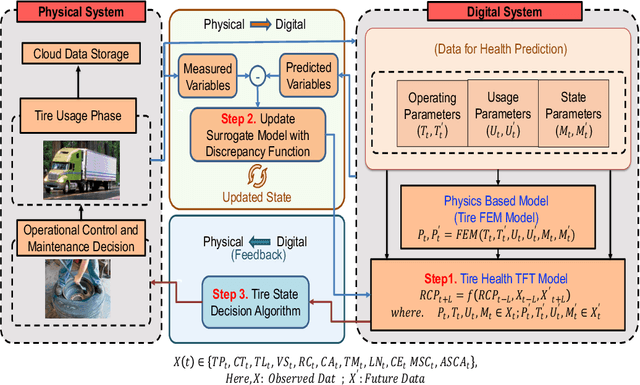


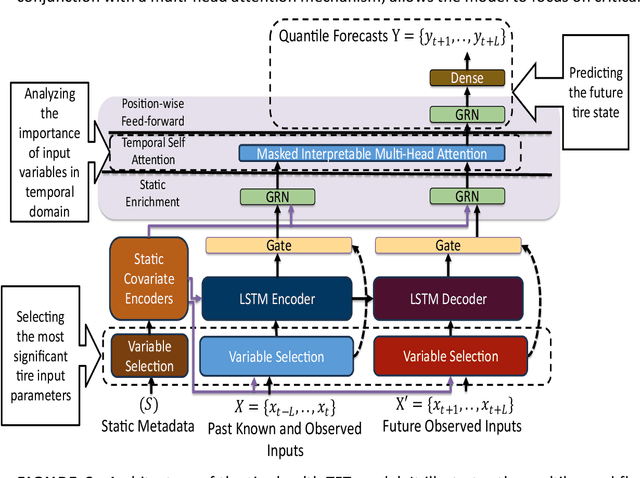
We introduce a novel digital twin framework for predictive maintenance of long-term physical systems. Using monitoring tire health as an application, we show how the digital twin framework can be used to enhance automotive safety and efficiency, and how the technical challenges can be overcome using a three-step approach. Firstly, for managing the data complexity over a long operation span, we employ data reduction techniques to concisely represent physical tires using historical performance and usage data. Relying on these data, for fast real-time prediction, we train a transformer-based model offline on our concise dataset to predict future tire health over time, represented as Remaining Casing Potential (RCP). Based on our architecture, our model quantifies both epistemic and aleatoric uncertainty, providing reliable confidence intervals around predicted RCP. Secondly, to incorporate real-time data, we update the predictive model in the digital twin framework, ensuring its accuracy throughout its life span with the aid of hybrid modeling and the use of discrepancy function. Thirdly, to assist decision making in predictive maintenance, we implement a Tire State Decision Algorithm, which strategically determines the optimal timing for tire replacement based on RCP forecasted by our transformer model. This approach ensures our digital twin accurately predicts system health, continually refines its digital representation, and supports predictive maintenance decisions. Our framework effectively embodies a physical system, leveraging big data and machine learning for predictive maintenance, model updates, and decision-making.

Impacts of Darwinian Evolution on Pre-trained Deep Neural Networks
Aug 10, 2024Darwinian evolution of the biological brain is documented through multiple lines of evidence, although the modes of evolutionary changes remain unclear. Drawing inspiration from the evolved neural systems (e.g., visual cortex), deep learning models have demonstrated superior performance in visual tasks, among others. While the success of training deep neural networks has been relying on back-propagation (BP) and its variants to learn representations from data, BP does not incorporate the evolutionary processes that govern biological neural systems. This work proposes a neural network optimization framework based on evolutionary theory. Specifically, BP-trained deep neural networks for visual recognition tasks obtained from the ending epochs are considered the primordial ancestors (initial population). Subsequently, the population evolved with differential evolution. Extensive experiments are carried out to examine the relationships between Darwinian evolution and neural network optimization, including the correspondence between datasets, environment, models, and living species. The empirical results show that the proposed framework has positive impacts on the network, with reduced over-fitting and an order of magnitude lower time complexity compared to BP. Moreover, the experiments show that the proposed framework performs well on deep neural networks and big datasets.
A Backbone for Long-Horizon Robot Task Understanding
Aug 07, 2024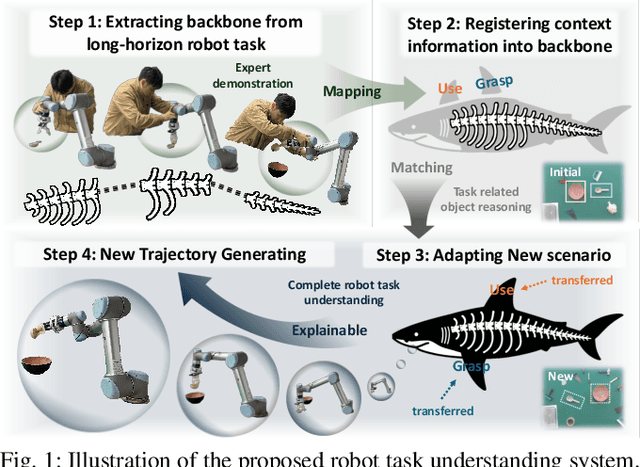
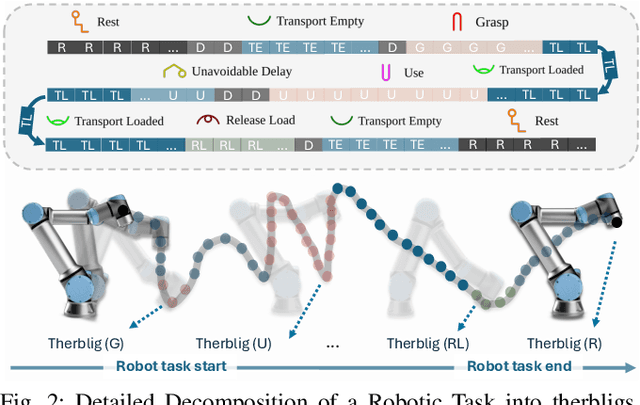
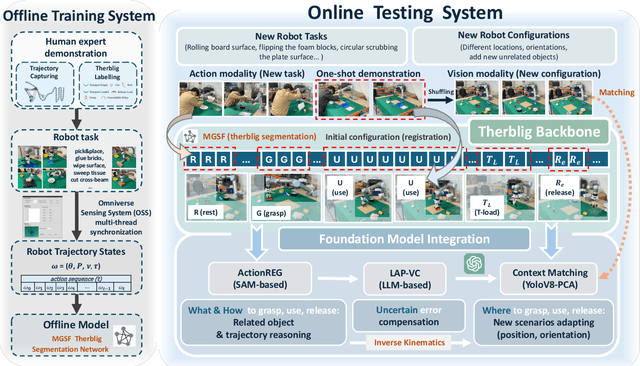
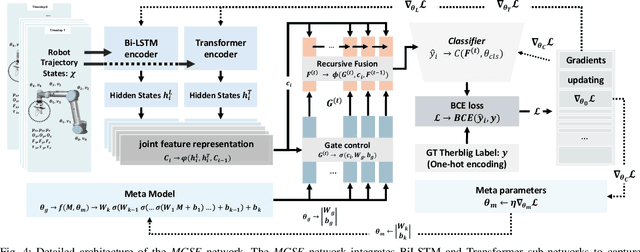
End-to-end robot learning, particularly for long-horizon tasks, often results in unpredictable outcomes and poor generalization. To address these challenges, we propose a novel Therblig-based Backbone Framework (TBBF) to enhance robot task understanding and transferability. This framework uses therbligs (basic action elements) as the backbone to decompose high-level robot tasks into elemental robot configurations, which are then integrated with current foundation models to improve task understanding. The approach consists of two stages: offline training and online testing. During the offline training stage, we developed the Meta-RGate SynerFusion (MGSF) network for accurate therblig segmentation across various tasks. In the online testing stage, after a one-shot demonstration of a new task is collected, our MGSF network extracts high-level knowledge, which is then encoded into the image using Action Registration (ActionREG). Additionally, the Large Language Model (LLM)-Alignment Policy for Visual Correction (LAP-VC) is employed to ensure precise action execution, facilitating trajectory transfer in novel robot scenarios. Experimental results validate these methods, achieving 94.37% recall in therblig segmentation and success rates of 94.4% and 80% in real-world online robot testing for simple and complex scenarios, respectively. Supplementary material is available at: https://sites.google.com/view/therbligsbasedbackbone/home
An Efficient and Effective Transformer Decoder-Based Framework for Multi-Task Visual Grounding
Aug 02, 2024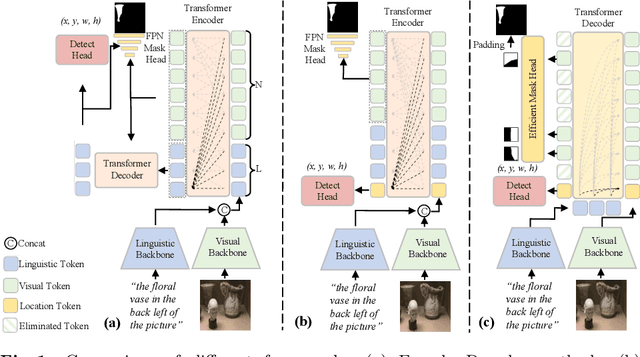
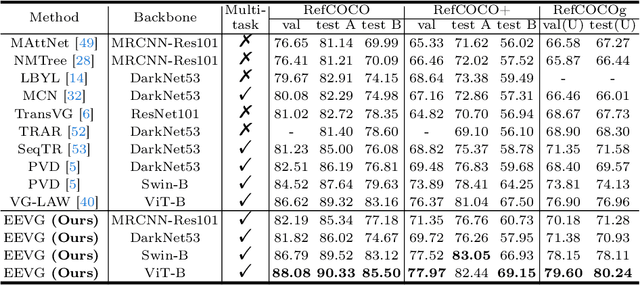
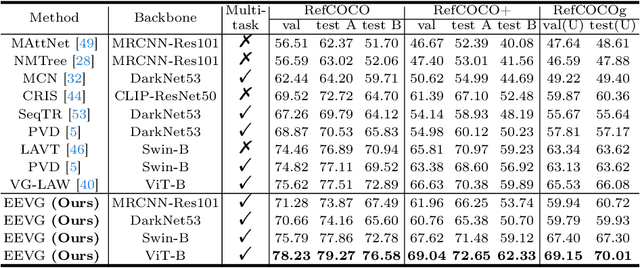
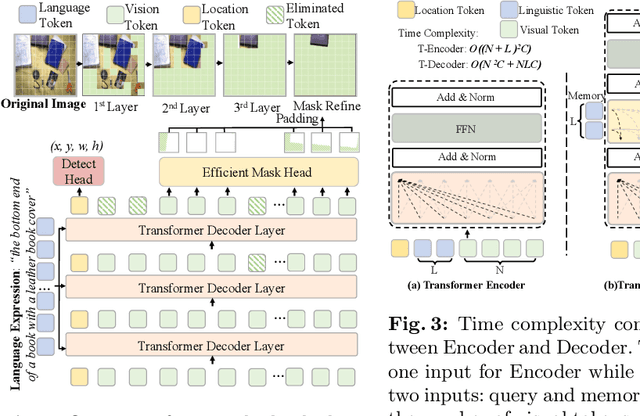
Most advanced visual grounding methods rely on Transformers for visual-linguistic feature fusion. However, these Transformer-based approaches encounter a significant drawback: the computational costs escalate quadratically due to the self-attention mechanism in the Transformer Encoder, particularly when dealing with high-resolution images or long context sentences. This quadratic increase in computational burden restricts the applicability of visual grounding to more intricate scenes, such as conversation-based reasoning segmentation, which involves lengthy language expressions. In this paper, we propose an efficient and effective multi-task visual grounding (EEVG) framework based on Transformer Decoder to address this issue, which reduces the cost in both language and visual aspects. In the language aspect, we employ the Transformer Decoder to fuse visual and linguistic features, where linguistic features are input as memory and visual features as queries. This allows fusion to scale linearly with language expression length. In the visual aspect, we introduce a parameter-free approach to reduce computation by eliminating background visual tokens based on attention scores. We then design a light mask head to directly predict segmentation masks from the remaining sparse feature maps. Extensive results and ablation studies on benchmarks demonstrate the efficiency and effectiveness of our approach. Code is available in https://github.com/chenwei746/EEVG.
Paying More Attention to Image: A Training-Free Method for Alleviating Hallucination in LVLMs
Jul 31, 2024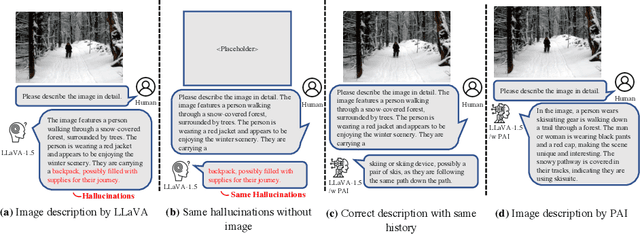
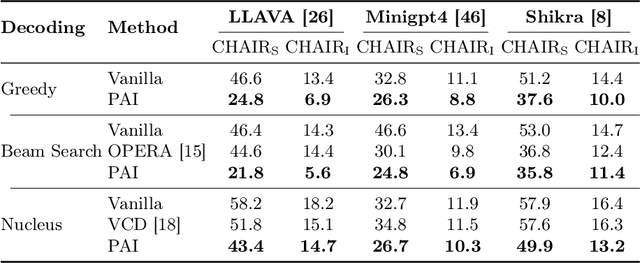
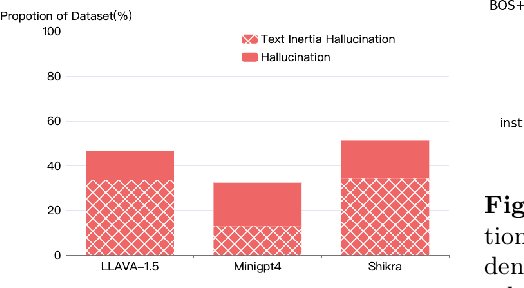
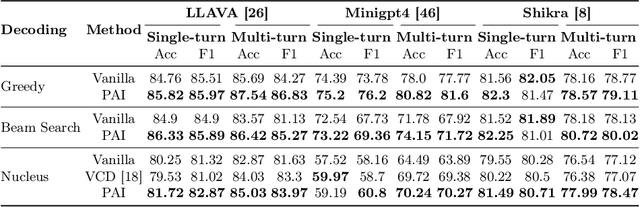
Existing Large Vision-Language Models (LVLMs) primarily align image features of vision encoder with Large Language Models (LLMs) to leverage their superior text generation capabilities. However, the scale disparity between vision encoder and language model may led to LLMs assuming a predominant role in multi-modal comprehension. This imbalance in LVLMs may result in the instances of hallucinatory. Concretely, LVLMs may generate consistent descriptions with or without visual input, indicating that certain outputs are influenced solely by context text. We refer to this phenomenon as "text inertia." To counteract this issue, we introduce a training-free algorithm to find an equilibrium point between image comprehension and language inference. Specifically, we adaptively involve adjusting and amplifying the attention weights assigned to image tokens, thereby granting greater prominence to visual elements. Meanwhile, we subtract the logits of multi-modal inputs from ones of pure text input, which can help LVLMs be not biased towards LLMs. By enhancing images tokens and reducing the stubborn output of LLM, we can let LVLM pay more attention to images, towards alleviating text inertia and reducing the hallucination in LVLMs. Our extensive experiments shows that this method substantially reduces the frequency of hallucinatory outputs in various LVLMs in terms of different metrics. Project page is available at https://lalbj.github.io/projects/PAI/.
Diffusion-Driven Semantic Communication for Generative Models with Bandwidth Constraints
Jul 26, 2024Diffusion models have been extensively utilized in AI-generated content (AIGC) in recent years, thanks to the superior generation capabilities. Combining with semantic communications, diffusion models are used for tasks such as denoising, data reconstruction, and content generation. However, existing diffusion-based generative models do not consider the stringent bandwidth limitation, which limits its application in wireless communication. This paper introduces a diffusion-driven semantic communication framework with advanced VAE-based compression for bandwidth-constrained generative model. Our designed architecture utilizes the diffusion model, where the signal transmission process through the wireless channel acts as the forward process in diffusion. To reduce bandwidth requirements, we incorporate a downsampling module and a paired upsampling module based on a variational auto-encoder with reparameterization at the receiver to ensure that the recovered features conform to the Gaussian distribution. Furthermore, we derive the loss function for our proposed system and evaluate its performance through comprehensive experiments. Our experimental results demonstrate significant improvements in pixel-level metrics such as peak signal to noise ratio (PSNR) and semantic metrics like learned perceptual image patch similarity (LPIPS). These enhancements are more profound regarding the compression rates and SNR compared to deep joint source-channel coding (DJSCC).
Deep learning for predicting the occurrence of tipping points
Jul 26, 2024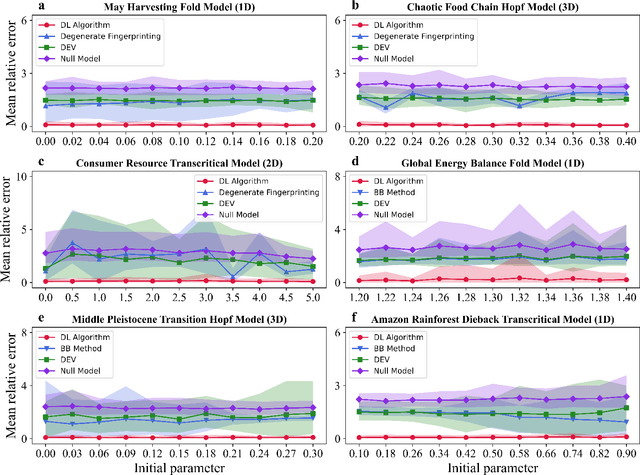
Tipping points occur in many real-world systems, at which the system shifts suddenly from one state to another. The ability to predict the occurrence of tipping points from time series data remains an outstanding challenge and a major interest in a broad range of research fields. Particularly, the widely used methods based on bifurcation theory are neither reliable in prediction accuracy nor applicable for irregularly-sampled time series which are commonly observed from real-world systems. Here we address this challenge by developing a deep learning algorithm for predicting the occurrence of tipping points in untrained systems, by exploiting information about normal forms. Our algorithm not only outperforms traditional methods for regularly-sampled model time series but also achieves accurate predictions for irregularly-sampled model time series and empirical time series. Our ability to predict tipping points for complex systems paves the way for mitigation risks, prevention of catastrophic failures, and restoration of degraded systems, with broad applications in social science, engineering, and biology.
Theoretical Analysis of Privacy Leakage in Trustworthy Federated Learning: A Perspective from Linear Algebra and Optimization Theory
Jul 23, 2024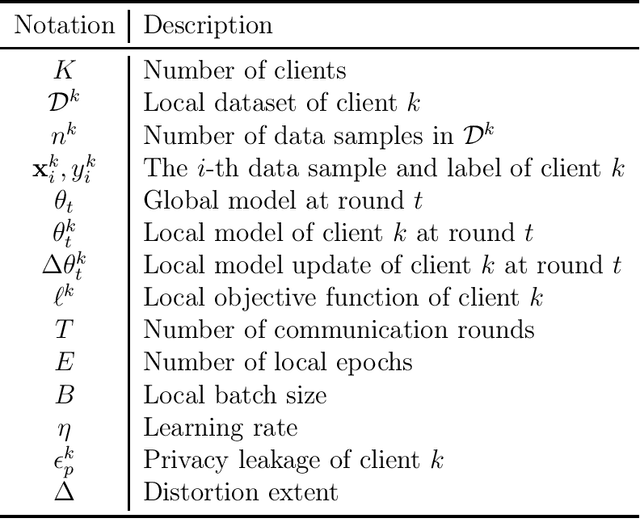
Federated learning has emerged as a promising paradigm for collaborative model training while preserving data privacy. However, recent studies have shown that it is vulnerable to various privacy attacks, such as data reconstruction attacks. In this paper, we provide a theoretical analysis of privacy leakage in federated learning from two perspectives: linear algebra and optimization theory. From the linear algebra perspective, we prove that when the Jacobian matrix of the batch data is not full rank, there exist different batches of data that produce the same model update, thereby ensuring a level of privacy. We derive a sufficient condition on the batch size to prevent data reconstruction attacks. From the optimization theory perspective, we establish an upper bound on the privacy leakage in terms of the batch size, the distortion extent, and several other factors. Our analysis provides insights into the relationship between privacy leakage and various aspects of federated learning, offering a theoretical foundation for designing privacy-preserving federated learning algorithms.
Norface: Improving Facial Expression Analysis by Identity Normalization
Jul 22, 2024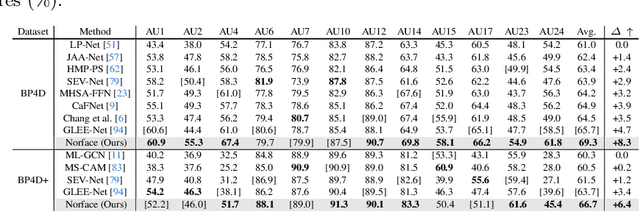



Facial Expression Analysis remains a challenging task due to unexpected task-irrelevant noise, such as identity, head pose, and background. To address this issue, this paper proposes a novel framework, called Norface, that is unified for both Action Unit (AU) analysis and Facial Emotion Recognition (FER) tasks. Norface consists of a normalization network and a classification network. First, the carefully designed normalization network struggles to directly remove the above task-irrelevant noise, by maintaining facial expression consistency but normalizing all original images to a common identity with consistent pose, and background. Then, these additional normalized images are fed into the classification network. Due to consistent identity and other factors (e.g. head pose, background, etc.), the normalized images enable the classification network to extract useful expression information more effectively. Additionally, the classification network incorporates a Mixture of Experts to refine the latent representation, including handling the input of facial representations and the output of multiple (AU or emotion) labels. Extensive experiments validate the carefully designed framework with the insight of identity normalization. The proposed method outperforms existing SOTA methods in multiple facial expression analysis tasks, including AU detection, AU intensity estimation, and FER tasks, as well as their cross-dataset tasks. For the normalized datasets and code please visit {https://norface-fea.github.io/}.
Real-Time 3D Occupancy Prediction via Geometric-Semantic Disentanglement
Jul 18, 2024Occupancy prediction plays a pivotal role in autonomous driving (AD) due to the fine-grained geometric perception and general object recognition capabilities. However, existing methods often incur high computational costs, which contradicts the real-time demands of AD. To this end, we first evaluate the speed and memory usage of most public available methods, aiming to redirect the focus from solely prioritizing accuracy to also considering efficiency. We then identify a core challenge in achieving both fast and accurate performance: \textbf{the strong coupling between geometry and semantic}. To address this issue, 1) we propose a Geometric-Semantic Dual-Branch Network (GSDBN) with a hybrid BEV-Voxel representation. In the BEV branch, a BEV-level temporal fusion module and a U-Net encoder is introduced to extract dense semantic features. In the voxel branch, a large-kernel re-parameterized 3D convolution is proposed to refine sparse 3D geometry and reduce computation. Moreover, we propose a novel BEV-Voxel lifting module that projects BEV features into voxel space for feature fusion of the two branches. In addition to the network design, 2) we also propose a Geometric-Semantic Decoupled Learning (GSDL) strategy. This strategy initially learns semantics with accurate geometry using ground-truth depth, and then gradually mixes predicted depth to adapt the model to the predicted geometry. Extensive experiments on the widely-used Occ3D-nuScenes benchmark demonstrate the superiority of our method, which achieves a 39.4 mIoU with 20.0 FPS. This result is $\sim 3 \times$ faster and +1.9 mIoU higher compared to FB-OCC, the winner of CVPR2023 3D Occupancy Prediction Challenge. Our code will be made open-source.