 Add to Chrome
 Add to Firefox
 Add to Edge
Agentic AI in medicine: architectures, applications, evaluation, and challenges for clinical translation
Jul 28, 2026
Large language models and multimodal foundation models are enabling medical artificial intelligence (AI) systems to move beyond isolated prediction and undertake multistep clinical tasks that require planning, tool use, memory, iterative correction, and coordination among specialized agents. However, the scope of agentic AI in medicine remains unsettled, and current evaluation practices are not yet aligned with the requirements of clinical use. We conducted a scoping review with systematic evidence mapping across five electronic sources, screened 1,649 exportable records, and provisionally included 557 unique studies that met predefined criteria for goal-directed task execution, tool use, interaction with external resources, feedback-based refinement, or multi-agent collaboration. The included studies describe single agents that use external tools, workflows supported by retrieval and external knowledge, multimodal agents, and multi-agent systems applied to medical question answering, image interpretation, electronic health record analysis, drug safety, and clinical trial prediction. The evidence base remains dominated by public benchmarks, simulated settings, retrospective datasets, and small-scale expert evaluation. Process reliability, evidence traceability, uncertainty, safety, workflow impact, and external validity are evaluated less consistently. Clinical translation will depend on clearer definitions, reproducible evaluation, auditable oversight, interoperable system design, and prospective validation in real-world clinical workflows.

Pavementscapes: a large-scale hierarchical image dataset for asphalt pavement damage segmentation
Jul 24, 2022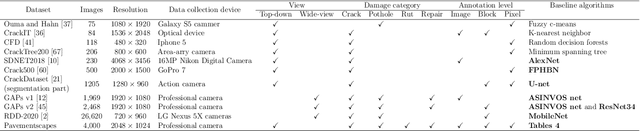
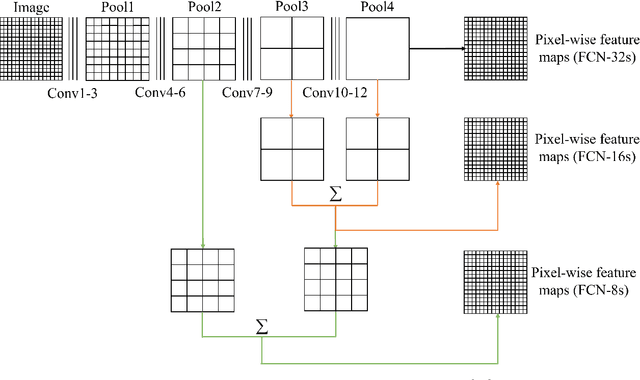
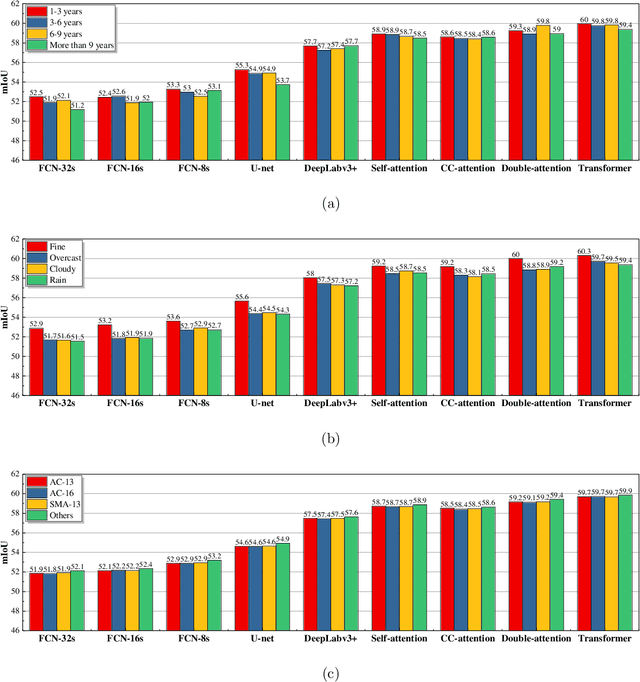
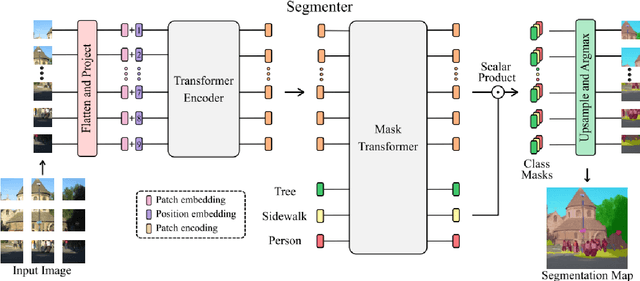
Pavement damage segmentation has benefited enormously from deep learning. % and large-scale datasets. However, few current public datasets limit the potential exploration of deep learning in the application of pavement damage segmentation. To address this problem, this study has proposed Pavementscapes, a large-scale dataset to develop and evaluate methods for pavement damage segmentation. Pavementscapes is comprised of 4,000 images with a resolution of $1024 \times 2048$, which have been recorded in the real-world pavement inspection projects with 15 different pavements. A total of 8,680 damage instances are manually labeled with six damage classes at the pixel level. The statistical study gives a thorough investigation and analysis of the proposed dataset. The numeral experiments propose the top-performing deep neural networks capable of segmenting pavement damages, which provides the baselines of the open challenge for pavement inspection. The experiment results also indicate the existing problems for damage segmentation using deep learning, and this study provides potential solutions.
Fusion of evidential CNN classifiers for image classification
Aug 23, 2021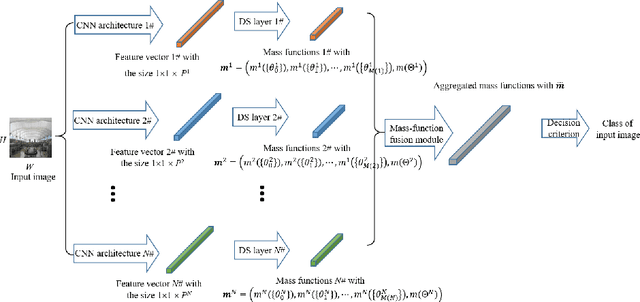
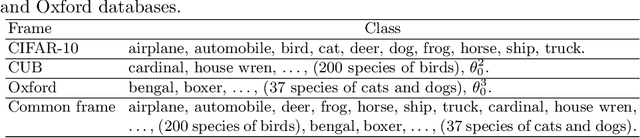
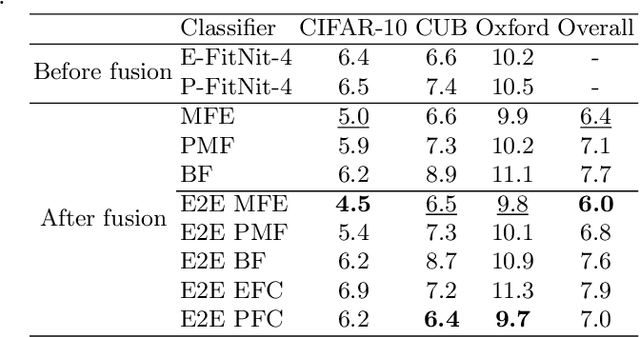
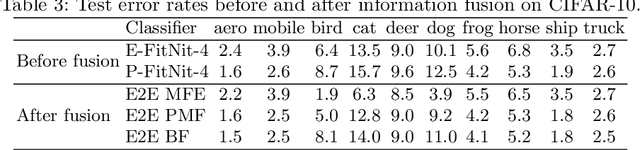
We propose an information-fusion approach based on belief functions to combine convolutional neural networks. In this approach, several pre-trained DS-based CNN architectures extract features from input images and convert them into mass functions on different frames of discernment. A fusion module then aggregates these mass functions using Dempster's rule. An end-to-end learning procedure allows us to fine-tune the overall architecture using a learning set with soft labels, which further improves the classification performance. The effectiveness of this approach is demonstrated experimentally using three benchmark databases.
An evidential classifier based on Dempster-Shafer theory and deep learning
Mar 25, 2021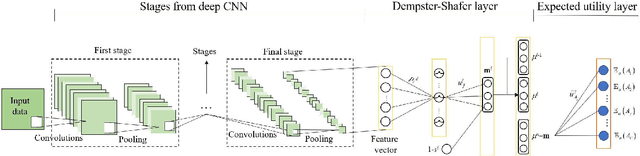
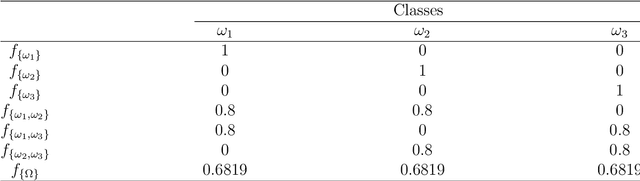
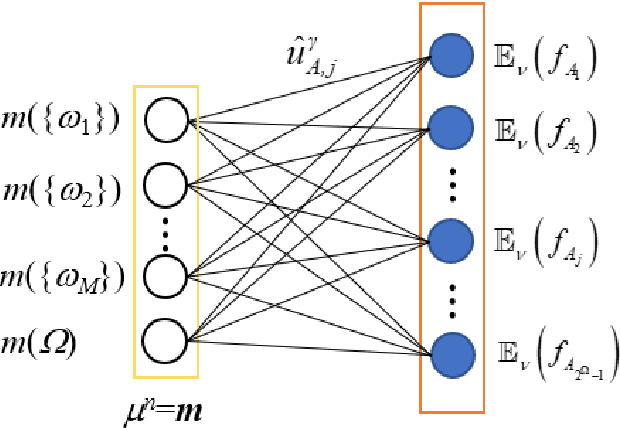
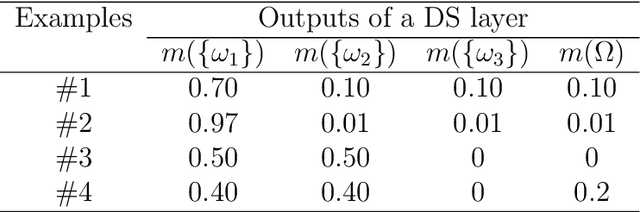
We propose a new classifier based on Dempster-Shafer (DS) theory and a convolutional neural network (CNN) architecture for set-valued classification. In this classifier, called the evidential deep-learning classifier, convolutional and pooling layers first extract high-dimensional features from input data. The features are then converted into mass functions and aggregated by Dempster's rule in a DS layer. Finally, an expected utility layer performs set-valued classification based on mass functions. We propose an end-to-end learning strategy for jointly updating the network parameters. Additionally, an approach for selecting partial multi-class acts is proposed. Experiments on image recognition, signal processing, and semantic-relationship classification tasks demonstrate that the proposed combination of deep CNN, DS layer, and expected utility layer makes it possible to improve classification accuracy and to make cautious decisions by assigning confusing patterns to multi-class sets.
Evidential fully convolutional network for semantic segmentation
Mar 25, 2021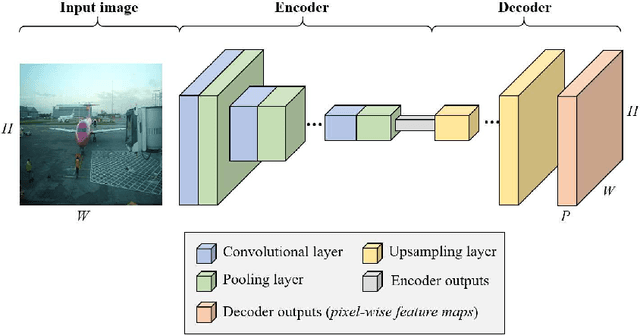
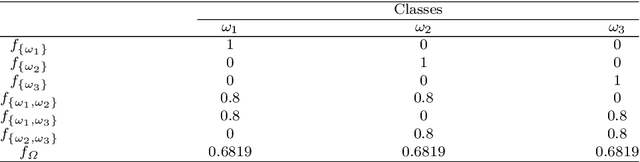
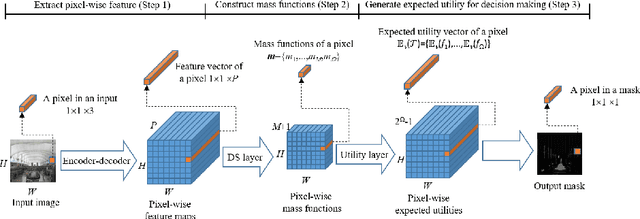
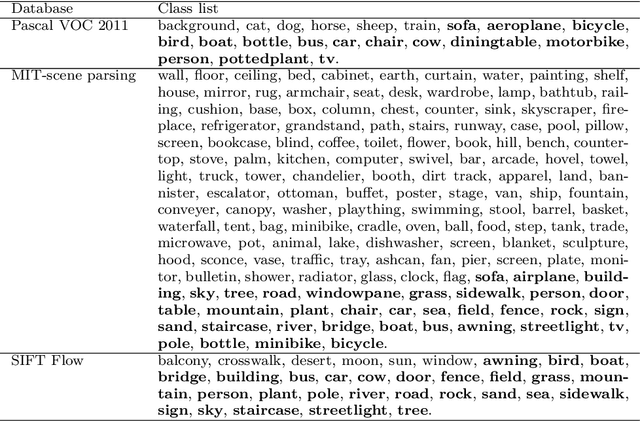
We propose a hybrid architecture composed of a fully convolutional network (FCN) and a Dempster-Shafer layer for image semantic segmentation. In the so-called evidential FCN (E-FCN), an encoder-decoder architecture first extracts pixel-wise feature maps from an input image. A Dempster-Shafer layer then computes mass functions at each pixel location based on distances to prototypes. Finally, a utility layer performs semantic segmentation from mass functions and allows for imprecise classification of ambiguous pixels and outliers. We propose an end-to-end learning strategy for jointly updating the network parameters, which can make use of soft (imprecise) labels. Experiments using three databases (Pascal VOC 2011, MIT-scene Parsing and SIFT Flow) show that the proposed combination improves the accuracy and calibration of semantic segmentation by assigning confusing pixels to multi-class sets.